All species › Passerines › Honeyeaters › Crescent Honeyeater
Crescent Honeyeater | Phylidonyris pyrrhopterus
Goudvleugelhoningeter | Mielero alafuego
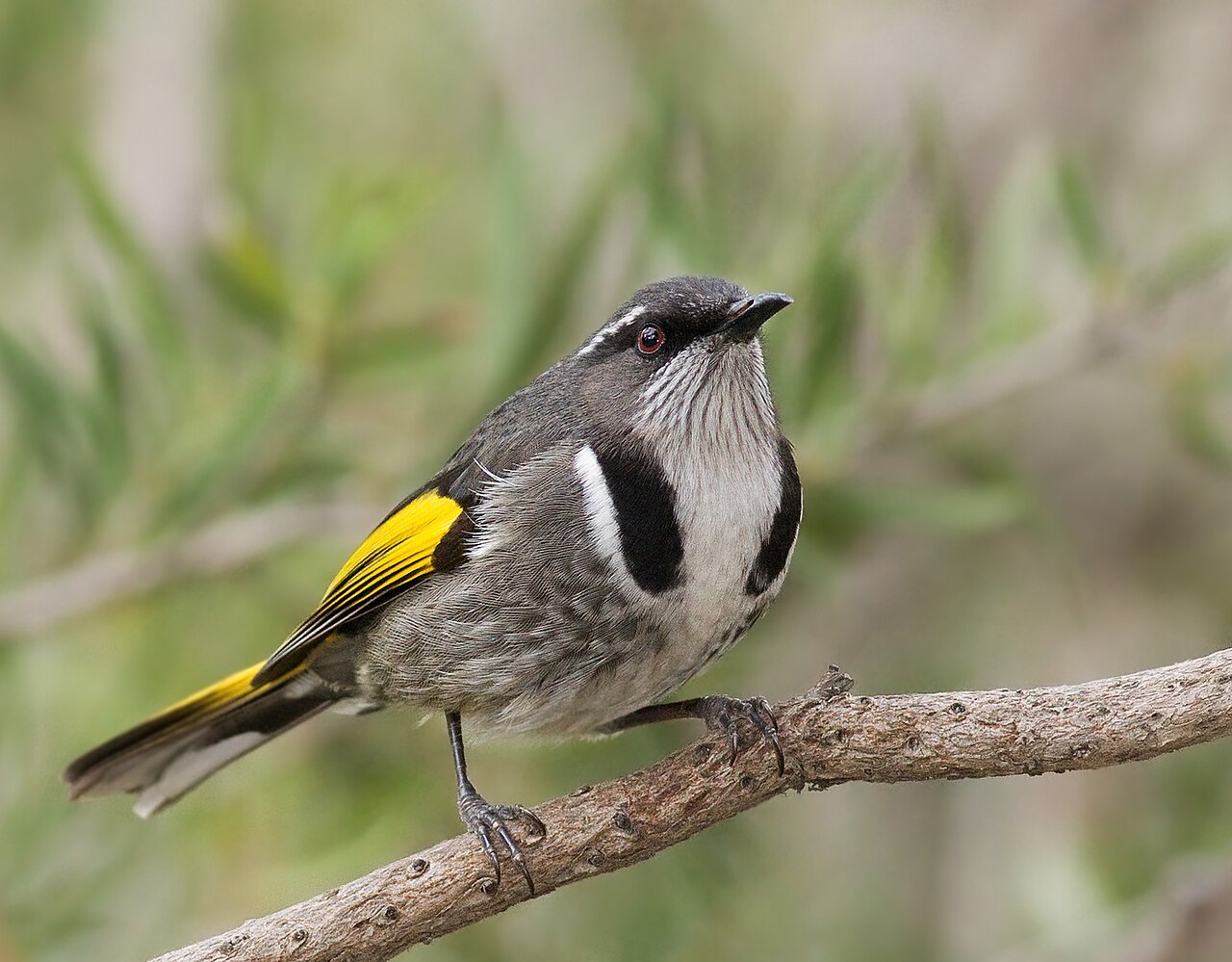
The Crescent Honeyeater is the honeyeater of the cool, wet southeast: a dark, slim bird with bright yellow wing panels and, in the male, a black crescent running like a half-moon down the side of the breast. It wants dense cover — wet fern gullies, mountain forest, coastal heath, tea-tree scrub — and is heard there far more often than seen. In winter part of the population drops from the ranges to the coast and into town gardens, and that is when most people meet it for the first time.
Voice
The contact call is the hallmark: a hard, two-syllable e-gypt or ee-jik, stressed on the second syllable, given from dense cover throughout the year and never forgotten once learnt. The male also sings year-round, a surprisingly rich and varied song of clear whistles and rolling phrases delivered from a half-hidden perch in the understorey. Disturbed birds give a sharp rattling alarm series that promptly brings every other honeyeater in the vicinity to attention.
No freely licensed recording has been found for this species yet; what to listen for is described below.
Identification
A slim honeyeater of fourteen to seventeen centimetres with a long, clearly down-curved bill and a reddish-brown eye. The male is dark slate-grey to almost black on head and upperparts, with a narrow white streak above the eye and — the feature that names it — a broad black crescent, outlined in white, running from the shoulder down the side of the breast. Wing and tail sides carry large bright yellow panels that flare at every wingbeat. The female is smaller and much duller: olive-brown rather than slate, with olive rather than black breast crescents and olive-yellow rather than yellow wing panels. Young birds resemble the female but show barely any breast-side marking at all.
Confusion species
The nearest confusion in the field is White-cheeked Honeyeater (Phylidonyris niger), which is larger, carries a big white cheek patch on a black head and is heavily streaked black and white below; that streaking is entirely absent in Crescent Honeyeater, and the black breast crescent is in turn absent in niger. New Holland Honeyeater (Phylidonyris novaehollandiae) shares the yellow wing panels and the heath, but has a white iris rather than a reddish-brown one and is likewise heavily streaked. Tawny-crowned Honeyeater (Gliciphila melanops) occurs in the same coastal heath but is pale buff with a yellow crown and has no yellow in the wing at all. Females and immatures are the hard ones: look for the olive-yellow wing panel combined with plain, unstreaked underparts — no other of the three shows that combination.
Habitat
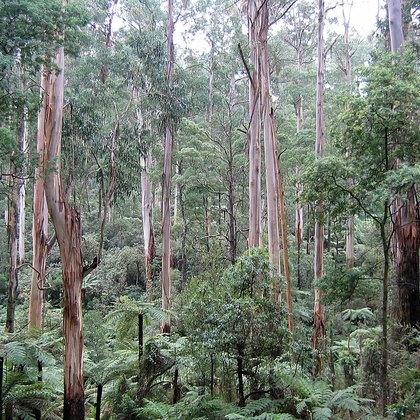
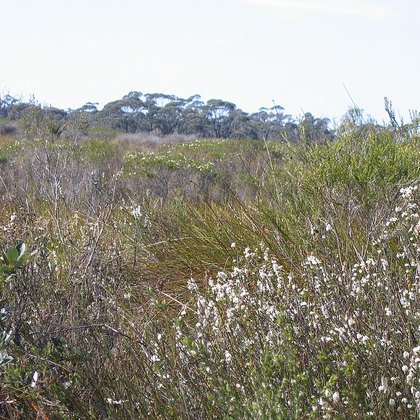
Dense cover with a closed understorey is the constant requirement: wet eucalypt forest with tree ferns, damp gullies, mountain forest up to the treeline, coastal heath and extensive tea-tree and melaleuca scrub. In autumn and winter part of the population moves down from the highlands to the coast and turns up in parks, cemeteries and gardens with flowering banksias, correas and grevilleas. Food is nectar, small fruits and insects, taken mainly in the understorey and in flowering shrubs; it usually forages in pairs or loose parties. The female alone builds a cup nest low in a dense shrub and incubates one to three eggs for thirteen days; the male defends a territory year-round.
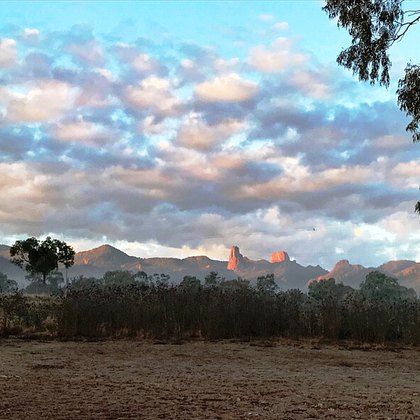
Where the bird is most often found, arranged by main group and formation.

Range and movements
Endemic to southeastern Australia. The continuous range runs from the highlands of southeastern New South Wales through the whole of Victoria, and across Tasmania and the Bass Strait islands it reaches some of the highest densities in the species' range. In South Australia a separate population holds the Mount Lofty Ranges and Kangaroo Island, referred to the subspecies halmaturinus. Northern Queensland and Western Australia have none, and it does not occur in New Zealand. In winter the centre of gravity shifts to lower elevations and the coastal strip.
- Resident
- dark = core range, pale = thinly spread
Where and when to look
Learn the call first. Anyone who picks out the hard e-gypt from a fern gully or a stand of tea-tree knows at once that the species is present, even with nothing in view — which is the rule rather than the exception. Then wait for a flight: the yellow wing panel flashes the moment the bird crosses between two shrubs and shows well even on the dull female. In winter the quickest route to the species is a flowering banksia or correa in a coastal garden, where it comes out in the open and close in, while in mountain forest it stays in the scrub almost throughout.
Conservation
Least Concern (LC), with a large range and locally high densities in Tasmania and the Victorian ranges. Even so, the literature notes that numbers fluctuate strongly and over the long run trend down rather than up. The reasons lie in the habitat: the species needs a dense understorey, and that is exactly what disappears under too-frequent or too-hot fire, under opening of forest for timber, and under scrub clearance around settlements. Repeated large bushfires in southeastern Australia have put whole valleys out of use for years. Where the understorey returns, the species usually follows quickly.
Scientific name
Phylidonyris pyrrhopterus | (Latham, 1801)
John Latham described the species in 1801 as Certhia pyrrhoptera; author and year stand in parentheses, because it has since moved genus. The genus Phylidonyris was erected by René Lesson in 1830 and is an artificial contraction of philedon, the old name for the friarbirds, and Cinnyris, the sunbird genus — a name that glues two other bird groups together. The epithet pyrrhopterus comes from Greek pyrrhos, 'flame-coloured', and pteron, 'wing', and refers to the yellow wing panels. The Dutch name goudvleugelhoningeter and the Spanish mielero alafuego therefore follow the scientific epithet, while the English name picks the black breast crescent instead. Two subspecies are recognised.