All species › Passerines › Honeyeaters › Striped Honeyeater
Striped Honeyeater | Plectorhyncha lanceolata
Gestreepte honingeter | Mielero lanceolado
The Striped Honeyeater is a big, pale honeyeater of dry inland woodland, unmistakable for the crisp black striping on a grey-white head and neck. The throat and upper breast feathers are long, pointed and lance-shaped, which gives the bird a dishevelled, shaggy look, as though it had just woken up. It is, besides, a honeyeater that eats very little honey: the short, straight, sharply pointed bill has become a pair of insect forceps, and the species lives largely on what it prises out of bark and foliage.

Voice
The standard call is a sharp, clear chew-ee, two syllables with the stress at the end, carrying far across open woodland and often the first sign of the bird's presence. Around it runs a rolling, chattering conversation that pairs and family parties keep up continuously. Alarmed, this turns into a shrill, whistling series. Because the species lives in small groups you seldom hear just one bird: the sounds come from several directions in the same clump of trees.
Recording: Eddy Smith — CC BY-NC-SA 4.0 · Gluepot, Pastoral Unincorporated Area, South Australia, Australia · xeno-canto
Identification
A large honeyeater of twenty to twenty-three centimetres, pale and rather thickset, with a short, straight, sharply tapering bill remarkably little curved for a honeyeater. Head and upper neck are grey-white with bold black lengthwise stripes, densest on the crown. The upperparts are plain grey-brown, the underparts off-white with fine, faint streaking on the belly. Long, pointed feathers on throat and upper breast stand free and give the bird its characteristic shaggy outline. Bill and legs are blue-grey, the eye dark. Females are browner and greyer below, young birds duller and less crisply marked.
Confusion species
The wattlebirds are the first thought, being likewise large and streaked, but Red Wattlebird (Anthochaera carunculata) is considerably bigger, darker and far more heavily streaked below, and carries a red wattle. The greatest risk of confusion is with Spiny-cheeked Honeyeater (Acanthagenys rufogularis), which occupies the same dry woodland and is about the same size: that species, however, has a warm orange-brown throat and upper breast and a two-toned bill, pink with a black tip, whereas Striped Honeyeater has a white throat and a wholly blue-grey bill. Little Friarbird (Philemon citreogularis) shares the habitat too but is plain grey-brown with no head striping at all.
Habitat
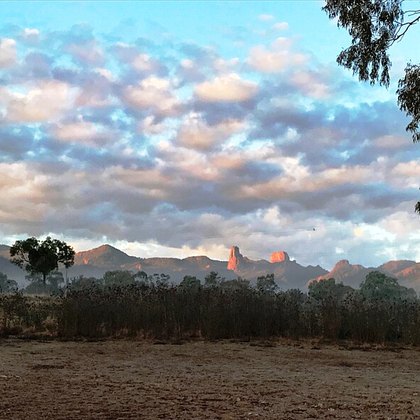
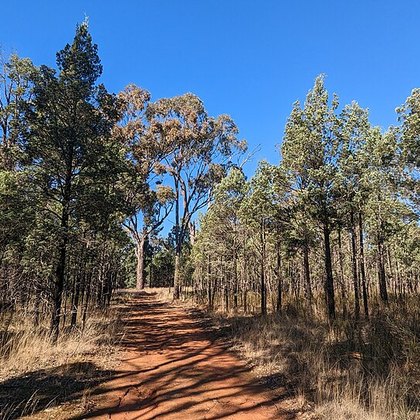
Drier open forest and woodland of the interior, often along rivers and creeks, together with mallee (low, multi-stemmed eucalypt scrub of dry southern Australia), mulga (acacia scrub of the dry interior, dominated by Acacia aneura), belah and casuarina woodland, heathland and, on the coast, swamp forest of paperbark and casuarina; also gardens in inland towns. Despite the family name it eats mainly insects and spiders, gleaned from foliage, prised from bark crevices and occasionally taken in the air; nectar, plant sugars, seeds, berries and fruit fill out the diet. It forages in pairs or small parties in dense foliage of the lower canopy. The nest is a deep, bag-shaped cup of grass slung from drooping twigs one to six metres up; the clutch is usually three eggs, both parents incubate for sixteen to seventeen days, and the young fledge after about sixteen days. Communal breeding with helpers has been recorded.
Where the bird is most often found, arranged by main group and formation.


Range and movements
Eastern Australia, predominantly inland: from Charters Towers in central Queensland south through western New South Wales into southeastern South Australia, with the Yorke Peninsula as the western limit. Along the New South Wales coast it locally reaches the sea, as far as about the Tuggerah Lakes. The species is absent from the tropical north, from Western Australia, from Tasmania and from New Zealand.
- Resident
- dark = core range, pale = thinly spread
Where and when to look
Watch the head, not the body. At a distance the bird reads simply as pale and unremarkable, but the moment the head fills the binocular the black-on-white striping leaps out, and no other honeyeater of dry inland woodland carries it. The sharp chew-ee is the second way in: walk a creek-side stand of casuarina or belah slowly and wait for the call. A third pointer is behaviour — this species hangs upside down and works its way through dense foliage the way a treecreeper does, not the way a nectar-seeking honeyeater moves from bloom to bloom.
Conservation
Least Concern (LC) on the strength of a large range and a stable population. At a regional scale it is nonetheless sensitive, because it depends on the dry woodland of the inland plains, and that has been cleared over vast areas for cropping and grazing. Where the woodland has been reduced to narrow strips along roads and creeks, small parties persist for a long time, but old trees with loose bark — its principal food source — disappear from those strips. Along inland rivers the river red gum also depends on floods that water extraction has reduced.
Scientific name
Plectorhyncha lanceolata | Gould, 1838
John Gould described the species in 1838 as Plectorhyncha lanceolata; author and year stand without parentheses, because it has always remained in this genus and is moreover the only species in it. Plectorhyncha comes from Greek plektron, 'spear-point' or 'spur', and rhynkhos, 'bill' — a reference to the unusually straight, sharply tapering bill that sets the species apart from the other honeyeaters. The epithet lanceolata is Latin for 'lance-shaped' and refers to the long, pointed feathers of throat and breast. The English name Striped Honeyeater, the Dutch gestreepte honingeter and the Spanish mielero lanceolado each pick a different character: the first two the striping, the Spanish the lanceolate plumage of the epithet. The nearest relative is the Painted Honeyeater (Grantiella picta).