All species › Passerines › Honeyeaters › Tui
Tui | Prosthemadera novaeseelandiae
Toei | Tui
The Tui is New Zealand's large honeyeater: black at a distance, at close range a bird of blue-green and bronze iridescence, with two curled white tufts under the throat. It is noisy, drives other birds off flowering trees, and turns up in almost any garden with kowhai or pohutukawa.

Voice
A long, disordered mixture of clear whistles, bell notes, coughs, grunts and clicks, in which a phrase can break off halfway with nothing following — the bird is singing on in notes barely audible to people. Just as distinctive is the sound of the flight: the wings make a loud whirring rush that betrays it before it comes into view.
Recording: craig wilson — CC BY 4.0 · Granity, Buller District, West Coast Region, New Zealand · xeno-canto
Identification
Thirty centimetres, solidly built, with a slightly decurved black bill and a long tail. The plumage looks black but shows green-blue and bronze sheen in good light, with a fine white lacy collar on the nape. The two features that work at distance are the white tufts under the throat — the poi — and the white shoulder bar, which shows at once in flight. The sexes are alike; the male is heavier, around 125 grams against 90.
Confusion species
New Zealand Bellbird or korimako (Anthornis melanura) is the only real confusion species: much smaller, olive green, with a red iris and no white throat tufts. In silhouette and flight a tui suggests a starling or a blackbird, both established introductions in New Zealand, but the whirring wings and the white shoulder bar rule them out. The Chatham Islands tui (Prosthemadera novaeseelandiae chathamensis) is distinctly larger and heavier and occurs only there.
Habitat
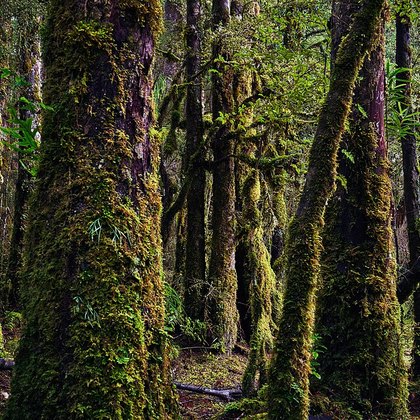
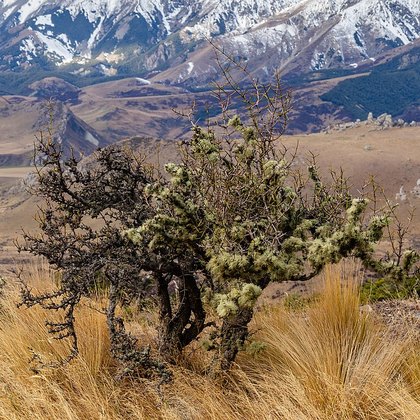
Native podocarp–broadleaf and kauri forest, and beyond that anywhere something flowers through the year: manuka and matagouri scrub, forest edges, farm gardens, town parks and street trees. It follows the flowering and the honeydew and covers tens of kilometres to do so, moving between lowland and hill country. Only in the dry, open country east of the Southern Alps is it scarce.
Where the bird is most often found, arranged by main group and formation.



Range and movements
Across the North and South islands, Stewart Island and almost all the offshore islands, with its own subspecies on the Chathams. After the nineteenth-century clearances it left large parts of the lowlands, but in recent decades it has increased in the cities, where native flowering trees have been planted and rats and possums controlled. It does not migrate but wanders seasonally after the flowering: the same garden can be full of tui one winter and empty the next.
- Resident
- dark = core range, pale = thinly spread
Where and when to look
Look for the flowering, not for the bird: a kowhai in flower in September or a pohutukawa around the new year will produce more tui in half an hour than a morning in the forest. It sits high and sings from a bare branch above the canopy; listen for the whirring wings as it drives another honeyeater out of the tree. In the winter months of June and July it comes daily to the sugar-water feeders in gardens.
Conservation
Not threatened; common on the mainland and stable to increasing across its range. The Chatham Islands subspecies stands differently: it is rated nationally vulnerable there and numbers a few hundred birds. Rats, stoats and possums empty nests; where these are controlled, tui increase noticeably within a few years.
Scientific name
Prosthemadera novaeseelandiae | (Gmelin, 1788)
Gmelin described the species in 1788 as Merops novaeseelandiae, among the bee-eaters; because it was later moved to another genus, author and year stand in parentheses. Gray introduced the genus Prosthemadera in 1840, from Greek prosthema (appendage) and dere (neck), after the throat tufts. The type locality is Queen Charlotte Sound, South Island. The name tui is Māori and is used unchanged in all three languages; older English books call it the parson bird.