All species › Passerines › Honeyeaters › New Holland Honeyeater
New Holland Honeyeater | Phylidonyris novaehollandiae
Witooghoningeter | Mielero de Nueva holanda
The New Holland Honeyeater is the black-and-white streaked honeyeater of the southern heath, with a big yellow wing patch and a white eye that is the first thing to catch the light. It is busy, inquisitive and loud, rarely stays a minute on one perch, and drives everything smaller than itself out of a flowering banksia. Where grevilleas are in flower it is seldom far away.

Voice
The everyday note is a hard metallic chik, short and sharp, running through the bushes all day, with a thinner pseet and a chattering scold during disputes over a flowering shrub. When a hawk or a cat appears the whole group launches a joint alarm call at once — a shrill chorus that brings other honeyeaters in as well.
No freely licensed recording has been found for this species yet; what to listen for is described below.
Identification
A slim honeyeater of 17 to 18.5 centimetres, black with white streaking on breast and flanks, a large yellow panel in the wing and yellow edges to the sides of the tail. The clean white eye is diagnostic, along with a small white ear patch and a thin white whisker at the base of the bill. The bill is fine and decurved. Females are slightly smaller; young birds are browner with a grey eye and a yellow gape.
Confusion species
White-cheeked Honeyeater (Phylidonyris niger) is very close but has one large white cheek patch and a dark eye; the two often share the same heath. Crescent Honeyeater (P. pyrrhopterus) is dark grey with a black crescent down the side of the breast and keeps higher in forest. Eastern Spinebill has a far longer sickle bill and a rufous nape. Brown juveniles can read as a featureless female honeyeater.
Habitat
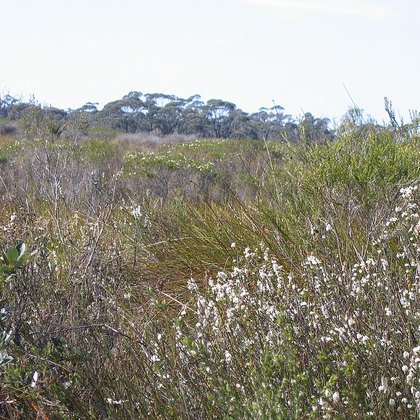
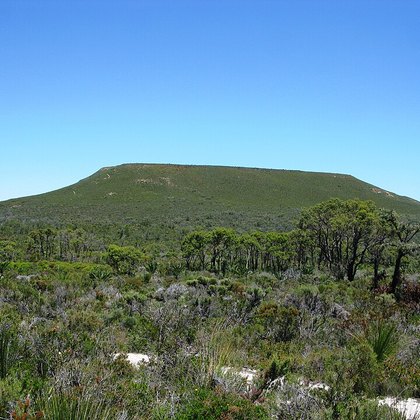
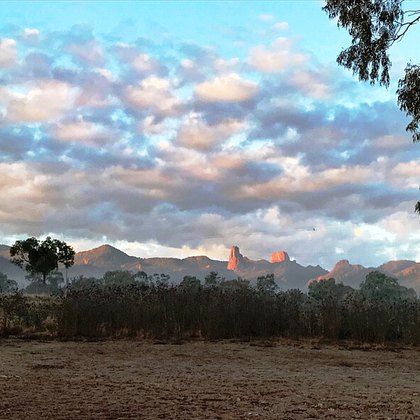
Heath is the core: the eastern coastal heath and the species-rich kwongan of southwestern Australia, anywhere banksia, hakea and grevillea grow. Beyond that, dry eucalypt woodland with a flowering shrub layer, dune scrub behind the beach, and gardens and parks as soon as native flowering plants go in. It likes low dense cover with open flowering heads above it.
Where the bird is most often found, arranged by main group and formation.

Range and movements
Southern Australia, from about Brisbane in Queensland along the coast and its hinterland to just north of Perth in Western Australia, taking in Tasmania, the Bass Strait islands and Kangaroo Island; five subspecies. It does not migrate but moves locally after the flowering: where a stand of banksia opens in winter, dozens of birds are in it within days.
- Resident
- dark = core range, pale = thinly spread
Where and when to look
Stand by a flowering banksia or grevillea at sunrise and wait; the bird comes of its own accord, often close, because it is frankly curious about people. Watch the white eye — against the light it is the last mark left. In autumn and spring look for nests in a low dense shrub, bound together with spider web.
Conservation
Least Concern (LC) and still numerous across the south. The species profits from gardens and road verges planted with banksia and grevillea, and from the restoration of coastal heath. It does disappear where heath is turned into cropland or housing, or burnt too often for the shrubs to flower; in small remnants it also loses out to Noisy Miners.
Scientific name
Phylidonyris novaehollandiae | (Latham, 1790)
Latham described the species in 1790 as Certhia novaehollandiae, among the treecreepers; the later move puts author and year in parentheses. The genus Phylidonyris was introduced by Lesson in 1830 and is put together from Philedon, Cuvier's name for the friarbirds, and Cinnyris, his genus of sunbirds. novaehollandiae means 'of New Holland', the old name for Australia.