All species › Passerines › Honeyeaters › White-cheeked Honeyeater
White-cheeked Honeyeater | Phylidonyris niger
Withalshoningeter | Mielero cariblanco
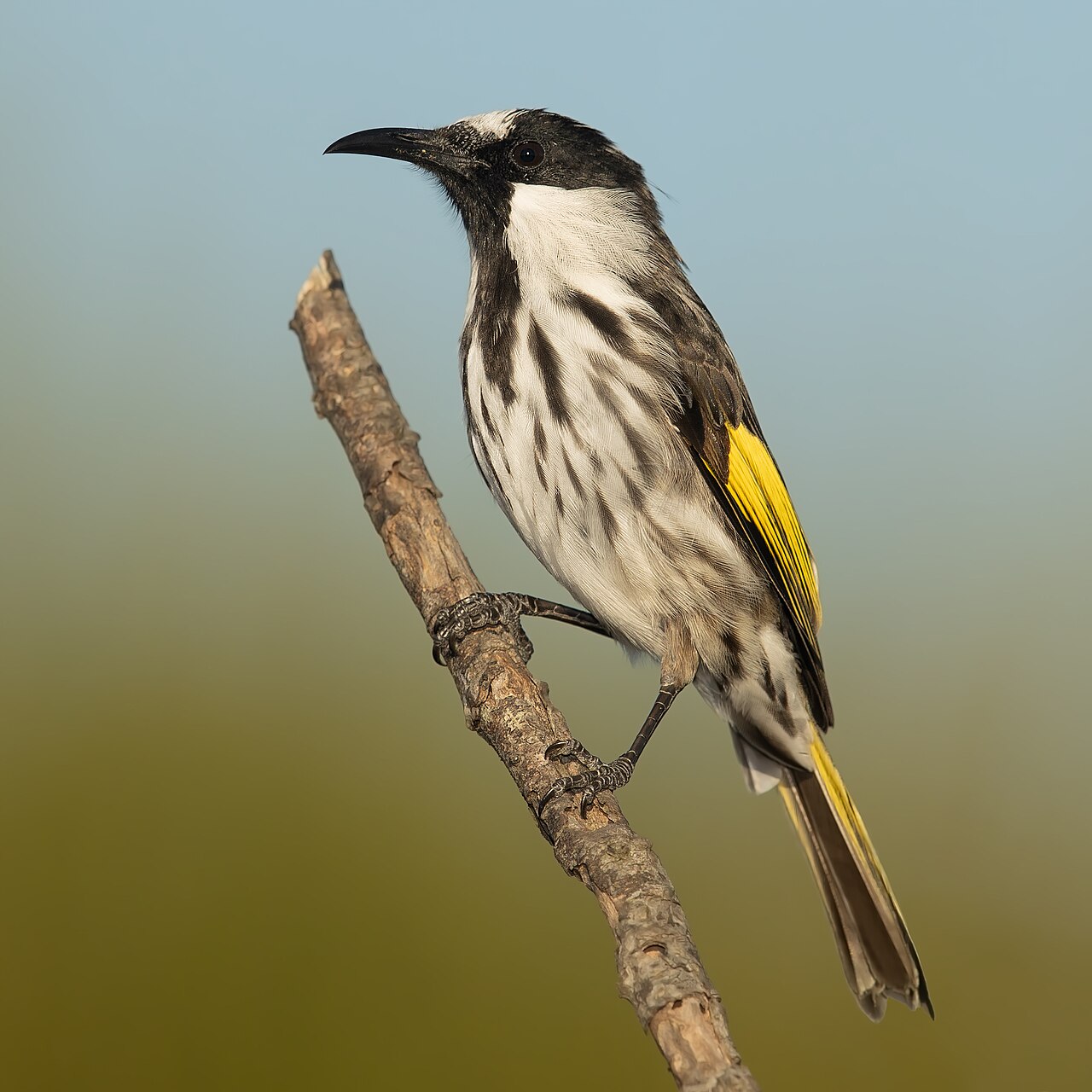
The White-cheeked Honeyeater is a loud, quarrelsome black-and-white honeyeater of moist heath and banksia scrub, with one feature that carries at any distance: a large, pure white cheek patch on a jet-black head. When it flies, big yellow panels flare in wing and tail. It lives in parties, rarely sits still for long, and in a flowering banksia is almost always the dominant bird — smaller honeyeaters are driven off without ceremony.
Voice
It is very nearly never silent. The standard call is a loud, clear double whistle followed by a short, sharp e-chip or chwik-up; a melodious chippy-choo serves as song. Around a flowering shrub a cacophony of yapping chatter and harsh, rasping alarm calls almost always develops, because the species defends flowering branches against its own kind and against other honeyeaters alike. The western subspecies gouldii sounds audibly different from eastern birds — a difference more obvious in the field than its slightly narrower cheek patch.
No freely licensed recording has been found for this species yet; what to listen for is described below.
Identification
A medium-sized honeyeater of sixteen to nineteen centimetres with a long, sturdy, down-curved bill. Head, throat and upperparts are black; the underparts are heavily streaked black and white. On the cheek sits a large, elongated, pure white patch running well back — the single most conspicuous mark on the bird. The eye is dark brown. Wing and tail sides carry large bright yellow panels that flash in flight, and the flight itself is fast and erratic. Male and female look alike; young birds are browner and duller with a smaller, off-white cheek. The western subspecies gouldii has a slightly narrower cheek patch.
Confusion species
New Holland Honeyeater (Phylidonyris novaehollandiae) is the classic confusion: almost the same size, likewise streaked black and white with yellow wing panels, and often in the same heath. The difference is in the eye — bright white in novaehollandiae, dark brown in White-cheeked — and in the white on the head: New Holland shows a narrow white whisker mark plus a white eyebrow, White-cheeked a single large, continuous white cheek patch with no eyebrow stripe. Crescent Honeyeater (Phylidonyris pyrrhopterus) is smaller and has plain, unstreaked underparts with a black breast crescent. Tawny-crowned Honeyeater (Gliciphila melanops) and White-fronted Honeyeater (Purnella albifrons) share the heath but are paler and lack the yellow wing panels.
Habitat
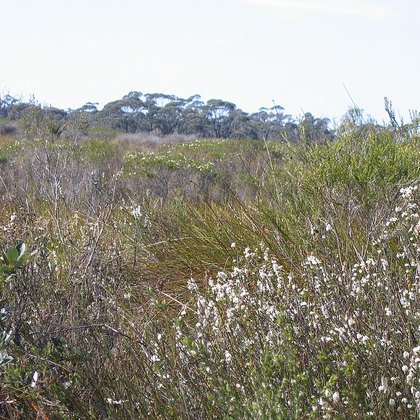
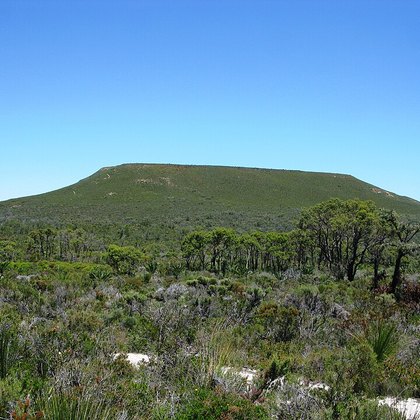
Moist heathland is the core habitat, with paperbark swamp forest, the margins of wetlands and pools, and forest or woodland carrying a heathy understorey alongside it. Anywhere banksia, grevillea, hakea or eucalypt flowers heavily it may appear, including suburban gardens and parks. It feeds mainly on nectar — banksia is the cornerstone — supplemented with insects gleaned from foliage and bark or taken in the air. The nest is a cup of twigs, bark and plant fibre, strikingly often finished with pieces of flower, hidden low in dense foliage. A pair stays together for several years and defends its territory jointly; two or three eggs hatch in about fifteen days and the young stay a further fifteen days in the nest.
Where the bird is most often found, arranged by main group and formation.


Range and movements
Endemic to Australia, in two widely separated areas. In the east the range runs from the Great Divide in Queensland south along the New South Wales coast to about Jervis Bay. In the southwest the subspecies gouldii holds Western Australia from the Perth area north to the Murchison River. Between the two lie thousands of kilometres of dry interior without a single population. The species is absent from Tasmania and from New Zealand.
- Resident
- dark = core range, pale = thinly spread
Where and when to look
Look for the flowering, not for the bird. A banksia in full flower at the edge of moist heath produces it near enough reliably, and usually four or five at once. Then go to the eye first: dark brown rules out New Holland Honeyeater, white confirms it. That works better than studying the cheek pattern, because an agitated, half-hidden bird often shows only part of its cheek while the eye reads clearly. In dull light the yellow wing flash in flight gives the fastest confirmation of the species — it is identical in both sexes, so there is nothing to misread there.
Conservation
Least Concern (LC), at high density in its core country and clearly tolerant of settled landscapes: planted banksias and grevilleas in gardens and roadside verges hold it right up to the edge of town. The pressure is on the habitat itself. Moist coastal heath is one of Australia's most heavily reduced vegetation types, lost to housing, drainage and sand extraction, and what remains is often fragmented. Too-frequent fire prevents banksias from reaching the age at which they flower heavily, and it is precisely those old, richly flowering shrubs that carry the species through winter.
Scientific name
Phylidonyris niger | (Bechstein, 1811)
Johann Matthäus Bechstein described the species in 1811 as Certhia nigra; author and year stand in parentheses, because it later moved to Phylidonyris, the genus René Lesson erected in 1830 as a contraction of philedon (the old name for friarbirds) and Cinnyris (sunbirds). The epithet niger is simply the Latin for 'black' and refers to the predominantly black head and upperparts. The English name and the Spanish mielero cariblanco both choose the white cheek. The Dutch name withalshoningeter departs from that and points at the neck, whereas the white patch in fact sits on the cheek and the throat is black — a less happy choice than the other two. Two subspecies are recognised: niger in the east and gouldii in the southwest.