All species › Passerines › Honeyeaters › Noisy Friarbird
Noisy Friarbird | Philemon corniculatus
Schreeuwlederkop | Filemón chillón
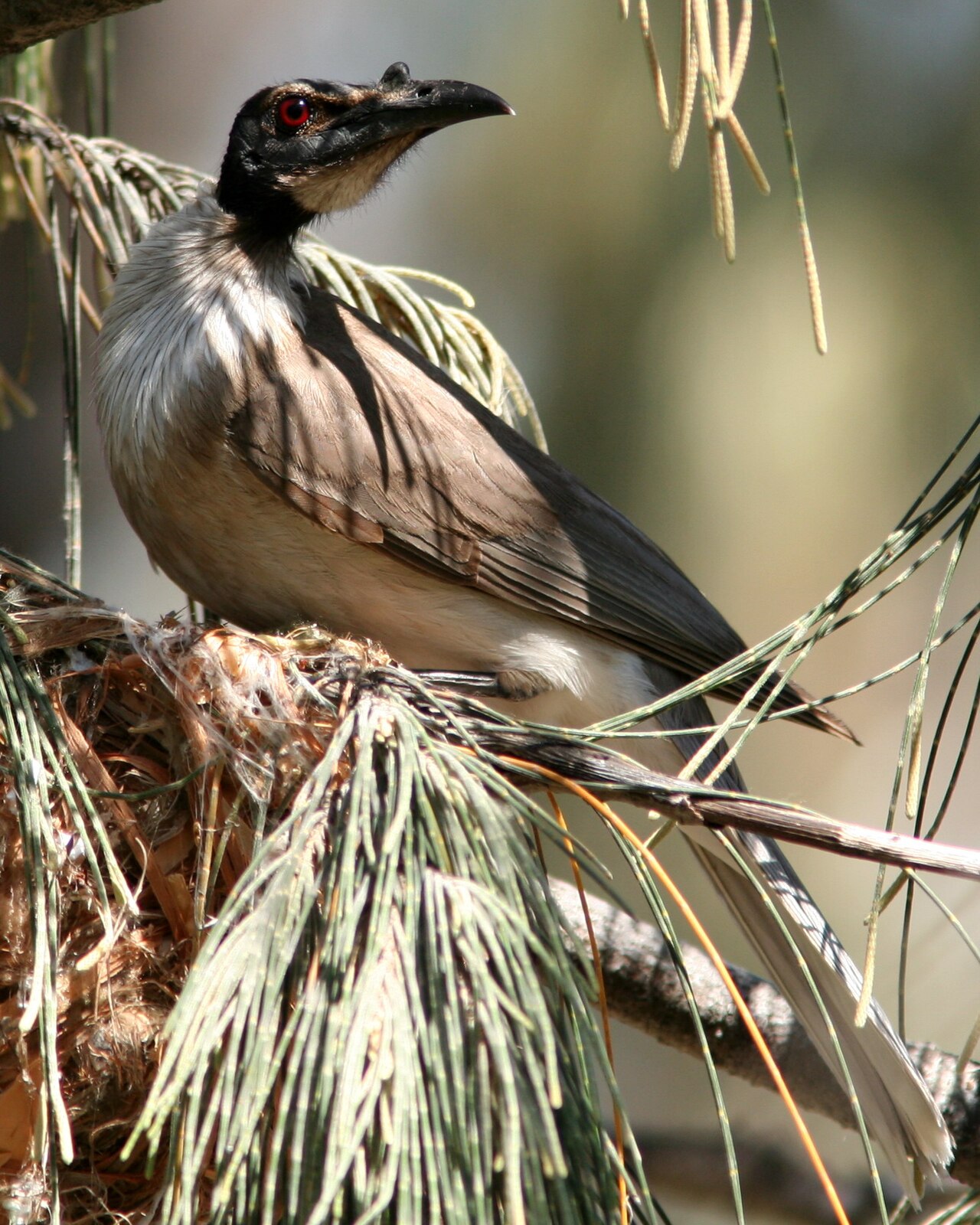
The Noisy Friarbird lives up to its name: where a party sits in a flowering eucalypt, the cackling and screeching fills the whole forest. It is a substantial grey-brown honeyeater of over thirty centimetres with a wholly bare, black head — only a tuft under the chin and a line above the eye still carry feathers — and a rounded, rhinoceros-like knob above the black bill. The eye is red. That knob is the mark that separates it at a glance from every other Australian honeyeater.
Voice
The loudest honeyeater in eastern Australia, which is saying something. The repertoire consists of harsh, hoarse, screeching and cackling notes the bird repeats continuously; one much-heard call is traditionally rendered in Australia as four o'clock. Where the species gathers in parties round a flowering tree, the voices merge into a sustained din that fills the forest and serves both territorial and social ends. The voice is the sharpest and shrillest of the four friarbirds — an audible difference from the mellow gee-wit of the Little Friarbird and the nasal, cat-like call of the Silver-crowned Friarbird.
Recording: Zebedee Muller — CC BY-NC-SA 4.0 · Denman Prospect, Australian Capital Territory, Australia · xeno-canto
Identification
A large honeyeater of thirty-one to thirty-six centimetres with dull grey-brown upperparts and paler grey-brown underparts. The head is the mark: wholly bare and black, unfeathered apart from a tuft under the chin and a line along the brow. Above the black bill base sits a rounded, conspicuous knob — the 'horn' the scientific name points at. The eye is red, the legs dark blue-black. The breast carries pale silvery streaking and the nape and neck sides a paler wash. The sexes are alike. Juveniles have a smaller knob, a duller eye and often a yellowish wash on the throat.
Confusion species
Among the four friarbirds this species is told by the combination of a wholly bare black head and a rounded knob. Little Friarbird (Philemon citreogularis) is clearly smaller and slimmer, lacks any knob and has a blue-grey patch of bare skin fanning back from below the eye over the cheek. Silver-crowned Friarbird (Philemon argenticeps) has a silvery-white, feathered crown above the bare black face and a higher, shorter horn; in that species the black bare skin also runs out to a sharp point behind the eye, where in the others it ends more roundly. Helmeted Friarbird (Philemon buceroides) is larger still, has a longer bony casque and bare skin extending onto the side of the neck; the two overlap in coastal Queensland, where the nasal, rolling call of P. buceroides gives the quickest separation. Outside the genus confusion is unlikely: no other Australian honeyeater has a bare head with a knob.
Habitat
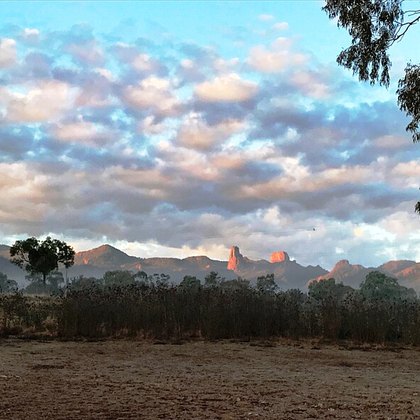
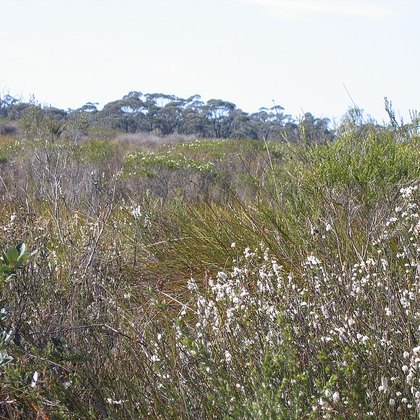
Dry eucalypt forest and woodland, forest edges, river woodland along creeks, coastal forest and heath, and increasingly orchards, parks and gardens with flowering native plantings. The species follows the blossom and gathers in noisy, loose parties around heavily flowering eucalypts, banksias and mistletoe. The diet is nectar, insects and fruit; the fruit component brings it locally into conflict with growers. It is fierce at the nest and will swoop intruders — including much larger birds, and at times people. Breeding runs from July to January, with one or two broods. The nest is a deep cup slung from a branch one to three metres up; the clutch is two to four, rarely five, eggs.
Where the bird is most often found, arranged by main group and formation.



Range and movements
Eastern Australia, from Lakes Entrance and the Murray valley in Victoria north through New South Wales and Queensland to Cape York, largely east of and on the Great Dividing Range. Beyond that it occurs in the Trans-Fly of southern New Guinea. Southern populations are migratory: they leave the south-east in autumn and winter further north, returning in spring, which in some districts produces conspicuous waves of passage along the coast. The species is absent from Tasmania and Western Australia, and does not occur in New Zealand.
- Resident
- Breeding (summer)
- dark = core range, pale = thinly spread
Where and when to look
Find it by following the sound: walk towards the racket. Flowering eucalypts often hold dozens of birds at once, and then there is ample time to study the knob. Pick out a bird in side view against the sky — the head profile with its rounded rise above the bill base is decisive and works even into the light, when colour tells you nothing. If two large friarbirds with different head patterns are in the same area, check the crown: bare and black to the back of the head means this species, silvery-white and feathered means Silver-crowned Friarbird. In the breeding season it is wise to keep away from nest trees, since the species swoops hard at anyone who comes close.
Conservation
Least Concern (LC) and common to numerous over most of its range. The species has adapted well to urban greenery and to plantings of flowering native trees, so it is a fixture in many eastern Australian towns. Where dry eucalypt forest has been cleared at scale for cropping and grazing it has disappeared, since it needs large continuous areas of flowering trees to make its seasonal movements. In orchards it is sometimes regarded as a pest; netting is the usual and, for the bird, harmless remedy there, though slack netting can entangle birds.
Scientific name
Philemon corniculatus | (Latham, 1790)
John Latham described the species in 1790; the parentheses around author and year record that it originally stood in another genus. The generic name Philemon goes back to Greek philemon, 'affectionate' or 'kissing'. The epithet corniculatus comes from Latin corniculum, 'little horn', and refers directly to the knob above the bill. The English Noisy Friarbird, the Dutch schreeuwlederkop and the Spanish filemón chillón all pick the voice instead of the horn. Friarbird and the Dutch lederkop ('leather head') refer to the bare head, suggesting a friar's tonsure; in this species that baldness is carried furthest of all the Australian friarbirds. Several subspecies are recognised, of which the New Guinean is the most distinct.