All species › Passerines › Honeyeaters › Little Friarbird
Little Friarbird | Philemon citreogularis
Kleine lederkop | Filemón goligualdo
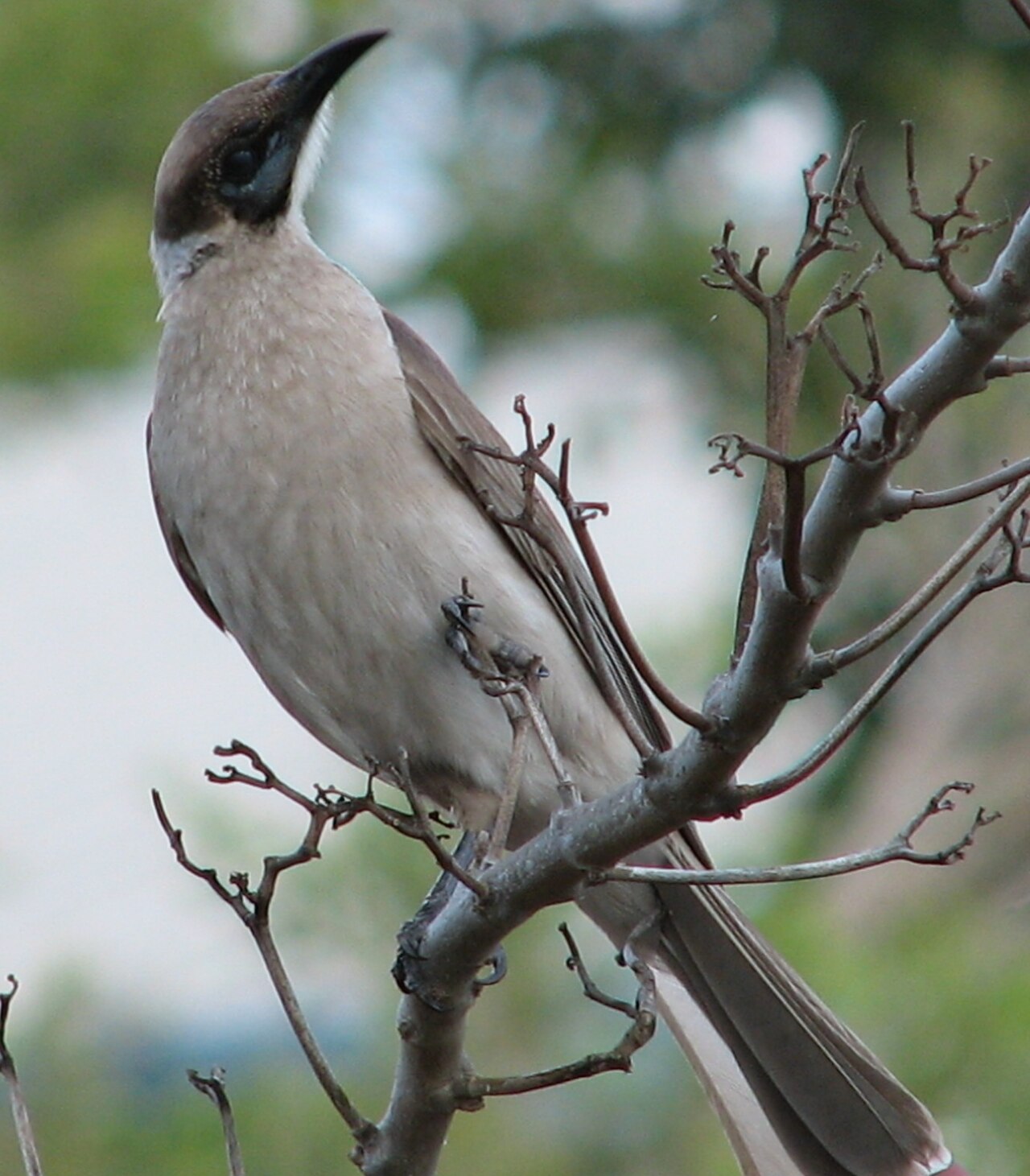
The Little Friarbird is the smallest and slimmest of the four Australian friarbirds and the only one without a knob on the bill. Instead it carries a blue-grey patch of bare skin that starts below the eye and widens over the cheek — the mark that separates it from its larger relatives. It is a bird of trees along water: creek woodland, swampy woodland, mangrove and orchard, where it moves busily and noisily through flowering canopies, often in mixed parties with other honeyeaters.
Voice
Less deafening than its big cousin the Noisy Friarbird, but far from silent. The usual call is a liquid, mellow gee-wit or chewip, repeated over and over and strikingly soft, almost tuneful, for a friarbird. In the breeding season the repertoire grows more complex and runs into longer chattering sequences with hard, hoarse notes between. A friarbird-like sound in creek woodland that reads as friendly rather than shrill is almost always this species.
No freely licensed recording has been found for this species yet; what to listen for is described below.
Identification
A medium-sized honeyeater of twenty-five to twenty-nine centimetres with a medium-length, curved black bill and no casque — the key feature of the species. Below the eye lies a patch of bare skin widening over the cheek, varying from blue-grey to almost black. Head and upperparts are dark grey-brown, with white feather fringes on the nape and neck sides forming a pale collar there. The chin carries soft, silky white feathers; the breast is silvery streaked and the remaining underparts greyish white. The legs are blue-black, the eye dark brown. Juveniles show a yellowish wash on the throat — exactly what the scientific epithet refers to. The sexes are alike, though the female is slightly smaller.
Confusion species
Among the Australian friarbirds this is the straightforward one, because only this species lacks a bill casque. Noisy Friarbird (Philemon corniculatus) is much larger and heavier, has a wholly bare black head and a clear rounded knob above the bill base, and lacks the blue-grey cheek patch. Silver-crowned Friarbird (Philemon argenticeps) is larger, has a silvery-white crown and a high, short horn on the bill. Helmeted Friarbird (Philemon buceroides) is the largest of all, with a heavy bony casque at the bill base and bare dark grey skin running onto the side of the neck. In doubt at distance, watch the outline of the bill base: if it runs smoothly into the forehead with no rise, this is the species. Blue-faced Honeyeater (Entomyzon cyanotis) also carries blue bare facial skin, but that patch surrounds the eye, the bird is boldly white and olive-green with a white nape band — so confusion is possible only in a poor glimpse.
Habitat
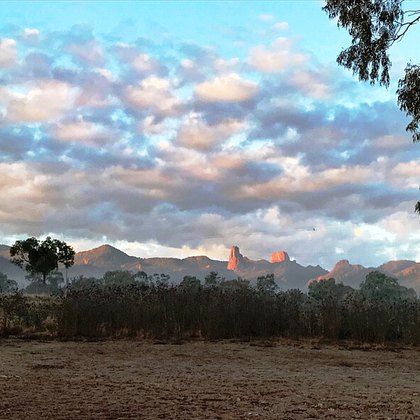
Open forest and woodland with a eucalypt canopy, almost always near water: creek woodland, swampy woodland, river banks and damp hollows. Beyond that it takes monsoon forest, mangrove, coastal heath, orchards and gardens with flowering plantings. It forages almost entirely in trees and seldom on the ground, living on nectar, blossom, fruit, seed and invertebrates, often in mixed company with other honeyeaters around a heavily flowering tree. The species forms monogamous pairs and breeds from July to February, sometimes with two broods a season. The nest is a deep, notably loosely woven open cup, often thin enough to see through, slung over or close to water; the clutch is two or three eggs. The Eastern Koel Eudynamys orientalis is a regular brood parasite of this species.
Where the bird is most often found, arranged by main group and formation.




Range and movements
Northern and eastern Australia plus southern Papua New Guinea. In Australia the range runs from Broome in Western Australia through the Northern Territory and Queensland to the coast of New South Wales, and inland along the Murray into northern Victoria and South Australia. Southern populations are seasonal: they appear in the south-east in summer and move north again in winter, while tropical birds are largely resident. The species is absent from the dry heart of the continent and from Tasmania, and does not occur in New Zealand.
- Resident
- dark = core range, pale = thinly spread
Where and when to look
Work along the water. Follow a creek or river bank where the trees are in flower and listen for the mellow, repeated gee-wit; that sound is the quickest separation from the shrill Noisy Friarbird. When the bird comes into view, go straight to the bill base: no knob, and a blue-grey patch fanning back from the eye over the cheek, and you are done. In the north all four friarbirds will at times be in the same flowering tree; that is an excellent chance to see the bill shapes side by side and fix the distinctions for good.
Conservation
Least Concern (LC) and common across a very large range. The species adapts well to landscapes reshaped by people: orchards, plantings around country towns and gardens with flowering native shrubs are readily occupied. Its tie to water does make it sensitive to the loss of creek woodland and riparian vegetation, a habitat heavily thinned in the farming districts of eastern Australia; restoring riparian strips directly benefits this species. There is no evidence of decline at a continental scale.
Scientific name
Philemon citreogularis | (Gould, 1837)
John Gould described the species in 1837 as Philemon citreogularis; it has remained in this genus since. Philemon goes back to Greek philemon, 'affectionate' or 'kissing', and has become established as the generic name for friarbirds without saying anything about their appearance. The epithet citreogularis comes from Latin citreus, 'lemon-yellow', and gula, 'throat', and refers not to the adult but to the yellow wash juveniles carry on the throat — the Spanish name filemón goligualdo follows that literally. The Dutch kleine lederkop and the English Little Friarbird pick size instead. The name friarbird refers to the bare head of most species in the genus, suggesting a friar's tonsure; in this species that baldness is least developed.