All species › Passerines › Honeyeaters › Helmeted Friarbird
Helmeted Friarbird | Philemon buceroides
Timorese helmlederkop | Filemón de yelmo
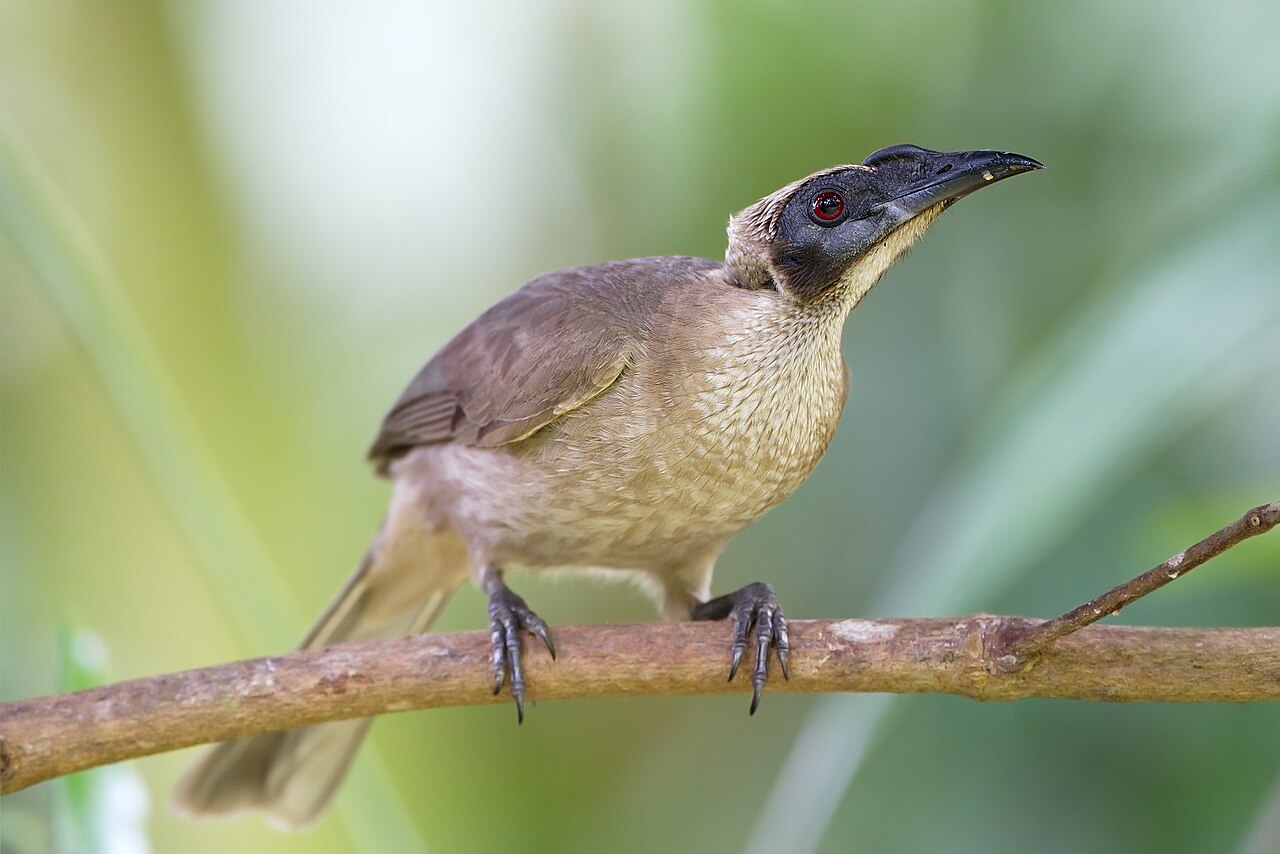
The Helmeted Friarbird is the largest friarbird of the Australo-Papuan region: a grey-brown honeyeater of over thirty centimetres with a bare dark grey face, a red eye and a heavy bony casque on the bill base — a growth no other Australian honeyeater carries. It is a bird of the wet tropical north: paperbark swamp, mangrove, monsoon forest and rainforest edge, where it works through the middle and upper storeys in noisy, roving parties and sends its rolling call far above the canopy.
Voice
Highly vocal. The call is a loud, rolling series rendered as keeyo-keoway or kowee ko keeyo and repeated up to a dozen times in succession; alongside it comes a hoarse kurr-rk, eight to ten times over. The birds call most in the early morning and strikingly hard as a storm approaches, something northern observers often remark on. The tone is fuller and more rolling than the shrill cackling of the Noisy Friarbird and less nasal than the call of the Silver-crowned Friarbird.
Recording: Elisabeth Hein — CC BY-NC-SA 4.0 · Lumi, Aitape-Lumi District, Sandaun Province, Papua New Guinea · xeno-canto
Identification
A very large honeyeater of thirty-two to thirty-eight centimetres, with males weighing up to nearly a hundred and eighty grams — markedly heavier than females. The upperparts are grey-brown, the underparts fading to off-white on breast and belly. The face is bare and dark grey to black, with a red iris; in this species that bare skin extends further than in its relatives, reaching onto the side of the neck. The crown is feathered and grey-brown, not silvery-white. The decisive feature is the bill: a heavy, elongated bony projection on the base of the upper mandible, unique among Australian honeyeaters. The projection is smaller and less sharply defined in juveniles.
Confusion species
All the confusion stays within the genus. Noisy Friarbird (Philemon corniculatus) overlaps in coastal Queensland and is the hardest: that species has a wholly bare black head to the back of the skull, where P. buceroides keeps a feathered grey-brown crown; the knob of P. corniculatus is also rounded and short, that of P. buceroides longer and helmet-shaped. Voice separates them at once: shrill cackling against a fuller, rolling call. Silver-crowned Friarbird (Philemon argenticeps) shares almost the whole northern range and is the main confusion species: it is slightly smaller, has a silvery-white crown, a shorter but higher horn, and its black bare cheek patch runs out to a sharp angle behind the eye where in P. buceroides it ends roundly; the voice of P. argenticeps is more nasal, at times cat-like. Note that the north-east Queensland form of P. buceroides can itself show a pale crown, so that facial skin shape and bill are then decisive. Little Friarbird (Philemon citreogularis) is far smaller and has no bill projection at all.
Habitat
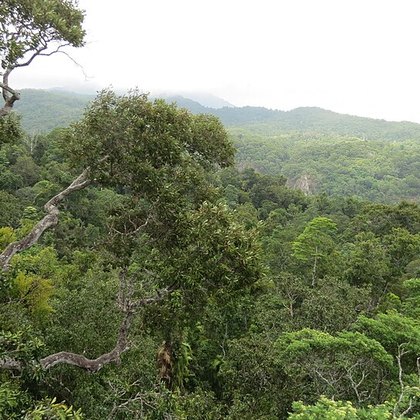
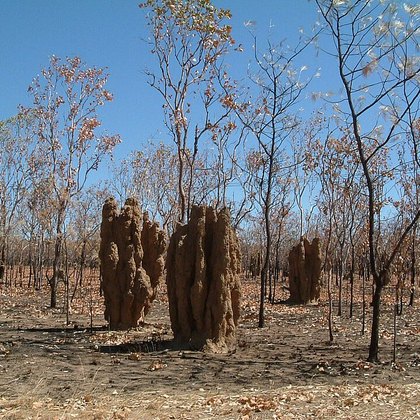
Humid tropical forest in the monsoon belt: monsoon forest and vine thicket, paperbark swamp forest, mangrove, tropical rainforest and rainforest margin, and open eucalypt forest nearby. It travels through the middle and upper storeys and forages in small noisy parties. The diet is chiefly nectar and fruit, with seed and invertebrates alongside; small lizards are taken very occasionally. Wherever a tree stands in heavy flower in the north — eucalypt, paperbark, grevillea or a fig in fruit — the species gathers with other honeyeaters and announces itself at once by size and voice. Breeding falls mainly from September to February; the nest is a large suspended cup, high in a tree and often over water. The clutch is two to four, sometimes five, eggs, with incubation of fifteen to eighteen days.
Where the bird is most often found, arranged by main group and formation.



Range and movements
In the broad sense the range runs from the eastern Lesser Sundas — Sawu, Timor and Wetar, home of the nominate form — across New Guinea into tropical northern Australia: from the edge of the Kimberley through the Top End and around the Gulf of Carpentaria to Cape York and the coast of north-eastern Queensland. Australian birds belong to the subspecies yorki in north-eastern Queensland and gordoni and ammitophilus in the north-west. The species does not occur in New Zealand.
- Resident
- dark = core range, pale = thinly spread
Where and when to look
In the tropical north your best chance is along the edge of a paperbark swamp or a strip of mangrove, early in the morning. Listen for the rolling keeyo series; it carries far and is often unceasing as a storm builds. When a large friarbird comes into view, work through three things in this order: is the crown feathered or bare, does the black cheek patch end roundly or in a sharp point, and is the bill projection long and helmet-like or short and high. Those three together separate it from Noisy and Silver-crowned Friarbird even when all three sit in the same tree, which happens regularly in northern Queensland.
Conservation
Least Concern (LC) and widespread across its range, although a decline of about a tenth of the population is suspected over the coming decade. In the Lesser Sundas the species is under pressure from the conversion of monsoon forest to cropland and pasture; in northern Australia the picture is better, though changing fire regimes and the erosion of mangrove and monsoon forest around northern towns locally degrade its habitat. Since the species depends heavily on flowering and fruiting trees, keeping strips of monsoon forest and paperbark swamp intact is the most direct interest.
Scientific name
Philemon buceroides | (Swainson, 1838)
Swainson described the species in 1838 as Philedon buceroides; because it now stands in Philemon, author and year are in parentheses. It was originally — and erroneously — described from Australia; the type locality was fixed on Timor in 1916. The generic name Philemon goes back to Greek philemon, 'affectionate' or 'kissing'. The epithet buceroides is built from Buceros, Linnaeus's 1758 genus of hornbills, and the Greek suffix -oides, 'resembling' — thus 'hornbill-like', for the casque on the bill. The Dutch name Timorese helmlederkop points at the Timorese type locality, which can mislead for a bird that appears in this guide mainly as an Australian species; the English Helmeted Friarbird and the Spanish filemón de yelmo pick the casque instead. About ten subspecies are recognised; some recent treatments raise the Australian and New Guinean forms yorki, gordoni and novaeguineae to species rank, but this guide keeps the broad concept.