All species › Passerines › Honeyeaters › Silver-crowned Friarbird
Silver-crowned Friarbird | Philemon argenticeps
Witkruinlederkop | Filemón coronado
The Silver-crowned Friarbird is the friarbird of the tropical savanna of northern Australia and the only one of the four with a silvery-white feathered crown above a bare black face. A short but high horn sits on the black bill, and the black facial skin runs out to a sharp point behind the eye — two details that separate it from its larger neighbour the Helmeted Friarbird. It is nomadic, following the flowering of eucalypt and paperbark through the north, calling loudly in a nasal, almost cat-like voice.

Voice
Noisy like all friarbirds, but with a recognisable timbre of its own: the tone is markedly nasal and Australian observers often describe it as cat-like, or compare it to the call of a koel. The sound consists of short, forceful series repeated in quick succession, with hoarse notes between. In the north, where the species occurs alongside the Helmeted Friarbird, this difference is the quickest separation: nasal and sharper against fuller and more rolling. It is loudest in the early morning and around a heavily flowering tree.
No freely licensed recording has been found for this species yet; what to listen for is described below.
Identification
A large honeyeater of twenty-seven to thirty-two centimetres. The upperparts are grey-brown, tending greyer as the season's wear proceeds; the underparts are light brown to off-white. The face is bare and black, as is the long, pointed bill, and above the bill base sits a short but high horn. The crown is feathered and silvery pale grey to white — the feature the species is named for and the thing that separates it at once from the Noisy Friarbird. The black bare cheek patch ends behind the eye in a sharp, angular point. The iris is red-brown to crimson. Juveniles are darker, have a black or dark grey bill base, a less developed horn and a yellow gape.
Confusion species
The main confusion species is Helmeted Friarbird (Philemon buceroides), with which it shares almost the whole northern range. That species is larger, has a shorter, lower crown that stays grey-brown rather than silvery-white, a longer and more helmet-shaped bill projection, and bare black skin that ends roundly and runs onto the side of the neck; in P. argenticeps that skin instead runs out to a sharp angle behind the eye. Note, though, that the north-east Queensland form of P. buceroides can itself show a pale crown, so that in that district face shape, horn shape and above all the nasal voice decide. Noisy Friarbird (Philemon corniculatus) meets it in Queensland and has a wholly bare black head with no silver crown, plus a rounded rather than high horn. Little Friarbird (Philemon citreogularis) is clearly smaller, has no horn at all and carries a blue-grey patch of bare skin over the cheek.
Habitat
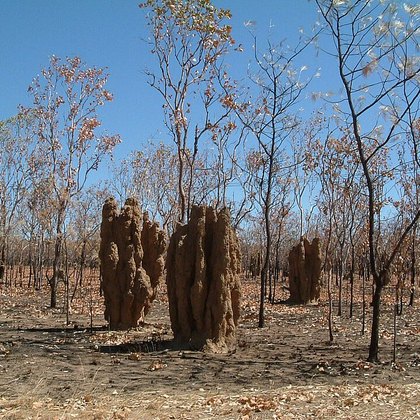
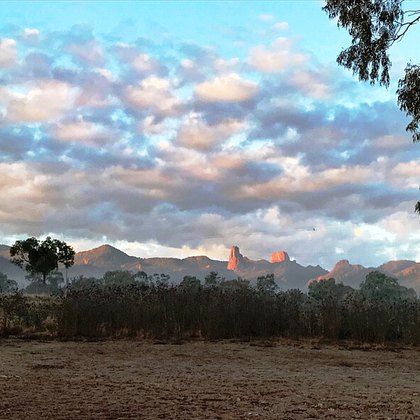
Open eucalypt forest and woodland of the tropical savanna, particularly the monsoon belt of the Kimberley, Arnhem Land and the Gulf Country, with paperbark swamp forest, river woodland along northern creeks, mangrove and monsoon forest alongside. The species moves nomadically, following the flowering of eucalypt, paperbark and grevillea; wherever there is heavy blossom it appears in parties and noisily drives off smaller honeyeaters. The diet is nectar, fruit and insects. The nest is a deep, suspended cup in the foliage, often over or near water, and breeding falls in the second half of the dry season and the early wet. Two subspecies are recognised: kempi in north-eastern Cape York and the nominate form across the rest of the north.
Where the bird is most often found, arranged by main group and formation.



Range and movements
Endemic to northern Australia: from the Kimberley in Western Australia through the Top End of the Northern Territory and around the Gulf of Carpentaria into northern Queensland and Cape York. Inland it reaches to where savanna gives way to drier country, roughly to the districts of Larrimah and Katherine. It is absent from the south and east of the continent and from Tasmania, and occurs nowhere outside Australia. It has never been recorded in New Zealand.
- Resident
- Winter
- dark = core range, pale = thinly spread
Where and when to look
Look for it in the northern dry season at flowering eucalypts and paperbarks along a creek or at a waterhole. Listen first: the nasal, almost mewing timbre gives it away even unseen and separates it at once from the other large friarbirds. When it comes into view, take in crown and cheek angle in one move — a silvery-white feathered crown plus a black patch tapering to a point behind the eye settles the identification. Into the light the silhouette helps: the horn of this species sits higher and shorter on the bill than in any other friarbird.
Conservation
Least Concern (LC) and common right along the tropical north coast. The species gains from its broad diet and nomadic habits, which let it respond well to the strongly fluctuating flowering of the monsoon belt. It does, however, depend on extensive continuous savanna with old, heavily flowering trees; changed fire regimes in northern Australia — burning more often and hotter than under traditional Aboriginal fire management — thin out old trees and paperbark swamps and are therefore the main concern. There is no evidence of decline at a continental scale.
Scientific name
Philemon argenticeps | (Gould, 1840)
John Gould described the species in 1840 as Philemon argenticeps; author and year stand without parentheses, because it has always remained in this genus. Philemon goes back to Greek philemon, 'affectionate' or 'kissing'. The epithet argenticeps is built from Latin argentum, 'silver', and -ceps, from caput, 'head', and refers to the silvery-white crown. The English Silver-crowned Friarbird follows that literally, as does the Dutch witkruinlederkop; the Spanish filemón coronado names the crown alone and not its colour. Friarbird refers to the bare head, suggesting a friar's tonsure — in this species that bare part is confined to the face, since the crown itself is feathered. Two subspecies are recognised.