All species › Passerines › Honeyeaters › White-eared Honeyeater
White-eared Honeyeater | Nesoptilotis leucotis
Witoorhoningeter | Mielero orejiblanco
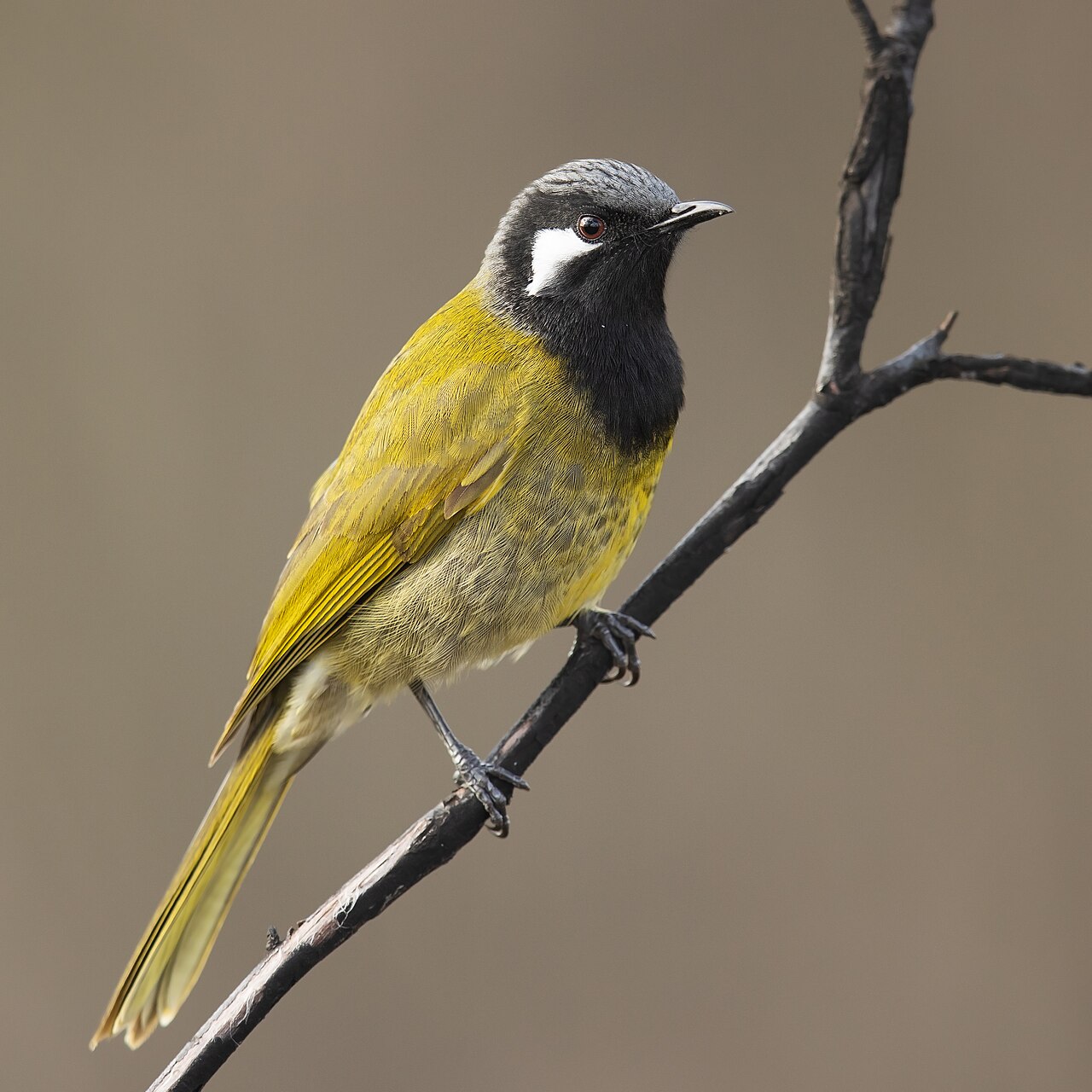
The White-eared Honeyeater is the honeyeater of dry eucalypt forest with a dense understorey: a solid olive-green bird of just over twenty centimetres with a grey crown, a black face and chin, and a large, pure white ear patch set into it like a brushstroke. It works up trunks and branches after insects and has a deep, faintly metallic voice that carries through the bush. It is famous for plucking hair — from stock, from kangaroos and wallabies, and at times from the head of a walker standing still — to line its nest.
Voice
A deep, full but slightly metallic voice, heavier than that of most honeyeaters of comparable size. The usual call is a loud, repeated chwok, chwok, chwok-whit or kwitchu, kwitchu, cut across by a sharply scratchy metallic chwik!. In dry forest you will often hear it calling from the same spot for minutes while it works slowly over a trunk. The voice is remarkably consistent across the whole range, which is useful: once you know the call you will find the species again from the Victorian mallee to the heaths of south-western Australia.
No freely licensed recording has been found for this species yet; what to listen for is described below.
Identification
A medium-sized, solid honeyeater of nineteen to twenty-two centimetres, with a black, straight-looking bill about seventeen millimetres long and dark grey legs. The upperparts are olive-green, the wings and tail carrying brown and yellow tones; the underparts are a paler olive-yellow-green. The crown is dark grey with fine black streaking, and the face is black: a black mask running over the cheek and chin and ending as a short black bib below the bill. Set into it is the large white ear patch, the feature the species is named for and the first thing to catch the eye at distance. The eye is red in adults, brown in juveniles; the sexes are alike, juveniles duller and browner.
Confusion species
Confusion is rare, because the combination of olive-green body, black face and crisply defined white ear patch is unique on the mainland. The chief point of comparison is the sister species Nesoptilotis flavicollis, of the same build and size but carrying a bright yellow chin and throat instead of the black face with white ear patch; the two nowhere occur together, since N. flavicollis is confined to Tasmania and the Bass Strait islands and N. leucotis does not reach Tasmania. Note also a naming matter: in Dutch N. flavicollis is called brilhoningeter, as is Ptilotula fusca — both are birds other than this one. Lewin's Honeyeater (Meliphaga lewinii) shares the forest locally on the east coast but is darker, larger and has a crescent-shaped yellow ear patch without any black face. The Melithreptus honeyeaters likewise have a black head, but are far smaller and carry a white nape band rather than an ear patch.
Habitat
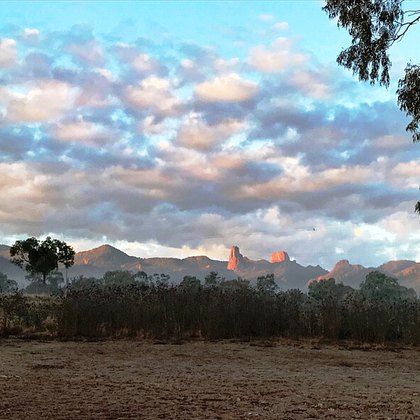
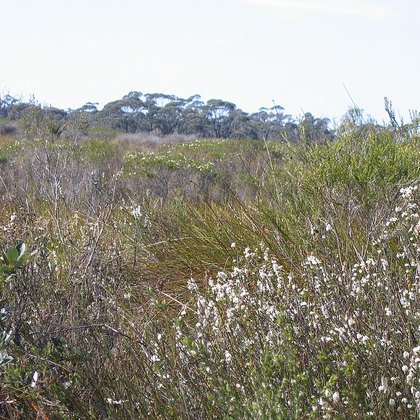
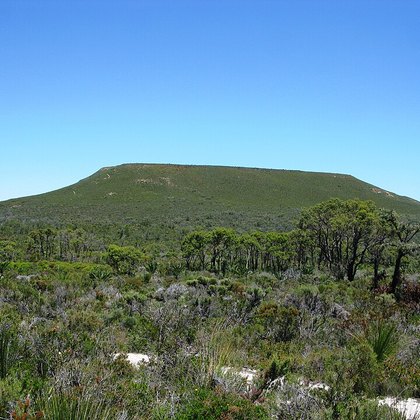
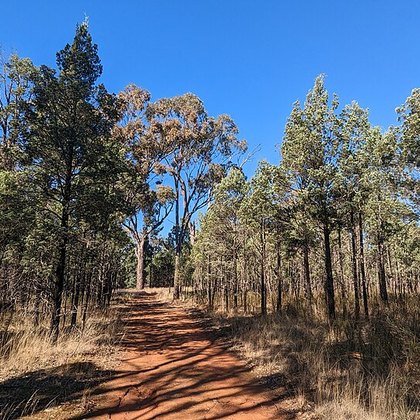
Dry eucalypt forest and woodland with a well-developed shrub layer, mallee, heath and dry inland scrub. The understorey is decisive: the species avoids thinned, recently burnt or grazed-out country and can, conversely, occupy small woodland remnants as long as the shrub layer is intact. It prefers not to cross open ground and follows closed tree lines where it can. Food is mainly insects — termites and spiders above all, actively sought on trunk and branch — with nectar, fruit, manna and lerp alongside, with a marked seasonal shift between the two. Study of foraging birds recorded one insect every five seconds. The nest is a deep, thick-walled cup half a metre to five metres up, lined with mammal hair the bird plucks straight off living animals. The clutch is usually two or three white eggs with brown speckling; breeding occurs in almost all months, peaking from July to March.
Where the bird is most often found, arranged by main group and formation.

Range and movements
Southern and eastern mainland Australia, from south-eastern Queensland through New South Wales and Victoria into South Australia, with a separate western population in south-western Australia and a link on the Eyre Peninsula. The inland subspecies reaches far into the dry south, into the mallee and the heaths along the desert edge. The species avoids the tropical north entirely and is absent from Tasmania, where its place is taken by Nesoptilotis flavicollis. It does not occur in New Zealand.
- Resident
- dark = core range, pale = thinly spread
Where and when to look
Do not look for it in the canopy, look on the trunk. Walk through dry eucalypt forest with a dense shrub layer and watch for a medium-sized bird working up a trunk or heavy branch in jerks, searching the bark — that posture, unusual for a honeyeater, is a pointer in itself. The deep, faintly metallic chwok usually gives it away first. Anyone sitting still in the bush for long also stands a chance of the hair harvest: the bird will land on a kangaroo, or occasionally a person, and tug out a tuft. The behaviour is well documented and is among the more delightful things the Australian bush has to offer.
Conservation
Least Concern (LC), but with local decline. The species stands or falls with the shrub layer: where understorey is lost to stock and deer grazing, to fire that is too frequent or too intense, or to the tidying-away of dead wood and scrub, the White-eared Honeyeater goes too, even where the trees remain. Fragmentation of dry eucalypt forest in the farming districts of the south compounds this, since the bird is reluctant to fly across open ground and so depends on continuous tree lines. Retaining a dense shrub layer and connecting strips of woodland is the most direct measure for this species.
Scientific name
Nesoptilotis leucotis | (Latham, 1801)
John Latham described the species in 1801 as Turdus leucotis; the parentheses around author and year record that it has since changed genus. It stood for a long time in Lichenostomus and moved after molecular phylogenetic work in 2011 into Nesoptilotis, together with its Tasmanian sister species. Nesoptilotis is built from Greek nesos, 'island', and ptilon, 'feather'. The epithet leucotis comes from Greek leukos, 'white', and ous, 'ear', and so points at the white ear patch — exactly what the Dutch witoorhoningeter, the English White-eared Honeyeater and the Spanish mielero orejiblanco also record. For once all four names pick the same feature. Four subspecies are recognised: the nominate leucotis, the smaller novaenorciae, and further schoddei and thomasi.