All species › Parrots › Old World parrots › Crimson Rosella
Crimson Rosella | Platycercus elegans
Blauwwangrosella | Perico elegante
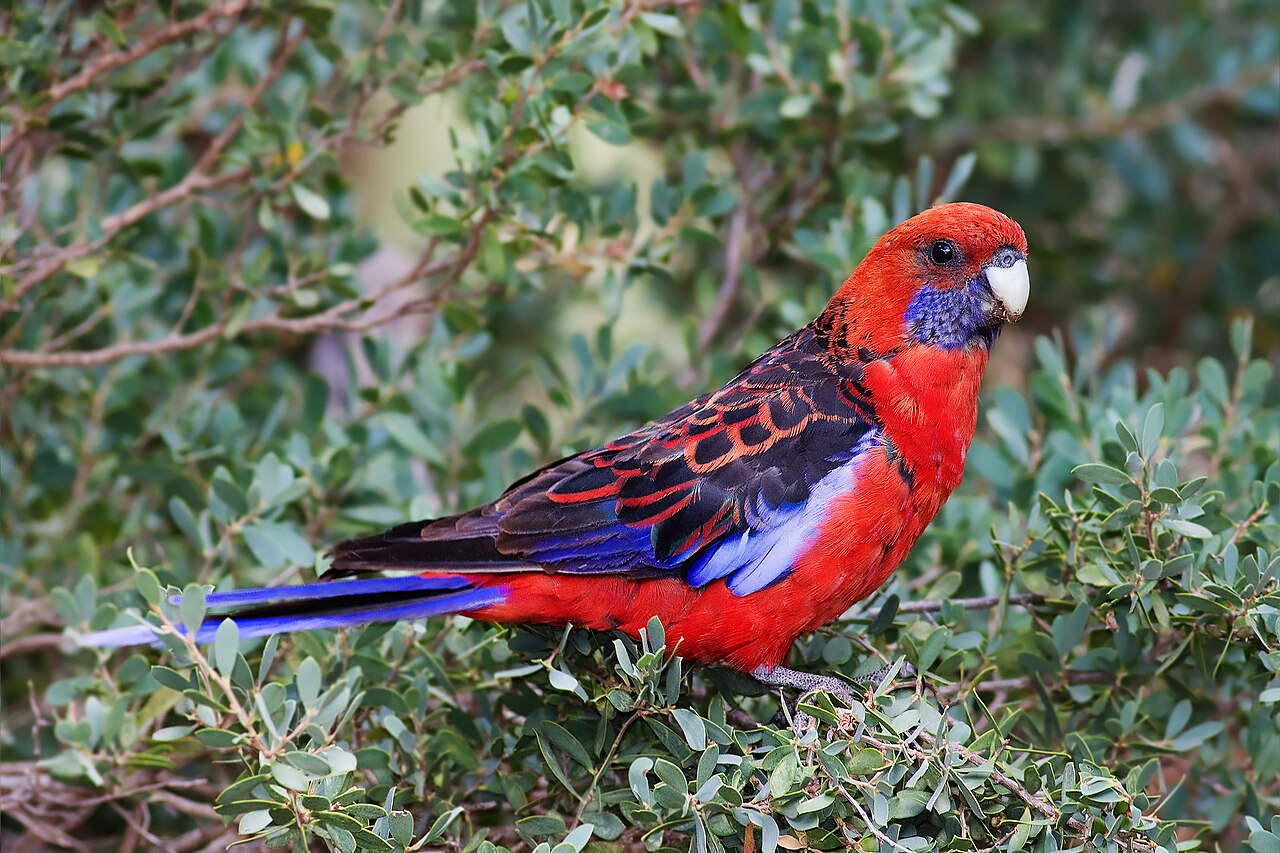
The Crimson Rosella is the scarlet parrot with the cobalt cheek of the wetter forests of southeastern Australia. Three quite different birds hide under the one name: the red bird of the ranges, the yellow form of the Murray and the orange Adelaide form in between. This guide keeps all three within this single species, because wherever they meet they interbreed without a break.
Voice
The usual call is a two-syllable, bell-like cussik-cussik, stressed and rising on the second syllable, which announces a passing bird well before it appears. Perched, it adds clear metallic whistles and a soft chatter. Alarm or a squabble brings a shrill hard screech. A flock in a flowering eucalypt keeps up a low continuous conversation that is only noticed by standing beneath it.
Recording: Romuald Mikusek — CC BY-NC-SA 4.0 · Devils River, Murrindindi Shire, Victoria, Australia · xeno-canto
Identification
A medium parrot of about thirty-five centimetres, a good deal of it tail. The adult of the red form is deep scarlet on head, underparts and rump, with cobalt cheeks, a broad blue margin along the wing and a blue tail; the back feathers are black with broad red edges, giving a scaled look. The yellow form of the Murray has all that red replaced by pale yellow and a greenish tail; the Adelaide form lies between, from deep orange-red in the south to pale orange-yellow in the north. The sexes look alike; the male is up to a seventh larger with a broader bill. Juveniles are olive-green with blue cheeks and only colour through at about sixteen months.
Confusion species
Eastern Rosella (Platycercus eximius) shares ground in the southeast but has white cheeks, a red head and breast with a yellow belly and a boldly scalloped mantle; confusion arises only on a glimpse. Australian King-Parrot (Alisterus scapularis) is larger, the male with an all-red head and no blue cheek, a green back, and a straight low flight instead of the rosella's short bounds. Green juvenile Crimson Rosellas get taken for Green Rosella (Platycercus caledonicus) of Tasmania, but that bird is yellow and green as an adult and does not occur on the mainland.
Habitat
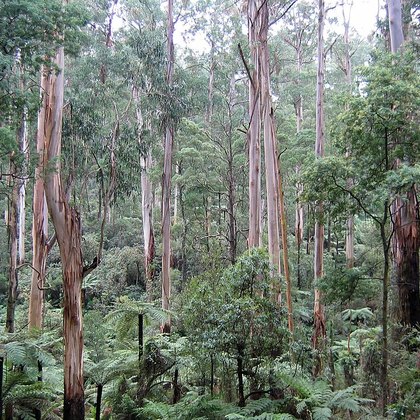
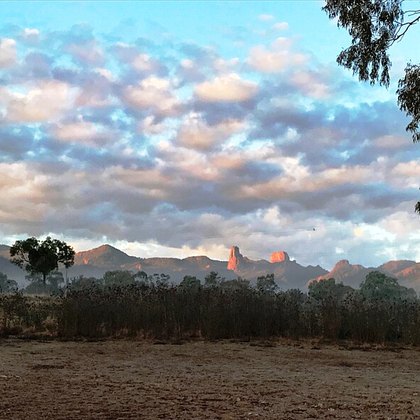
Tall wet eucalypt forest with a moist understorey, and the rainforest beside it, form the core of the range; below that, drier eucalypt forest and forest edge. The yellow form belongs to the river red gum woodland of the Murray and Murrumbidgee, a wholly different landscape from the mountain forest of the red form. Beyond that gardens, parks, orchards and plantings, where it comes to feeding tables and fruiting trees. It nests in a deep hollow in an old eucalypt, the eggs laid on rotted wood.
Where the bird is most often found, arranged by main group and formation.


Range and movements
Southeastern Australia, from southeastern Queensland along the coast and ranges through New South Wales and Victoria to southeastern South Australia and Kangaroo Island, with a separate population in the mountain rainforest of North Queensland. The yellow form follows the Murray and Murrumbidgee, the Adelaide form the hills around Adelaide, and orange hybrids stand where red and yellow meet. Off the mainland it has been released on Norfolk and is established there; in New Zealand it never took hold. It does not migrate, but in winter it drops from the ranges into the valleys.
- Resident
- dark = core range, pale = thinly spread
Where and when to look
In winter, June to August, walk a forest road through the ranges and watch for the short bounding flight just below the canopy; the bell-like cussik-cussik comes before the sighting. To see the story of the forms, go to the Murray at Barmah or Renmark for the yellow birds and to the Adelaide Hills for the orange: the same bird, the same voice, another colour. Green juveniles often keep apart from the red flocks.
Conservation
Least Concern (LC) and common throughout its range; in towns and gardens it has if anything increased. The limit is the same as for the other hollow-nesters of the eastern forests: big old trees with deep hollows have grown scarce and young forest does not supply them. Beyond that, birds are lost to traffic where they cross forest tracks low, and psittacine beak and feather disease spreads around busy feeding tables. Trapping for the bird trade no longer matters much in Australia.
Scientific name
Platycercus elegans | (Gmelin, 1788)
Gmelin described the species in 1788 as Psittacus elegans; because it was later moved to another genus, author and year stand in parentheses. The genus Platycercus was introduced by Vigors in 1825, from Greek platus, 'broad', and kerkos, 'tail', after the broad fanned tail of these parrots. elegans is Latin for 'elegant'. The yellow form flaveolus and the Adelaide form adelaidae were long carried as species of their own; since it emerged that they interbreed freely in the zones of contact they stand as subspecies of elegans, and this guide follows that.