All species › Parrots › Old World parrots › Green Rosella
Green Rosella | Platycercus caledonicus
Geelbuikrosella | Perico de Tasmania
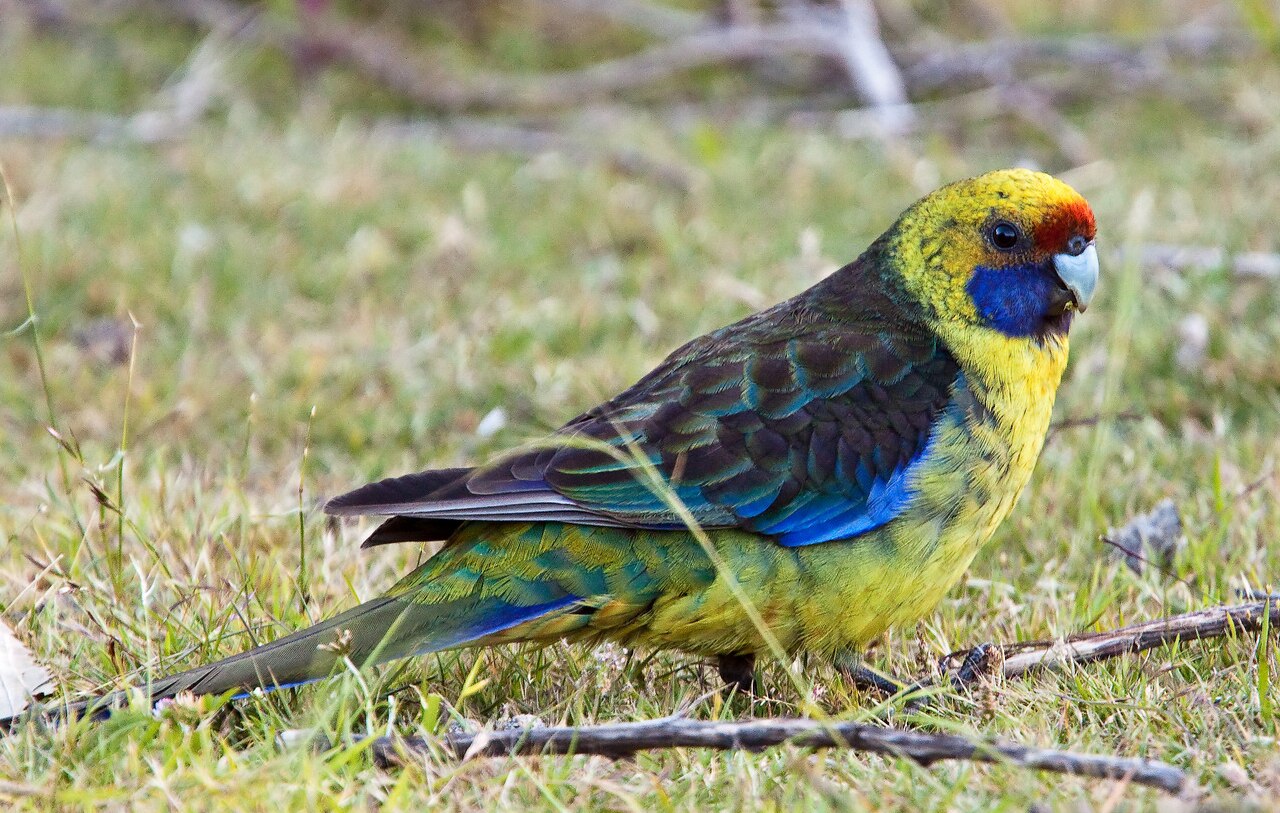
The Green Rosella is the largest rosella in Australia and the only one confined to Tasmania and the Bass Strait islands. Head, neck and the whole underside are deep yellow, with a narrow red band above the bill and a blue cheek patch; the upperparts are dark mottled green and black. Young birds are largely green, which is where the English name comes from.
Voice
The contact note is a repeated two-syllable kussik kussik, often rendered cossack cossack, and almost always given in flight. From a perch comes a rising kwik-kweek kwik-kweek, and disturbance brings a sharp metallic kzink. Feeding birds are strikingly quiet, but the moment a party lifts off the typical rosella chatter fills the canopy.
No freely licensed recording has been found for this species yet; what to listen for is described below.
Identification
A heavy rosella of about thirty-two centimetres, noticeably bigger and bulkier than any mainland species. Head, neck, breast and belly are an even deep yellow, with a crisp red frontal band and a blue-violet cheek patch running below the eye. Mantle and shoulders are black with broad green feather edges, the shoulder and primaries cobalt, the tail dark blue-green with blue outer edges. Females are duller yellow and more often show red feathering on head and breast. Juveniles are largely green over a dark brown feather base and do not take the yellow plumage until their second year.
Confusion species
On Tasmania the only other rosella is Eastern Rosella (Platycercus eximius), present as the subspecies diemenensis in the east and north-east: smaller, with a bright red head and breast, white cheeks and a yellow belly, so any view of the head settles it. Juvenile Green Rosellas are green and are sometimes taken for something else; the blue cheek, the red frontal band and the sheer size give them away. Crimson Rosella (Platycercus elegans) and the other mainland rosellas do not occur in Tasmania. The heavy build and the slow straight flight on shallow beats also separate the species on shape from the small coastal Neophema parrots.
Habitat
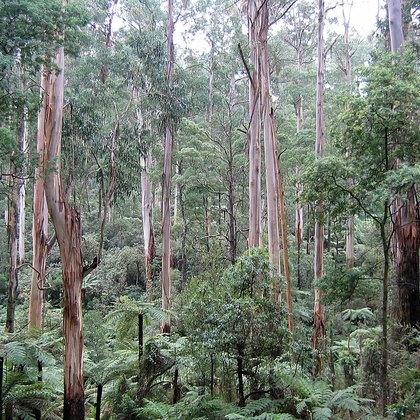
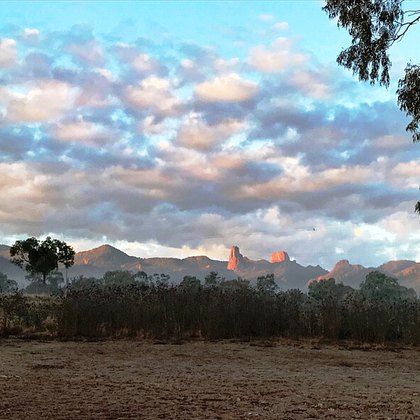
Almost any Tasmanian landscape with some tree cover up to about 1500 metres: rainforest, wet and dry sclerophyll forest, open eucalypt woodland, heath and the edges of the southern beech forest. It avoids only treeless moorland and cleared farmland. In towns from Hobart to Launceston it counts as an ordinary garden bird and comes to feeding tables. It nests in eucalypt hollows, from low down to high in the crown.
Where the bird is most often found, arranged by main group and formation.


Range and movements
Tasmania and the Bass Strait islands only: the whole main island, plus Maria, Bruny, De Witt, Maatsuyker and King Island. It does not occur on mainland Australia, nor anywhere beyond. It is sedentary in the strict sense: even the highland birds do not move away in winter. On King Island forest loss has made it scarce.
- Resident
- dark = core range, pale = thinly spread
Where and when to look
Walk a track through Tasmanian eucalypt forest and listen for the two-syllable cossack overhead; the birds give themselves away in flight rather than while feeding. In winter find a flowering or seeding eucalypt and stand still — they hang upside down at the outer twigs. In Hobart gardens a feeding table brings them within a few metres.
Conservation
Least Concern (LC), with a large Tasmanian range and at most a slow decline. The King Island form brownii is another matter: fewer than five hundred remain, threatened by the clearing and fragmentation of the island's forest, and it is treated as vulnerable. On the main island the species has at times been controlled as an orchard pest, and the loss of old hollow trees is the main long-term concern. The species is listed on CITES Appendix II.
Scientific name
Platycercus caledonicus | (Gmelin, 1788)
Gmelin described the species in 1788 as Psittacus caledonicus in his edition of the Systema Naturae; because it was later moved to another genus, author and year stand in parentheses. The genus Platycercus was introduced by Vigors in 1825, from Greek platus, 'broad', and kerkos, 'tail'. caledonicus means 'of New Caledonia' and rests on a mistake: Gmelin wrongly believed the type came from there, whereas the type locality is Adventure Bay on Bruny Island off Tasmania. Two subspecies are recognised: caledonicus on Tasmania and brownii on King Island.