All species › Parrots › Old World parrots › Pale-headed Rosella
Pale-headed Rosella | Platycercus adscitus
Bleekkoprosella | Perico pálido
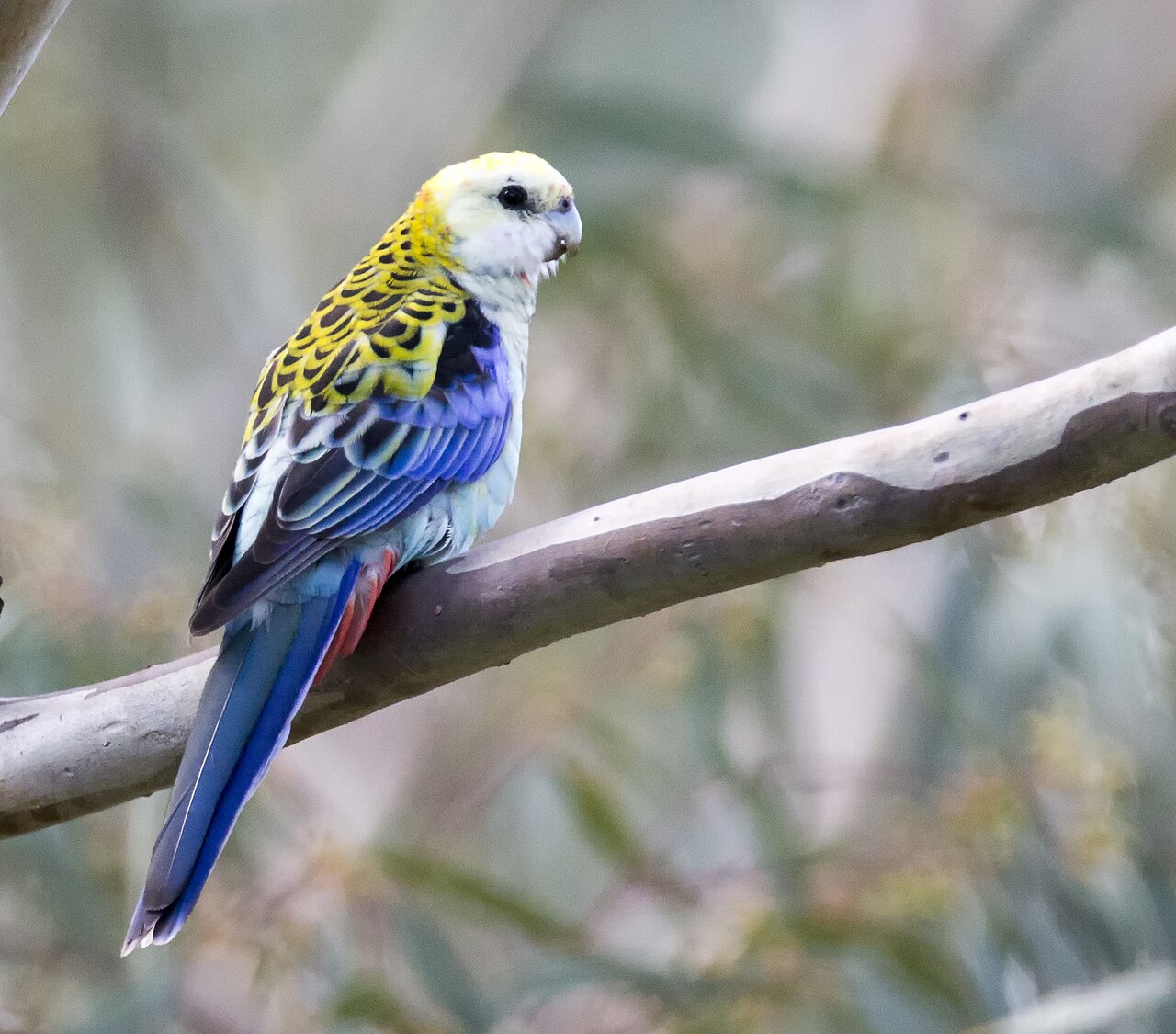
The Pale-headed Rosella is the rosella of the Queensland savanna woodland: a medium-sized broad-tailed parrot with a pale yellow, almost cream-white head that carries no red at all, white or blue-and-white cheeks and plain light blue underparts. Back and shoulders carry a block of black scalloped with gold, and the moment the bird lifts off a blood-red patch shows beneath the tail.
Voice
The ordinary contact note is a clear two- or three-syllable kwik-kwik, given in flight and from a perch, and barely separable from that of Platycercus eximius. Excitement brings a high, rapid pi-pi-pi-pi-pi, and parties feeding on the ground keep up a soft running chatter. Come too close and a shrill alarm follows as the birds swing away in short undulations to the next tree.
No freely licensed recording has been found for this species yet; what to listen for is described below.
Identification
About thirty centimetres long, almost half of that tail. The head is pale straw-yellow to cream-white and carries no red; the cheeks are wholly white in the Cape York birds and blue with white in the eastern ones. Mantle and shoulders are black with broad golden feather edges, which reads at range as a scalloped saddle. Breast and belly are plain light blue, the shoulder and underwing dark blue, the tail blue-green with blue-black. The undertail coverts are blood-red, the bill blue-white, the eye yellow-brown and the legs dark grey. Females are slightly smaller and duller and usually show a pale stripe across the underwing.
Confusion species
Eastern Rosella (Platycercus eximius) is the hard one: the same size and the same white cheek, but with a bright red head and breast and a yellow belly instead of a pale head and blue underparts. Where the two meet in north-eastern New South Wales and south-eastern Queensland hybrids occur with a head half red and half pale — leave such birds unidentified. Northern Rosella (Platycercus venustus) has a black crown and finely black-scalloped yellow underparts and lives far to the west, outside this bird's range. Crimson Rosella (Platycercus elegans) is larger and wholly deep red with cobalt cheeks.
Habitat
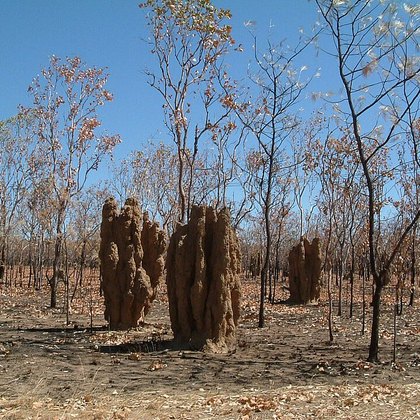
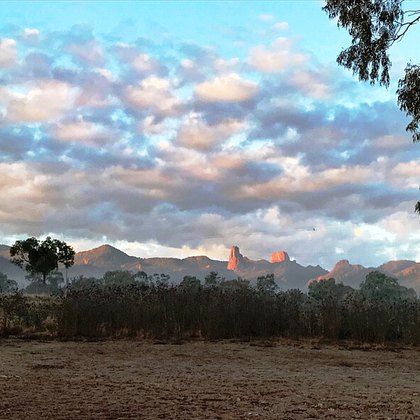
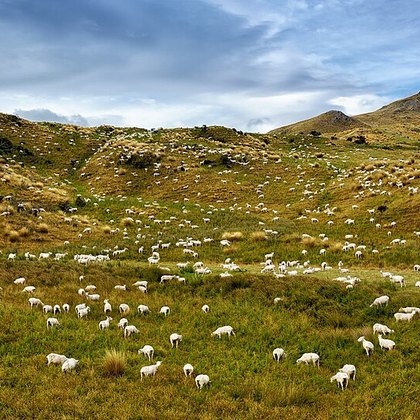
Open eucalypt savanna woodland with a grassy understorey is the core, together with lightly timbered woodland, lines of trees along creeks and the edges of crop and grazing land. It is not shy of a man-made landscape: parks, town gardens and orchards are all used, and on fruit it can count locally as a pest. It nests in hollows in dead or living eucalypts, in hollow stumps and even in fence posts, usually not far from water.
Where the bird is most often found, arranged by main group and formation.



Range and movements
North-eastern and eastern Australia only. The northern form runs from Cape York south through central-northern Queensland to about Cardwell; the eastern form takes over there and reaches from Townsville south into north-eastern New South Wales, roughly to the Clarence. Within that area it is common and largely resident; little is known of any seasonal movement.
- Resident
- dark = core range, pale = thinly spread
Where and when to look
Drive a grassy bush road in inland Queensland early in the morning and watch for pairs lifting off the verge: the pale head against the dark back carries a hundred metres. Check the undertail of every bird that flies off, because the blood-red is the quickest mark. Water points late in the afternoon give the best close views.
Conservation
Least Concern (LC). The species holds a large unbroken range and a steady population, and has gained rather than lost from the clearing of woodland for grazing: grassy openings with old hollow trees are exactly what it needs. Where old trees go on a large scale the supply of nest hollows does fall away, and as a supposed orchard pest it is persecuted in places. The species is listed on CITES Appendix II.
Scientific name
Platycercus adscitus | (Latham, 1790)
Latham described the species in 1790 as Psittacus adscitus; because it was later moved to another genus, author and year stand in parentheses. The genus Platycercus was introduced by Vigors in 1825, from Greek platus, 'broad', and kerkos, 'tail'. adscitus is Latin for 'adopted' or 'admitted'. The type locality was fixed in 1912 on Cooktown, Queensland. Two subspecies are recognised: adscitus with wholly white cheeks on Cape York and palliceps with blue-and-white cheeks in eastern Queensland.