All species › Parrots › Old World parrots › Ground Parrot
Ground Parrot | Pezoporus wallicus
Grondpapegaai | Perico terrestre
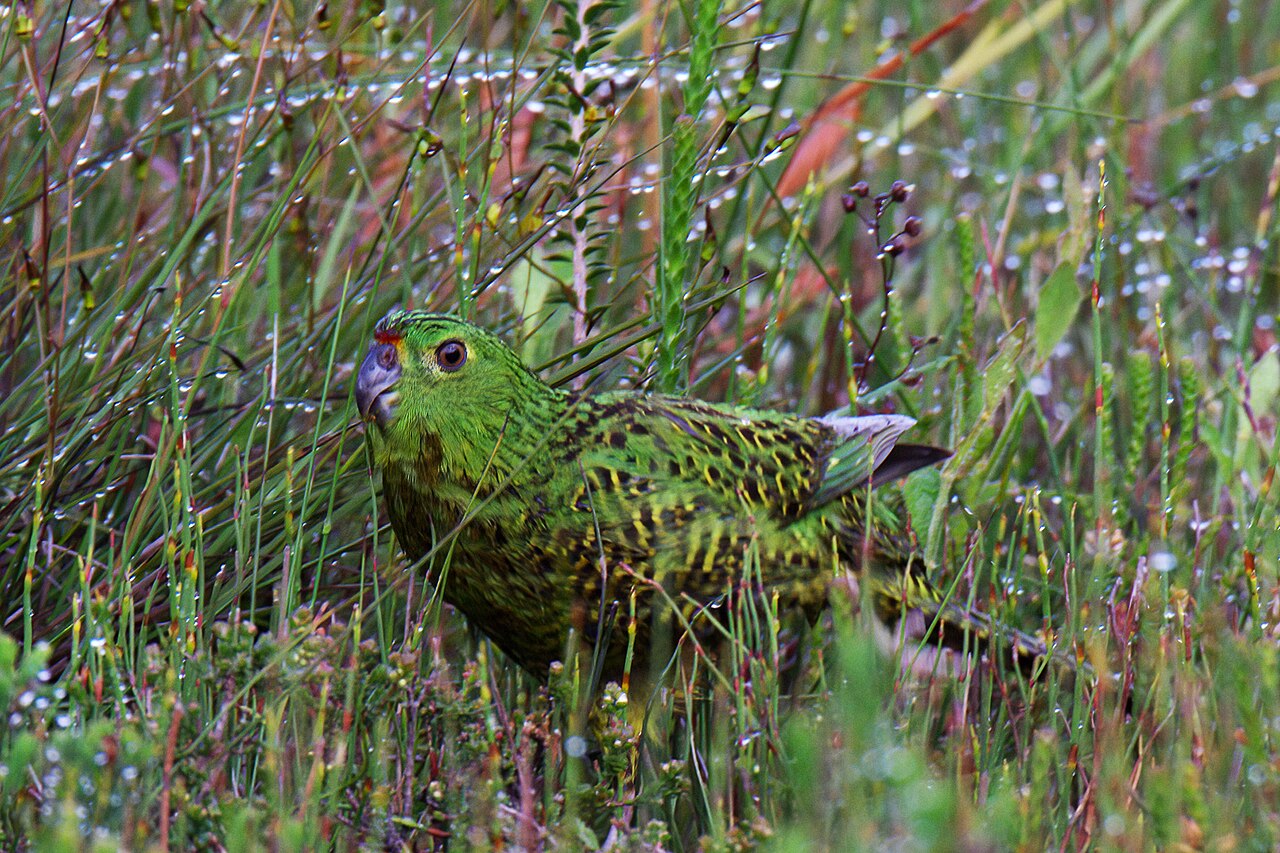
The Ground Parrot is a slim, grass-green parrot that spends its whole life on the ground in dense coastal heath and flushes only when you are almost standing on it. It is heavily spotted black and streaked yellow, with a long barred tail and a narrow red band across the forehead. In practice you hear it long before you see it: in the last minutes of dusk its rising series of whistles carries over the heath.
Voice
The call is a set of clear, piercing whistles rising in steps, about half a second apart: tee ... tee-tee ... tzee-tzee-tzee, accelerating and fading at the end. It calls almost only in the twenty minutes either side of sunrise and sunset, sometimes with several birds answering across the plain. There is also a rapid sharp trilling chatter that sounds surprisingly like a Budgerigar. Anyone new to the heath easily mistakes the whistled series for that of the honeyeater Phylidonyris melanops, which shares the same habitat.
No freely licensed recording has been found for this species yet; what to listen for is described below.
Identification
Twenty-eight to thirty-two centimetres, well over half of it the long, narrow, green-and-yellow barred tail — a silhouette that stands out in flight as unusually slender and drawn-out. The plumage is grass-green, closely marked with black spots and yellow streaks, yellower on the belly and darker on the back. A narrow bright red band crosses the lower forehead just above the bill; young birds lack it. The iris is pale yellow, the bill horn-coloured and the legs grey-pink. In flight a pale yellow bar shows across the primaries. It flies rarely, then low and fast with irregular beats, to dive back into the vegetation like a snipe after twenty to a hundred metres.
Confusion species
It is hardly confusable with other parrots: no other species combines this colour, the heavy black spotting and a life on the ground. On the buttongrass plains of south-west Tasmania it shares ground with Orange-bellied Parrot (Neophema chrysogaster), which is smaller, far brighter blue and yellow, flies high and openly and is not nearly so long-tailed; in coastal heath further west the same goes for Rock Parrot (Neophema petrophila). The only other ground-dwelling parrot in this guide is Kakapo (Strigops habroptilus), three times the weight, mottled moss-green, nocturnal, flightless and confined to predator-free New Zealand islands. Its closest relative is Night Parrot (Pezoporus occidentalis) of the dry interior, yellower-green and shorter-tailed, which this guide does not cover.
Habitat
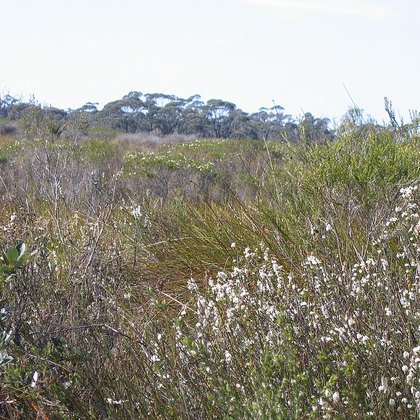
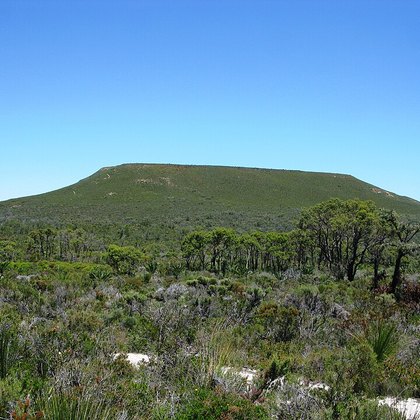
Low, dense coastal heath, sedgeland and buttongrass plain on poor, wet to damp soil, usually under a metre high and treeless. It needs vegetation that has gone unburnt for years: densities build from three to five years after fire and are highest in heath fifteen years old and more. In south-western Australia the western form favours kwongan heath left alone for forty years or longer. The nest is a shallow bowl of twigs and grass under a low shrub, with a screening tunnel of vegetation in front of it.
Where the bird is most often found, arranged by main group and formation.

Range and movements
Scattered populations along the east coast of Australia, from south-eastern Queensland through a handful of reserves in New South Wales to Gippsland in Victoria, plus the Bass Strait islands. The stronghold is Tasmania, where the buttongrass plains of the south-west hold tens of thousands of birds. A separated western form hangs on in two small areas on the south coast of Western Australia: Cape Arid National Park with the adjoining Nuytsland Nature Reserve, and Fitzgerald River National Park with the Waychinicup–Many Peaks district. It occurs nowhere outside Australia.
- Resident
- Breeding (summer)
- dark = core range, pale = thinly spread
Where and when to look
Stand on a track or a firebreak through unburnt heath and listen, without moving, for the last twenty minutes before sunrise or after sunset; that is the only time it reliably gives itself away. The classic eastern site is Barren Grounds Nature Reserve on the Illawarra escarpment in New South Wales, where the birds can be heard from the tracks. Trying for a view rarely works: do not walk into the heath, which tramples the nesting habitat and buys you at most one second of a bird diving away.
Conservation
Least Concern (LC) globally thanks to the Tasmanian population of more than a hundred thousand birds, but that figure hides two very different stories. The eastern mainland form is assessed as endangered federally and as vulnerable in New South Wales, Queensland and Victoria: most of the coastal heath has been cleared or subdivided, and what remains burns too often for the vegetation ever to grow old enough. The western form is in the worst state, with estimates ranging from under a hundred and fifty to a little over three hundred birds in two areas; large fires in 2015 removed much of the Cape Arid habitat, and foxes and feral cats make short work of a bird that nests on the ground and flies poorly. Fox control, fire management on long intervals and a captive-breeding programme are what keep that last population going.
Scientific name
Pezoporus wallicus | (Kerr, 1792)
Kerr described the species in 1792 as Psittacus wallicus; because it has since moved genus, author and year are bracketed. The epithet wallicus is New Latin for 'of Wales' and points not to Wales itself but to the type locality, New South Wales. Illiger introduced the genus Pezoporus in 1811, from Greek pezoporos 'going on foot' — exactly what this bird does. The folk names Swamp Parrot and Button-grass Parrot name the habitat; in Western Australia the Noongar name is kyloring.