All species › Parrots › Old World parrots › Little Lorikeet
Little Lorikeet | Parvipsitta pusilla
Dwerglori | Lori carirrojo
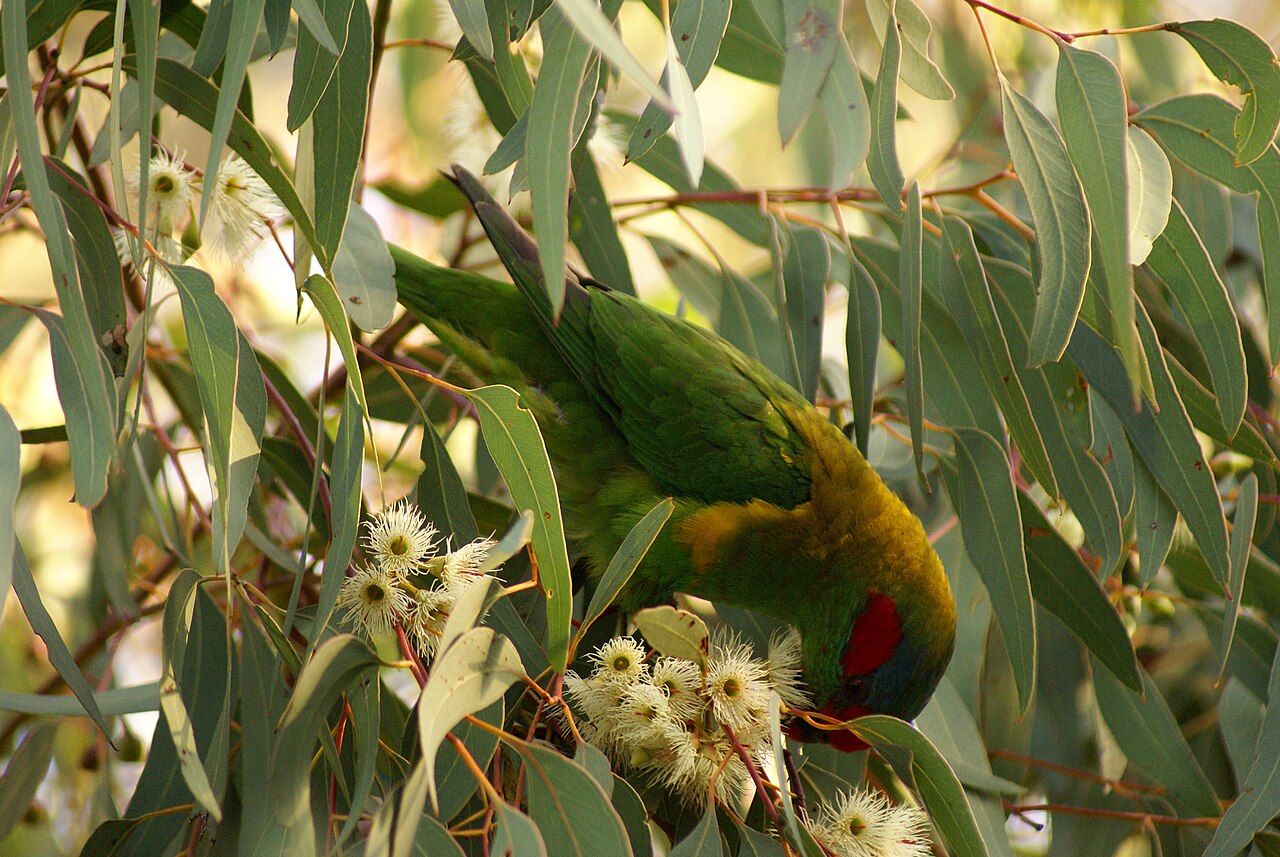
The Little Lorikeet is the smallest parrot of eastern Australia: a short, compact green bird barely the size of a palm, with a sharply cut red face around a black bill. It lives high in flowering eucalypts and almost always gives itself away by a tinkling sound overhead long before it is seen.
Voice
A short, sharp and very high screech, usually a single zit or a rapid zit-zit, delivered continuously in flight by every bird in the flock. That metallic tinkle is thinner and higher than the rolling screech of the Rainbow Lorikeet, and higher again than the Musk Lorikeet. Feeding in the canopy the birds keep up a soft, steady chatter that barely carries to the ground.
No freely licensed recording has been found for this species yet; what to listen for is described below.
Identification
Sixteen to eighteen centimetres and about forty grams, roughly the size of a House Sparrow and easily the smallest lorikeet in the region. Mostly bright grass-green, a little yellower below, with a sharply bordered red mask covering forehead, lores, cheeks and throat. Behind the red lies a bronze to golden-olive wash over crown, nape and mantle, the best second mark. The bill is black, the iris golden-yellow and the tail short and pointed. Sexes alike, the female slightly duller; juveniles show a paler orange face, a brown bill and a brown iris.
Confusion species
Musk Lorikeet (Trichoglossus concinnus) is a quarter larger, with red confined to the forehead and a band through the eye to the ear coverts — never on the throat — plus a blue crown, a yellow patch at the side of the breast and a black bill tipped red. Purple-crowned Lorikeet (Parvipsitta porphyrocephala) is as small, but has a dark purple crown, an orange-yellow forehead and ear patch, pale blue underparts and red underwing coverts. Rainbow Lorikeet (Trichoglossus moluccanus) is nearly twice as long with a blue-purple head and orange-red breast. Scaly-breasted Lorikeet (Trichoglossus chlorolepidotus) has an all-green head and a red bill — exactly the reverse. A black bill plus red running onto the throat settles Little Lorikeet.
Habitat
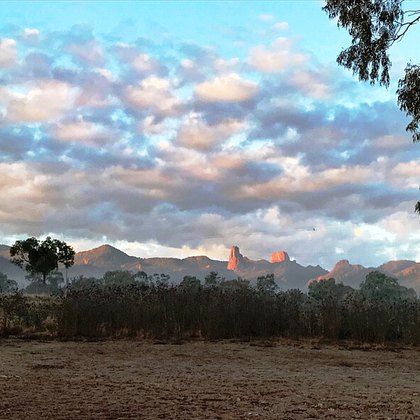
Dry, open sclerophyll eucalypt forest and woodland is the core: box-ironbark country, yellow box and white gum, and above all lines of old River Red Gums along creeks and standing in grazed paddocks. It follows the blossom and is as ready to work flowering melaleuca and bloodwood as inland woodland. It nests in small hollows of living or dead eucalypts, often over water. Urban parks and street trees with flowering eucalypts are used as well.
Where the bird is most often found, arranged by main group and formation.


Range and movements
A broad band down eastern Australia, from about Cairns in north Queensland south through Queensland and New South Wales and all of Victoria into south-eastern South Australia. The stronghold lies on the inland side of the Great Dividing Range and in the valleys of the Murray-Darling. It reaches Tasmania only exceptionally. It is strongly nomadic: a district holds Little Lorikeets one winter and none the next, depending on which eucalypt is in flower.
- Resident
- dark = core range, pale = thinly spread
Where and when to look
Find it by ear rather than by binocular: stand under a flowering eucalypt and listen for that high zit-zit, which betrays a passing flock while the birds themselves are no more than fast dots. If a flock is in the canopy, watch for moving leaves — the birds hang upside down on the blossom and are all but invisible against the foliage. On any view check the bill colour first: black is immediately decisive.
Conservation
Not globally threatened (LC), but that hides the picture: the species is listed as Vulnerable in New South Wales under the Biodiversity Conservation Act and as Endangered in South Australia, with documented declines in both states. The cause is the loss of old box-ironbark woodland and of hollow-bearing River Red Gums: the Little Lorikeet nests in small hollows that take more than a century to form, and those trees have been cleared on a large scale or drowned by altered river management. Keeping old trees standing in grazing country is therefore the heart of its conservation.
Scientific name
Parvipsitta pusilla | (Shaw, 1790)
George Shaw described the species in 1790 as Psittacus pusillus, in the appendix to John White’s journal of the first years of the New South Wales colony; the type locality is New South Wales. Because the bird later moved to another genus, author and year take parentheses. Latin pusillus means ‘very small’, which is indeed its most obvious feature. The genus Parvipsitta was introduced by Mathews in 1916, from Latin parvus, ‘small’, and psitta, from psittacus, ‘parrot’. Until recently the species sat in Glossopsitta; AviList v2025b places it with the Purple-crowned Lorikeet in Parvipsitta.