All species › Passerines › Honeyeaters › Cryptic Honeyeater
Cryptic Honeyeater | Meliphaga imitatrix
Cryptische honingeter | Mielero críptico
The Cryptic Honeyeater did not get its name for nothing: until 2021 it passed as the southern form of the Graceful Honeyeater, and it cannot be told with certainty from that species, nor from the other two brown Meliphaga of north Queensland, on appearance alone. The case for the split rested mainly on voice: where its northern counterpart commands a dozen vocalisations and a recognisable song, this bird has only two simple calls and does not sing. Anyone visiting the Wet Tropics will almost certainly see it — and can almost never name it with certainty without a call.
Voice
Strikingly poor: only two simple calls, among them a short single contact note, and no recognisable song. That poverty is itself the best character. Lewin's Honeyeater rattles continuously like a machine gun, the Yellow-spotted Honeyeater repeats a loud whistle four or five times, and the Graceful Honeyeater of Cape York has a repertoire of as many as twelve different sounds including song. In playback trials the Cryptic and the Graceful Honeyeater do not respond to one another's calls.
No freely licensed recording has been found for this species yet; what to listen for is described below.
Identification
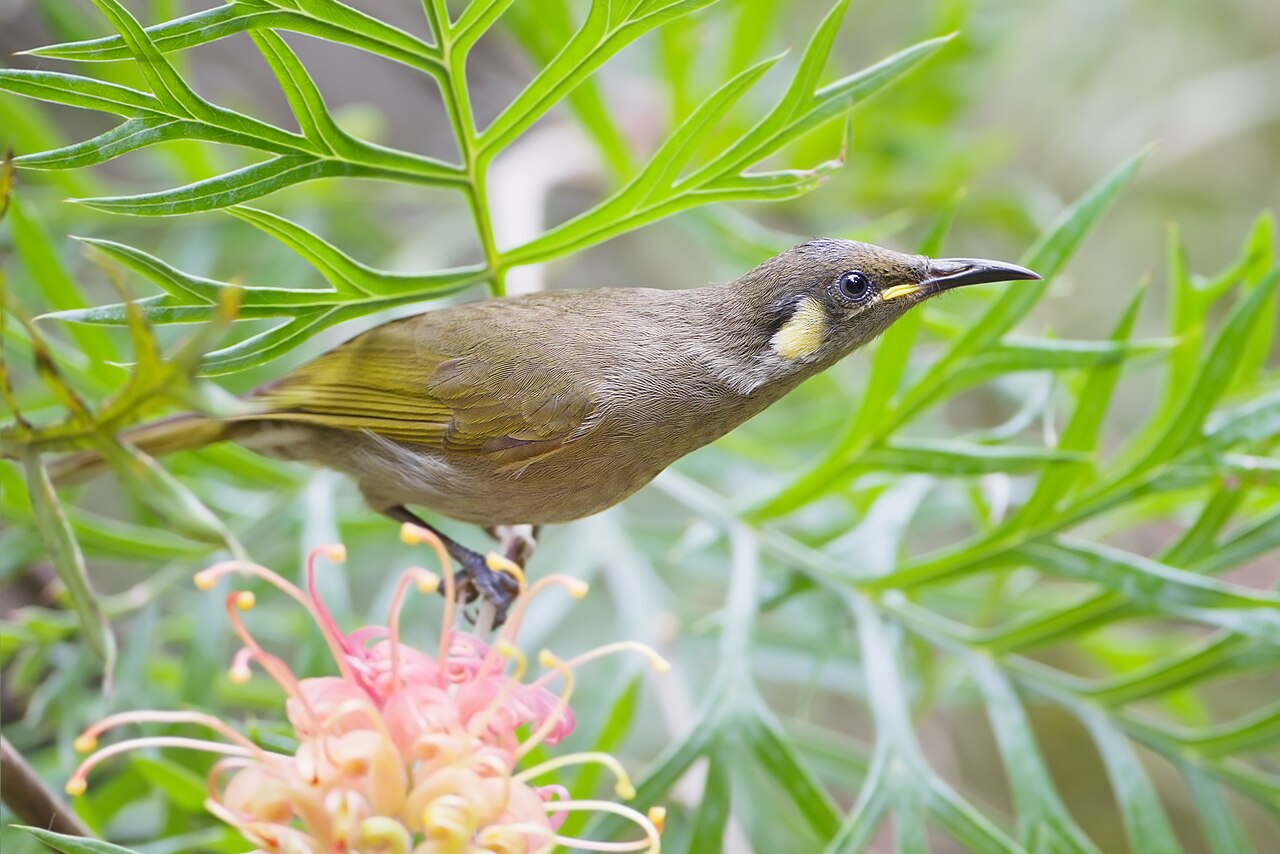
Fifteen to seventeen centimetres: a small olive-grey honeyeater with a relatively fine, slightly decurved bill. The ear patch is pale yellow and round at its core, but runs out behind into a diffuse yellow extension, so that it reads as wedge-shaped rather than purely round. The iris is navy-blue to blue-grey and the gape dull yellow. Compared with the Graceful Honeyeater the plumage is darker and more olive-green, with more uniform and darker underparts. Male and female are alike.
Confusion species
This is the hardest case among the six Meliphaga in this guide and the sources offer little to hold on to; a motionless, silent bird should be recorded as an unidentified Meliphaga. The Graceful Honeyeater (Meliphaga gracilis) is the nearest relative and until 2021 the same species: it is slightly more yellowish in tone, with a paler off-white belly and undertail-coverts, a purely round ear patch, an orange-yellow rather than dull yellow gape and a dark brown rather than navy-blue iris. Fortunately geography helps: between the two range edges on Cape York lies a gap of about a hundred and forty kilometres with no zone of intergradation. The Yellow-spotted Honeyeater (Meliphaga notata) is larger and paler with an oval ear patch and a brown eye; Lewin's Honeyeater (Meliphaga lewinii) is clearly larger, heavier-billed and has a crescent-shaped ear patch. From both, voice is the quickest separation.
Habitat
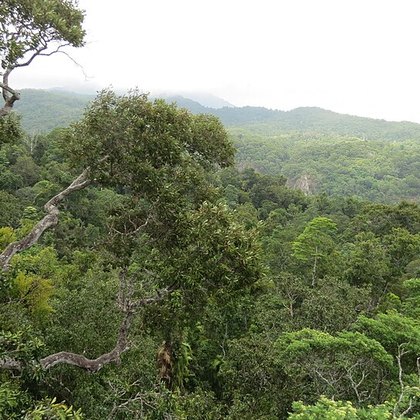
Moist lowland forest in the wettest parts of north Queensland: tropical rainforest and its edges, adjoining monsoon forest and vine thicket, and coastal mangrove forest. It stays largely in the lowlands and takes fruit, nectar and insects in the middle and lower storeys; flowering Grevillea in gardens at the forest edge are visited too.
Where the bird is most often found, arranged by main group and formation.



Range and movements
Endemic to north-eastern Australia: from south-eastern Cape York south through the Wet Tropics of Queensland, roughly from Cooktown to the country around the Burdekin. The type locality is Cairns. Resident and territorial, usually alone or in pairs, with small movements following flowering and fruiting.
- Resident
- dark = core range, pale = thinly spread
Where and when to look
Work by voice and by map. South of Cooktown every small Meliphaga is in principle this species and north of the gap on Cape York it is the Graceful Honeyeater, but do not rely on that blindly without a call. Watch for the poverty of the repertoire: a small Meliphaga that only utters short single notes and never sings is almost certainly this bird. Bear in mind too that all records and photo captions from before 2021 lump the two species under the name of the Graceful Honeyeater.
Conservation
Not threatened; the species is common within its small range and much of that range falls within the protected Wet Tropics. Because it is a lowland bird, the loss of lowland rainforest to sugar cane and building weighs more heavily on it than on the upland members of its genus; quantitative data on a decline are lacking, and no trend is stated here for that reason.
Scientific name
Meliphaga imitatrix | (Mathews, 1912)
Gregory Mathews described the form in 1912 as Ptilotis gracilis imitatrix, that is as a subspecies of the Graceful Honeyeater, from material from Cairns in north Queensland; only in 2021 was it raised to species, and author and year therefore stand in parentheses. imitatrix is Latin for 'the imitator, the mimic', after its likeness to its relatives, and the older English name Imitatress Honeyeater goes back to the same word. The current name Cryptic Honeyeater names the same problem from the other side: the bird is not so much a mimic as unidentifiable. For the genus Meliphaga, from Greek meli (honey) and phagos (eating), see Lewin's Honeyeater; between 2019 and 2025 the species was also carried in the genus Microptilotis.