All species › Passerines › Honeyeaters › Lewin's Honeyeater
Lewin's Honeyeater | Meliphaga lewinii
Geeloorhoningeter | Mielero de Lewin
Lewin's Honeyeater is the largest and the best known of the six brown Meliphaga honeyeaters of Australia: a dark greenish-grey bird with a yellow crescent-shaped ear patch, announcing the wet east of the continent with a hard rattling call. It is the only member of its genus that is common outside the tropical north, and the only one that can be watched at leisure in gardens and parks. That makes it the yardstick: anyone who wants to tell the Meliphaga of north Queensland apart does well to know this species inside out first.

Voice
A hard, fast rattle of even notes, generally described as a machine-gun burst: tr-tr-tr-tr-tr-tr, fired off in one breath and audible at long range. It is the most characteristic sound of the wet eastern forest and the quickest separation from all its relatives, none of which commands such a burst. Beside it comes a sharp single contact note and, in agitation, a scolding rattle.
No freely licensed recording has been found for this species yet; what to listen for is described below.
Identification
Twenty to twenty-two centimetres, large for a Meliphaga and with a heavy, slightly decurved black bill. The plumage is dark greenish-grey, a little darker above than below, with vague grey streaking on the breast. The ear patch is yellow and distinctly crescent-shaped rather than round; the gape carries a creamy yellow stripe. The eye is blue-grey in adults and brown in young birds. In flight the pale yellow edges of the flight feathers show up. Male and female are alike.
Confusion species
In north-eastern Queensland it overlaps with two all but identically marked but smaller relatives, and there size has the first word and voice the last. The Yellow-spotted Honeyeater (Meliphaga notata) is smaller, has an oval rather than crescent-shaped ear patch and a brown eye, and calls a loud repeated whistle instead of a burst. The Cryptic Honeyeater (Meliphaga imitatrix) is smaller again and darker olive, has a round ear patch with a diffuse yellow extension, and commands only two simple calls without a recognisable song. In honesty, the markings of all three are so alike that a motionless bird at middle distance often cannot be named at all; leave such a bird unnamed. South of Cooktown confusion with the Bridled Honeyeater (Bolemoreus frenatus) is possible, but that species has an orange bill base and a yellow lore spot.
Habitat
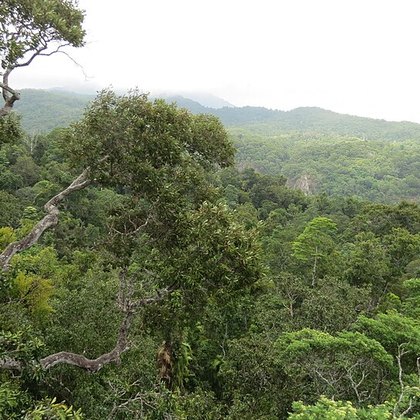
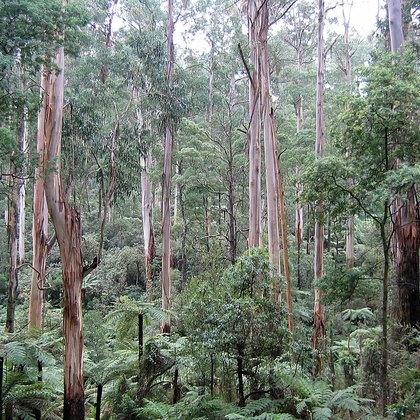
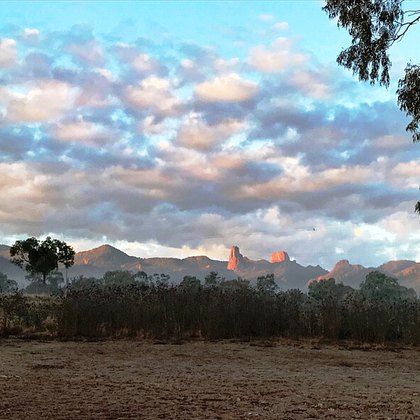
Rainforest and wet sclerophyll forest are the core, with extensions into moist woodland, forest edges, creek-side forest, mangrove margins and any planting that bears fruit. In the eastern cities it counts among the regular garden birds, and it comes to the fruit in orchards and banana crops. It works the middle and upper layers of the vegetation and the trunks, searching bark and epiphytes.
Where the bird is most often found, arranged by main group and formation.

Range and movements
Along the wet eastern edge of Australia, from the Wet Tropics and Cape York in northern Queensland south to central Victoria. Three subspecies are recognised: the nominate form from central Victoria to Rockhampton, mab from Rockhampton to Cooktown, and amphochlora in the McIlwraith Range on Cape York. Largely resident, with an altitudinal movement: in winter birds come down from the ranges to lower ground, so that it then appears in coastal gardens where it is absent in summer.
- Resident
- dark = core range, pale = thinly spread
Where and when to look
Learn the burst. In the country where three Meliphaga occur together, voice is the only character that works through dense foliage, and this species' rattle can be mistaken for nothing else. If the bird is in view, look at the shape of the ear patch — crescent, oval or round — and at the eye colour, and note both before it dives away.
Conservation
Not threatened and common over the whole range; the species adapts well to gardens, parks and orchards and has profited from the planting of the eastern cities rather than suffered by it. Where rainforest and wet sclerophyll forest disappear locally it declines with them, but at national scale there is no sign of decrease.
Scientific name
Meliphaga lewinii | (Swainson, 1837)
William Swainson described the bird in 1837 as Ptilotis lewinii; because the species was later placed in Meliphaga, author and year stand in parentheses. The genus Meliphaga was introduced in 1808 by the English artist and naturalist John Lewin, from Greek meli (honey) and phagos (eating), and this species is its type species. The specific name lewinii honours that same Lewin, the first free artist to work in the colony of New South Wales. The Dutch name points to the yellow ear patch where the English name keeps the person. The genus was split in 2019 after molecular work showed it to be paraphyletic, but in the 2025 arrangement this guide follows, its seventeen species are reunited under one name.