All species › Passerines › Honeyeaters › Yellow-spotted Honeyeater
Yellow-spotted Honeyeater | Meliphaga notata
Torreshoningeter | Mielero marcado
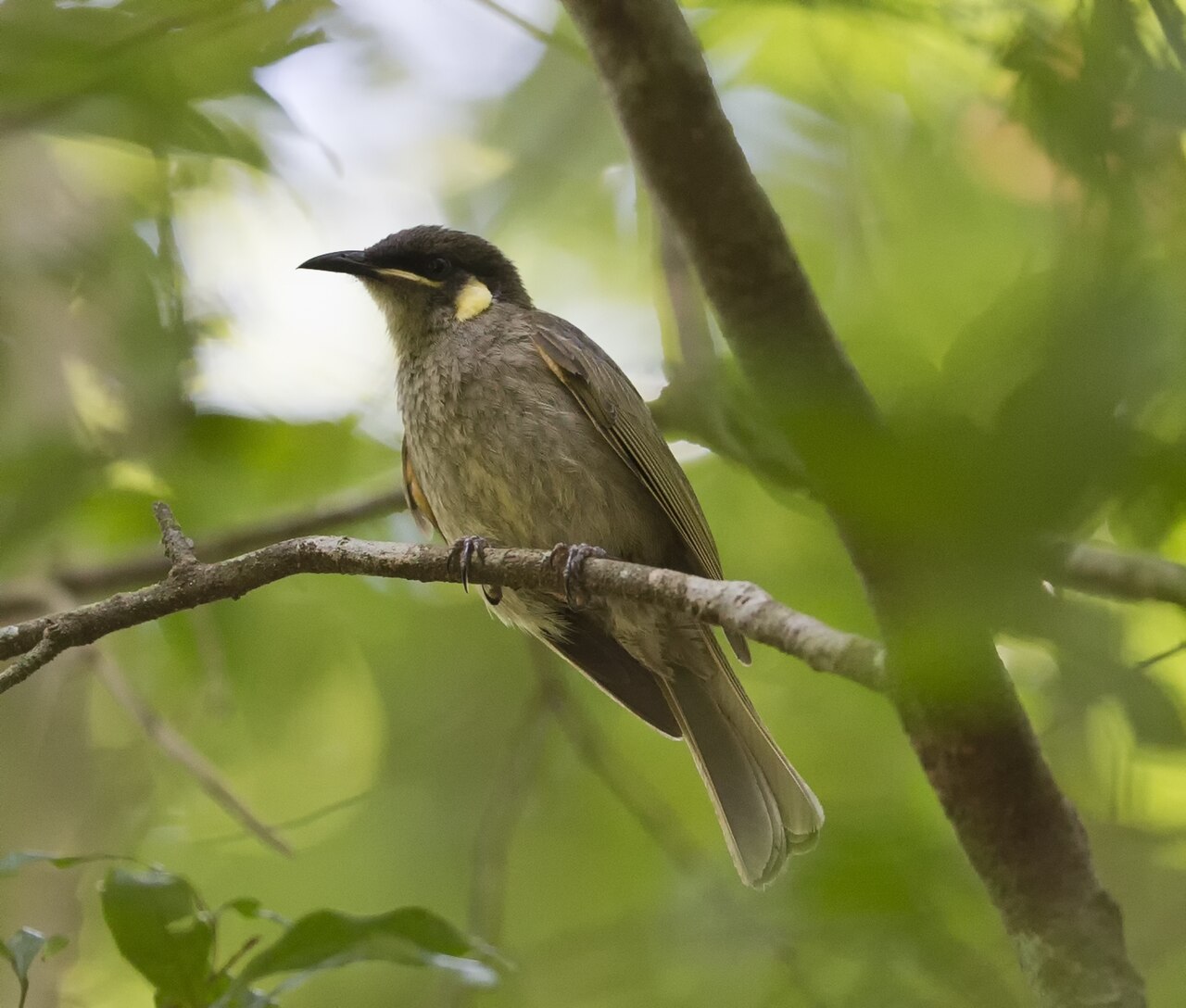
The Yellow-spotted Honeyeater is the middle one of the three brown Meliphaga honeyeaters that overlap in the rainforest of north Queensland, and therefore the hardest. It looks like a small Lewin's Honeyeater with an oval instead of crescent-shaped ear patch and a brown eye, but in the field that difference only registers when both birds are seen close together. Its voice — a loud repeated whistle — is more reliable than its plumage, and that holds for the whole group.
Voice
A metallic, high-pitched rattling song of four to five repetitions of an ee-yew, loud and far-carrying. It is slower and more clearly resolved into separate notes than the unbroken burst of Lewin's Honeyeater, and far richer than the two bare calls of the Cryptic Honeyeater. Beside it come harsh scraping cries in agitation; the species is quick-tempered and noisy by nature.
No freely licensed recording has been found for this species yet; what to listen for is described below.
Identification
Seventeen to nineteen centimetres: olive-brown above, olive-grey below, with a lightly streaked breast and a fairly fine, slightly decurved dark bill. The ear patch is yellow and oval in shape, somewhat more drawn out than a circle but without the clear sickle shape of Lewin's Honeyeater; the gape stripe is yellow. The eye is brown, not blue-grey. Legs and feet are brown. Two subspecies are recognised, differing slightly in wing length. Male and female are alike.
Confusion species
This is one of the hardest identification problems in Australia, and it is fairer to say so at once than to promise a character that does not work. Lewin's Honeyeater (Meliphaga lewinii) is clearly larger and heavier-billed, has a crescent-shaped ear patch and a blue-grey eye, and rattles like a machine gun. The Cryptic Honeyeater (Meliphaga imitatrix), which occurs alongside this species from Cooktown southward, is smaller and darker olive with paler grey underparts, has a round ear patch with a diffuse yellow extension, a navy-blue iris and a dull yellow gape. The Graceful Honeyeater (Meliphaga gracilis) is the smallest, lighter in colour and finer-billed, with a round ear patch and an orange-yellow gape, and holds the ground north of this species on Cape York. In short: ear-patch shape and eye colour are the only usable visual characters and they demand good light and short range; in doubt the voice decides, and without a voice such a bird should be recorded as an unidentified Meliphaga.
Habitat
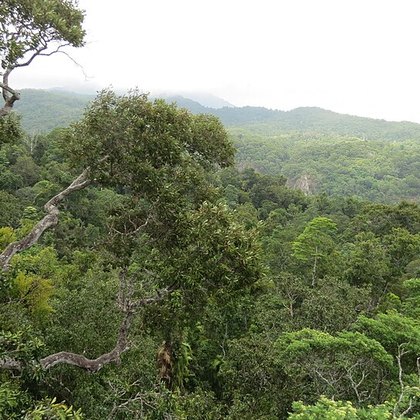
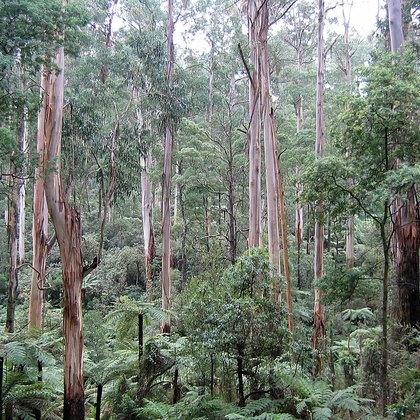
Tropical rainforest and its edges, from about two hundred metres up and rarely above five hundred. It also uses the adjoining monsoon forest and vine thicket, open forest with a shrubby understorey, and suburban gardens where there are trees enough. Foraging, it takes mainly fruit, nectar and insects in the middle storey.
Where the bird is most often found, arranged by main group and formation.


Range and movements
Endemic to north-eastern Australia, from Cape York south along the wet coastal strip to about the latitude of Townsville and Mackay in north Queensland. The type locality is Cape York. Resident, with small local movements following flowering and fruiting. An old report of occurrence in New Guinea around 1901 is no longer followed in current literature.
- Resident
- dark = core range, pale = thinly spread
Where and when to look
Do not look for one decisive character but for the combination: note size first against a familiar bird, then the shape of the ear patch, then the eye colour, and then wait for a call. Birds that slip silently through the canopy on Cape York and in the Wet Tropics often simply cannot be named, and that is no failing on the observer's part.
Conservation
Not threatened; the species is common in the rainforest of north Queensland and a large part of its range lies within the protected Wet Tropics. Loss of lowland rainforest to agriculture is unfavourable locally, but there is no sign of a national decline.
Scientific name
Meliphaga notata | (Gould, 1867)
John Gould described the bird in 1867 as Ptilotis notata, from material from Cape York; because the species was later placed in Meliphaga, author and year stand in parentheses. For the genus Meliphaga, from Greek meli (honey) and phagos (eating), see Lewin's Honeyeater. notata is Latin for 'marked, spotted', after the yellow ear patch, and the English name follows that meaning directly. The Dutch name takes the range instead and refers to the Torres Strait, at the northern edge of the distribution.