All species › Passerines › Australasian robins › Dusky Robin
Dusky Robin | Melanodryas vittata
Tasmaanse vliegenvanger | Petroica de Tasmania
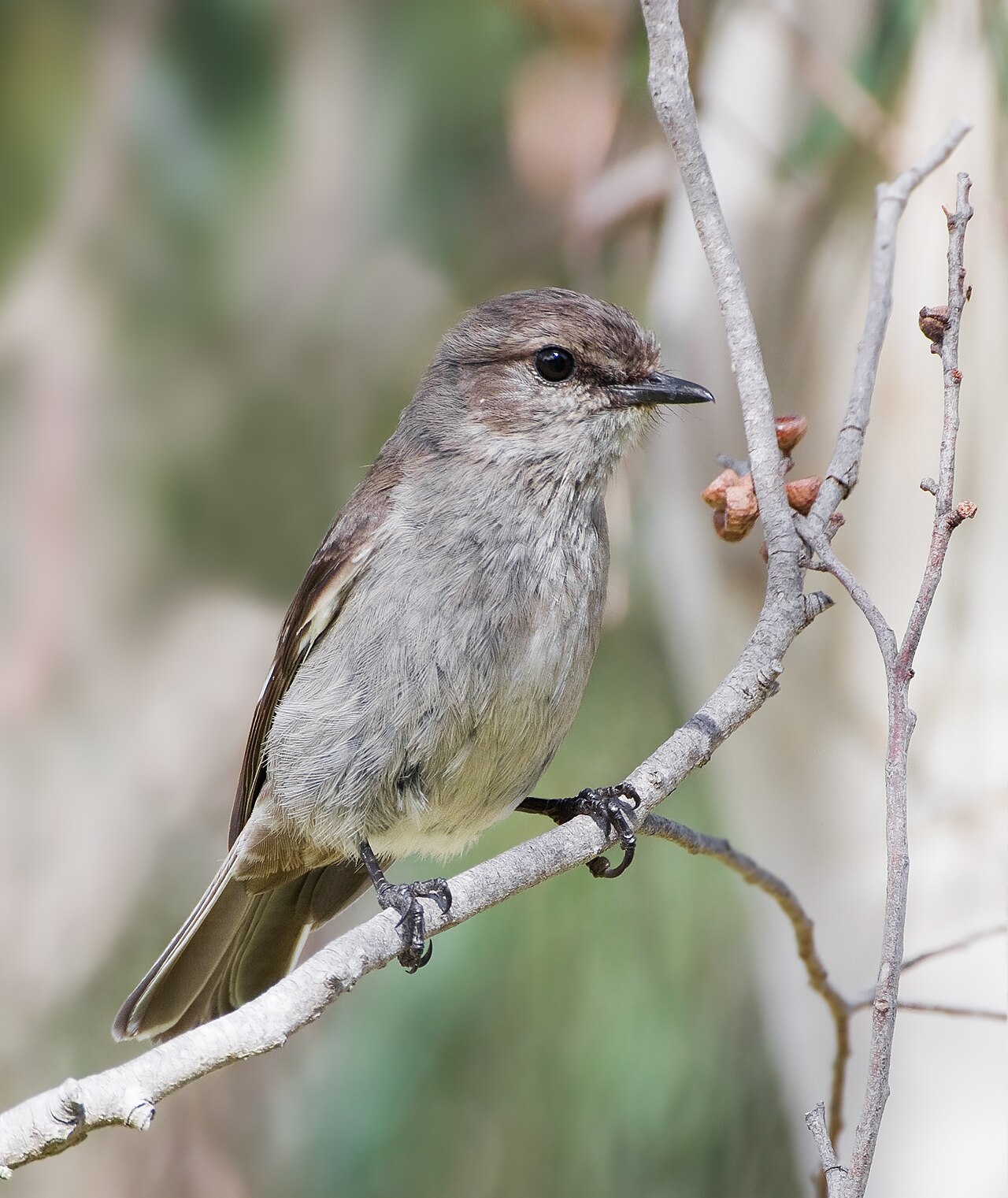
The Dusky Robin is the drab outsider of a brightly coloured family: a plain olive-brown bird of about fifteen centimetres that sits on a cut stump or a fence post and looks at the ground. It occurs on Tasmania and the Bass Strait islands and nowhere else on earth. Early settlers called it stump robin, sad robin and sleepy robin — three names that between them make a fairly complete portrait.
Voice
A far-carrying, mournful choo-wee, choo-we-er, low in pitch and without ornament, usually repeated three or four times. It is among the first sounds at daybreak and is heard all year, outside the breeding season as well. The bird sings little; what strikes the listener is mostly how little there is to hear. Beyond that, a short hard tick as contact and alarm note.
No freely licensed recording has been found for this species yet; what to listen for is described below.
Identification
A stocky bird of fourteen to seventeen centimetres, uniformly olive-brown on head, back and wing, with pale grey-brown underparts showing no pattern at all. The sharpest mark is the fine narrow white line along the leading edge of the wing and a white smudge at the bend of the wing; in flight the white sides and tip of the tail also show. A faint dark eye-stripe runs from behind the eye to the ear-coverts. Male and female cannot be told apart in the field. Juveniles are darker and heavily streaked cream, from crown to belly.
Confusion species
Within its own genus confusion is impossible: Melanodryas cucullata has a jet-black hood in the male and a bold pied pattern, and does not occur on Tasmania, while Melanodryas pulverulenta is a grey mangrove bird of the tropical north coast. The real difficulty is with females and immatures of the red Petroica species that live on Tasmania: Petroica boodang, Petroica phoenicea and Petroica rodinogaster. Those are smaller and slimmer and always show a clear, broad pale wing bar and usually a pale forehead spot; the Dusky Robin is larger, heavier, plainer, and has only that thin white line along the wing edge. Petroica macrocephala does not occur on Tasmania.
Habitat
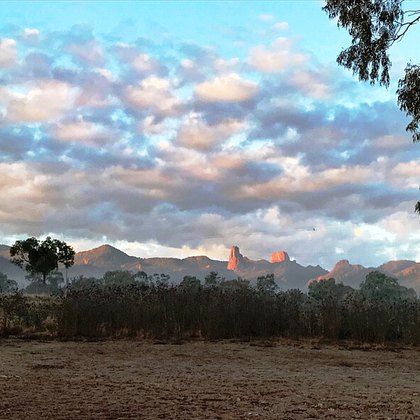
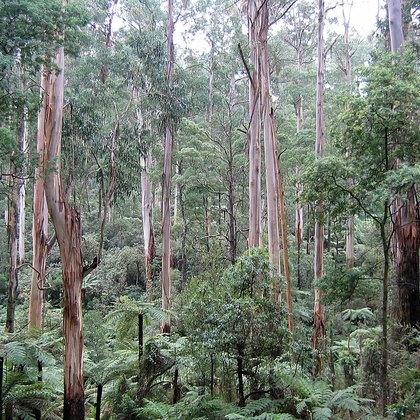
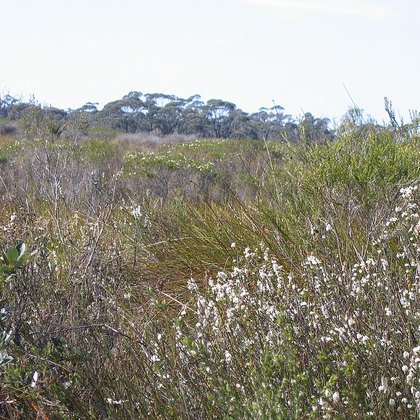
Open dry eucalypt forest and woodland from sea level to 1200 metres, with a preference for the transitions: forest edges, clearings, recently burnt ground and young regrowth. Territories lie where shrub cover remains. It is also found in wet eucalypt forest, in coastal heath and sedgeland and on the buttongrass plains, and it follows people into farmland with scattered dead trees, fence posts and stumps — exactly the lookout perches it needs.
Where the bird is most often found, arranged by main group and formation.

Range and movements
Endemic to Tasmania, where it is distributed across the whole island, plus the Bass Strait islands; King Island holds a separate subspecies. It has never been recorded on the Australian mainland. It is sedentary and moves hardly at all, though loose winter parties of six to twelve and occasionally twenty birds form, often with many juveniles among them.
- Resident
- dark = core range, pale = thinly spread
Where and when to look
Do not look for a bird in a tree, look for one on a post. Drive along a forest edge or a freshly cut coupe and check every stump, fence post and charred trunk at eye level: a brown, rounded bird sitting still and turning only its head is almost certainly this species. It allows a close approach. Wait until it drops to the ground and flies up again — then the white tail edge flashes, and that is the mark that separates it from the female red robins.
Conservation
Vulnerable (VU). The IUCN moved the species from Least Concern to Vulnerable in 2022, on the grounds of a continuing decline within a range no larger than Tasmania itself. The causes are the familiar ones for ground-foraging Australian woodland birds: loss and fragmentation of open forest, loss of the shrub layer to grazing, and predation by feral and roaming cats. For a bird that takes its food from bare ground and nests low in a stump, that last one counts heavily. On its island it is still widespread, and for now that is the main buffer.
Scientific name
Melanodryas vittata | (Quoy & Gaimard, 1832)
Quoy and Gaimard described the bird in 1832 as Muscicapa vittata, from a specimen they believed came from King George Sound in Western Australia; in fact it had been collected in Tasmania. Because the species later moved to another genus, authors and year stand in parentheses. vittata is Latin for 'banded', after the line along the wing. The genus Melanodryas is from Greek melas, 'black', and dryas, 'wood-nymph'. For a long time the species stood as Petroica vittata. Among early settlers it was the stump robin, after its habit of perching on stumps.