All species › Passerines › Australasian robins › Jacky Winter
Jacky Winter | Microeca fascinans
Lathams vliegenvanger | Petroica fascinante
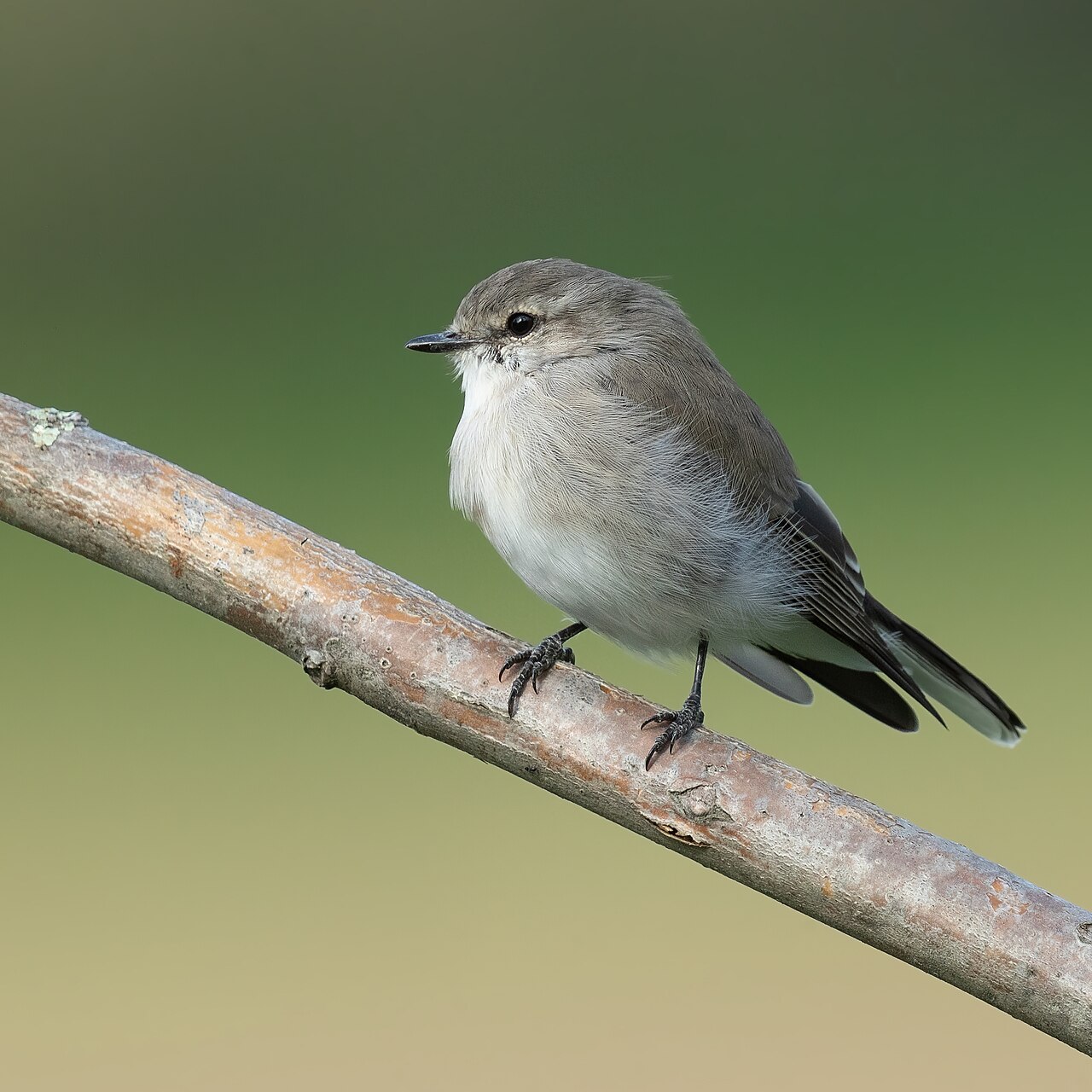
The Jacky Winter is the bird of the bare branch: small, grey-brown, upright, on a dead twig or a fence post in the middle of open woodland, with a tail that swings constantly from side to side. It occurs across almost the whole Australian mainland and is among the most familiar birds of farming country. Its English name is nothing but a rendering of its own call.
Voice
Clear and far-carrying: a rapid chwit-chwit-chwit-peter-peter-peter, of which that last part is so recognisable that the bird is also simply called 'peter peter' in Australia. It starts well before sunrise and usually falls silent around the middle of the day, sometimes starting again towards dusk. In the run-up to breeding the male sings most, including in slow, high song-flights; once the young hatch the song almost disappears.
No freely licensed recording has been found for this species yet; what to listen for is described below.
Identification
A small, slim flyrobin of twelve to fourteen centimetres with an upright stance and a fairly long tail. Grey-brown on head and back, slightly darker on the wing with pale feather edges, greyish on the breast and white on the belly, with a faint pale eye-line. The sharpest mark is the tail: blackish brown with conspicuous white outer feathers that flash at every landing and every sideways swing. Bill and legs are black. There are three Australian subspecies: the eastern nominate, the darker and greyer assimilis of South and south-western Australia, and the smaller, pale sandy pallida of the north and the inland. The sexes are alike.
Confusion species
The direct counterpart is Microeca flavigaster: smaller, shorter-tailed, with lemon yellow underparts and — decisively — no white in the tail. In the Kimberley that species' subspecies tormenti lacks the yellow, and then the tail is the only quick mark left. Beyond that, female and immature Petroica robins resemble it, but they always show a clear pale wing bar, which the Jacky Winter does not have. The female Melanodryas cucullata is considerably larger, greyer on the breast, and has broad white wing and tail panels rather than only white outer tail feathers.
Habitat
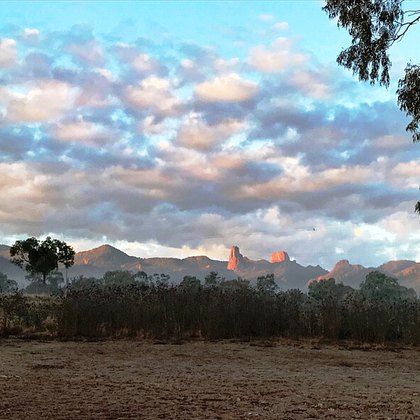
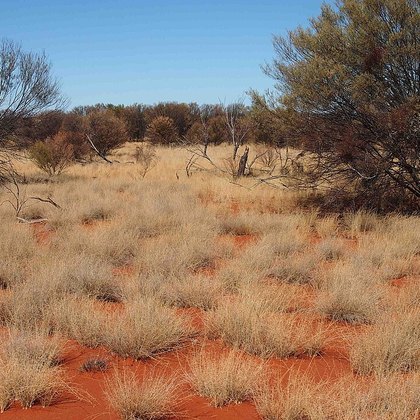
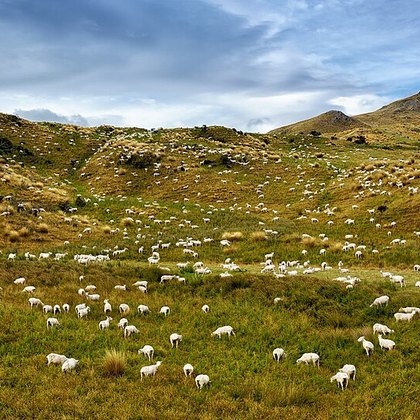
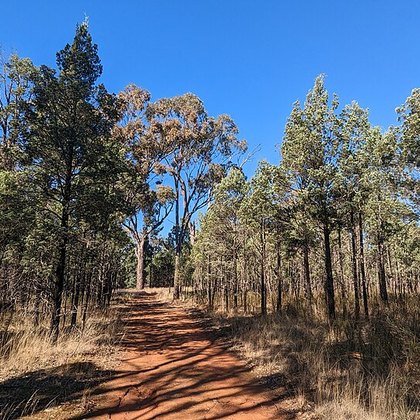
Open eucalypt woodland with a sparse shrub layer and much bare ground between — it needs both the lookout perch and the open landing place. Box woodland with scattered live trees, fallen trunks and stumps is the ideal. Also in mulga, in casuarina and callitris woodland, and in the man-made equivalent: farmland with scattered trees, fenced paddocks and spacious parks. It avoids dense undergrowth.
Where the bird is most often found, arranged by main group and formation.
Range and movements
Almost the whole Australian mainland, and in addition south-eastern New Guinea, where a subspecies of its own occurs. In the eastern states it breeds mainly west of the Great Dividing Range, where eucalypt woodland begins. It is largely sedentary and defends its territory year-round; locally it behaves as a seasonal visitor. A territory measures about 1.7 hectares.
- Resident
- dark = core range, pale = thinly spread
Where and when to look
Search along fences and dead branches at eye level, and watch the tail: no other small brown bird of Australian woodland swings its tail sideways so emphatically, and every swing shows the white outer edges. If you find one in the breeding season, look for the nest — a saucer of grass and bark bound with spider web and decorated on the outside with bark and lichen, on a bare horizontal fork. It is one of the smallest and best camouflaged nests in Australia and looks, from a few metres away, like a knot on the branch.
Conservation
Least Concern (LC), but declining. All three Australian subspecies are decreasing: the eastern form in New South Wales, Queensland and Victoria, assimilis in Western and South Australia, pallida in parts of Queensland, the Northern Territory and the Kimberley. The cause is the one shared by the whole guild of small insectivorous woodland birds: clearing for agriculture and housing, fragmentation of what remains, and the loss of that combination of bare ground, fallen timber and low lookout perches these birds live on. In the south the decline is clearest.
Scientific name
Microeca fascinans | (Latham, 1801)
John Latham described the species in 1801; because it was later moved to another genus, author and year stand in parentheses. fascinans is Latin for 'bewitching', from fascinare, 'to bewitch'. The genus Microeca is from Greek mikros, 'small', and oikos, 'house' — a reference to the nest, the smallest of any Australian bird. The Dutch name honours Latham himself. In Australia the bird carries a whole string of vernacular names: Jacky Winter and peter peter after the call, and also brown flycatcher, postboy, spinks and stumpbird.