All species › Passerines › Australasian robins › Lemon-bellied Flyrobin
Lemon-bellied Flyrobin | Microeca flavigaster
Citroenbuikvliegenvanger | Petroica limón
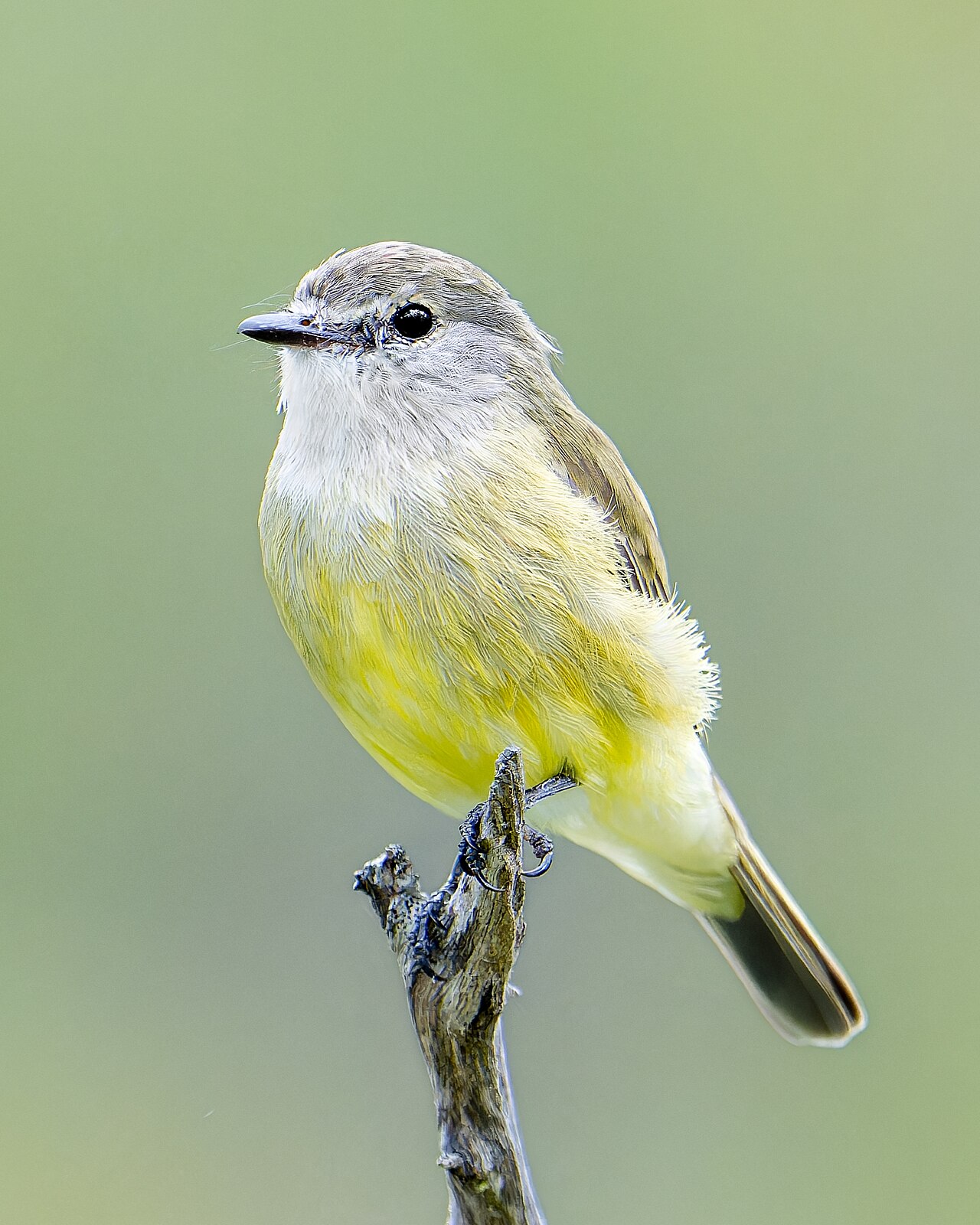
The Lemon-bellied Flyrobin is a small bird of barely twelve centimetres that sits at the top of a paperbark or a mangrove and calls from there without let-up. Grey above, lemon yellow below — except in the Kimberley, where the local form lacks the yellow entirely and is clean white. It belongs to the monsoon belt: where water stands in the landscape of northern Australia, this species is in the canopy above it.
Voice
One of the most vocal birds of the northern woodlands. From a high open branch it delivers clear whistled phrases almost continuously, repeating them in varying order. It starts early and keeps going longer than most species around it; anyone standing by a paperbark creek in the Top End at sunrise will almost certainly hear it before seeing it.
No freely licensed recording has been found for this species yet; what to listen for is described below.
Identification
A small, short-tailed flyrobin of about eleven and a half centimetres. The nominate form is olive-brown to grey on back and wing, with a grey face, a white eyebrow stripe, a white throat and lemon yellow underparts. The sexes look alike. Subspecies flavissima of Cape York and New Guinea is yellower, including on back and eyebrow, and shorter-tailed; laetissima of the central-northern Queensland coast resembles the nominate but is larger and shorter-billed; tormenti of the Kimberley lacks the yellow entirely, and is greyer, larger and longer in bill and tail. An important negative mark: no pale wing bar and no white in the tail.
Confusion species
The first test is Microeca fascinans, the only other Australian Microeca: it is larger and longer-winged, plain grey-brown without a trace of yellow, and has conspicuous white outer tail feathers that show the moment it lands — which the Lemon-bellied Flyrobin does not have. In the Kimberley this gets awkward, because subspecies tormenti is also yellowless there; then go by the tail and by the habitat. On Cape York the Yellow-legged Flyrobin (Kempiella griseoceps, formerly also placed in Microeca) occurs alongside it: that species keeps to closed rainforest and owes its name to its yellow legs. Golden Whistler is far larger and heavier-billed.
Habitat
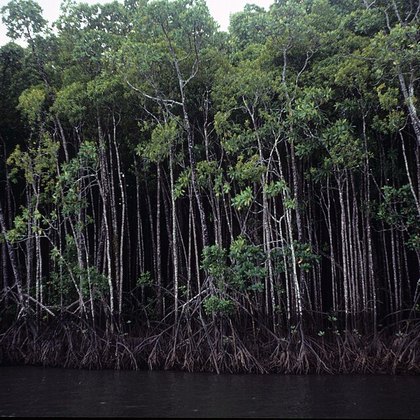
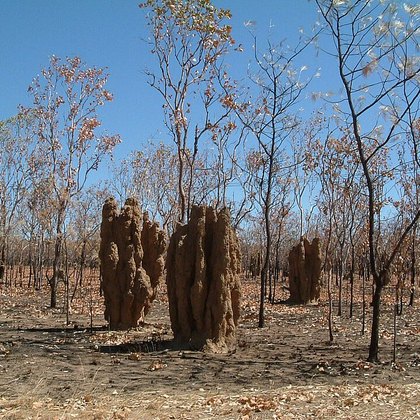
Mangrove, paperbark swamp forest and eucalypt savanna of the northern monsoon belt, plus the monsoon forests and vine thickets that lie as islands within that savanna. The connecting thread is water: floodplains, creek margins and tidal forest. It hunts in the foliage and on the dead branches of trees and shrubs and only rarely comes to the ground — fieldwork in Kakadu National Park showed that it takes its prey almost always on the wing or by sallying, from the air or from foliage.
Where the bird is most often found, arranged by main group and formation.


Range and movements
From the Ord River in the west along the whole north coast of Australia to the Queensland coast, with four subspecies replacing one another geographically: tormenti in the Kimberley, the nominate across the Top End, flavissima on Cape York and in New Guinea, and laetissima along the central-northern Queensland coast. The two Queensland forms are separated by the Atherton Tableland and the Burdekin-Lynd Divide. Beyond Australia the species also occurs in New Guinea and Indonesia. Hybrids between tormenti and the nominate have been found around Cambridge Gulf — the reason the Kimberley form, once treated as a separate species, now ranks as a subspecies.
- Resident
- dark = core range, pale = thinly spread
Where and when to look
Look up, not down. Unlike most robins this species likes to perch high and in the open, often on the outer dead branches of a paperbark or a mangrove. Find the sound first: an unbroken, clear whistled phrase from the top of a tree along a creek in northern Australia is nearly always this bird. Then watch the tail as it takes off; if it stays plain dark with no white, it is the Lemon-bellied Flyrobin and not the Jacky Winter.
Conservation
Least Concern (LC). The species is widespread across the entire northern monsoon belt and common in its usual habitats. It is, however, tied to mangrove, paperbark swamp and monsoon forest — precisely the three formations in northern Australia that suffer most from altered fire regimes, trampling by cattle and water buffalo, and water and agricultural development. A national assessment of that pressure on this species is lacking; what is known gives no cause for concern about the species as a whole for now.
Scientific name
Microeca flavigaster | Gould, 1843
John Gould described the species in 1843 from a specimen from Port Essington in the Northern Territory. flavigaster combines Latin flavus, 'yellow', with Greek gaster, 'belly' — the same idea as in the English name. The genus Microeca is from Greek mikros, 'small', and oikos, 'house', after the nest: species of this genus build the smallest nest of any Australian bird, a shallow saucer of bark and grass on a branch. Subspecies tormenti was long treated as a separate species, the Kimberley Flyrobin or Brown-tailed Flycatcher.