All species › Owls › Bay owls and barn owls › Eastern Grass Owl
Eastern Grass Owl | Tyto longimembris
Aziatische grasuil | Lechuza patilarga
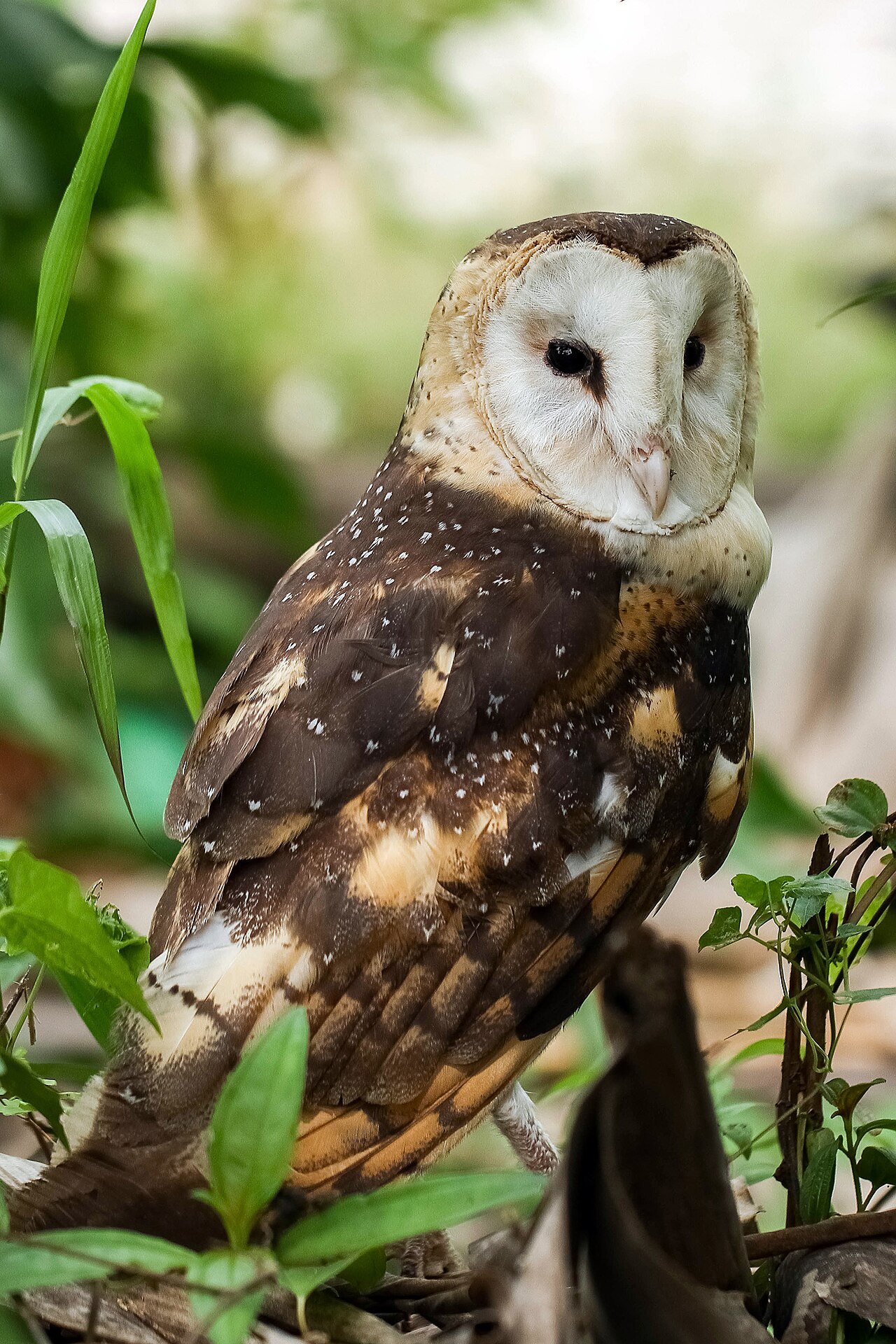
The Eastern Grass Owl is the one Australian owl that needs no tree: it roosts, hunts and breeds on the ground, in tall tussock grass and reedbed. The extremely long, thin legs that trail well beyond the tail in flight identify it at once, even in a headlight beam.
Voice
Most of the time it is wholly silent — as befits a bird that lives by concealment. Surprised, or defending the nest, it gives a harsh, raw rasping screech, shorter and shriller than the Australasian Masked Owl's. Around the nest and during display flights come soft high twittering and chirruping and a series of clicking notes; the young hiss steadily from the grass. Anyone hunting by ear rarely finds this species: here the eye does the work.
No freely licensed recording has been found for this species yet; what to listen for is described below.
Identification
A medium-sized barn owl with a heart-shaped face and small dark eyes set above a conspicuous black and buff 'tear' mark. The upperparts are dark chocolate brown with buff spotting and a silvery speckling; the underparts pale cream to white with fine dark dots. The male has a white facial disc, the female a pale orange-buff one with dark speckles. The decisive feature is at the bottom: the legs are extraordinarily long, thin and barely feathered, built to reach down through dense grass, and they hang far past the tail in flight. The wings are long and barred with silver spots. Flight is slow and wavering, low over the grass, with much hovering.
Confusion species
Eastern Barn Owl (Tyto javanica) causes the most trouble: about the same size, but golden brown and grey above rather than chocolate, pure white below, and with short legs that do not trail beyond the tail. It also hunts from posts and wires, while the Grass Owl nearly always hangs in the air over the grass. Australasian Masked Owl (Tyto novaehollandiae) is clearly heavier built, with thick legs feathered to the toes and massive talons, and belongs to forest, not open grassland. Greater Sooty Owl (Tyto tenebricosa) is dark sooty grey above and below and keeps to damp gully forest. Habitat settles most cases already: a barn owl flushed from tall tussock grass is this one.
Habitat
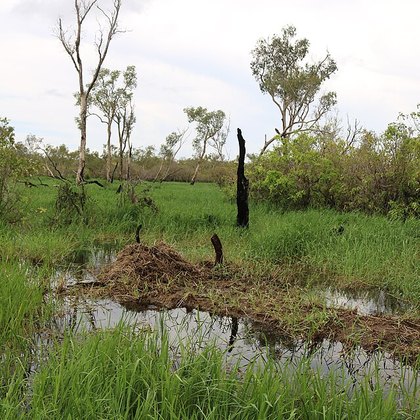
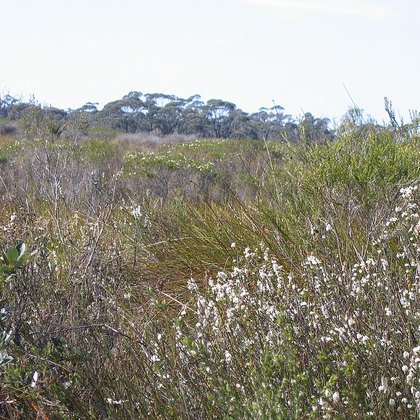
Tall tussock grassland and reed swamp, coastal heath, lignum flats and boggy hollows, and beyond that farmland that offers the same picture — sugar cane, sorghum and fallow rice. By day it presses itself into a 'form', a trampled cup in a dense tussock, with a net of tunnels through the grass around it; the nest lies the same way under a clump of grass or sedge. Without tall, unburnt grass it leaves a site within a season.
Where the bird is most often found, arranged by main group and formation.


Range and movements
Within Australia two separate cores: an eastern one along the floodplains of the large rivers, from Cape York south to the Manning River in New South Wales, and an inland one in the Mitchell grass of the Barkly Tableland and the Channel Country. Between them it appears irregularly, because it moves with the rain: after wet years and the rodent plagues that follow, dozens can suddenly occupy a plain where the species had been absent for years, only to vanish again. It does not occur in New Zealand. Beyond the map window the range runs on through New Guinea, New Caledonia, Fiji and much of southern and eastern Asia.
- Resident
- dark = core range, pale = thinly spread
Where and when to look
Drive a levee or a road through reedland or cane in the last minutes of dusk and watch for a pale owl hanging and hovering low over the grass; the dangling long legs close the identification there and then. Go to the coastal plains of Queensland in wet years, or inland to the Mitchell grass after a good wet season. Do not walk through the grass to flush it: roosts and nests are on the ground and are easily trampled.
Conservation
Not threatened globally (LC), since the range runs deep into Asia, but the Australian picture is less comfortable: in New South Wales the species is listed as vulnerable. The bottleneck is the grassland itself. Burning too often or at the wrong time, grazing that keeps the tussocks short, and the conversion of floodplains to cropland take away the cover on which everything here depends — roosting, breeding and hiding the young. Because it nests on the ground, foxes, feral cats and pigs are a direct threat to nests as well, and because numbers rise and fall with the rain a decline is hard to see.
Scientific name
Tyto longimembris | (Jerdon, 1839)
Jerdon described the species in 1839 as Strix longimembris, with the Nilgiri Hills near Coonoor in southern India as the type locality; because it later moved to Tyto, author and year stand in parentheses. The epithet combines longus, long, and membrum, limb: 'long-limbed', exactly the feature that identifies it — the Spanish name lechuza patilarga says the same. The Dutch name aziatische grasuil points to the Asian type locality and to the grassland it lives in. The genus Tyto was introduced by Billberg in 1828, from the Greek tuto, 'night owl'.