All species › Owls › Bay owls and barn owls › Australasian Masked Owl
Australasian Masked Owl | Tyto novaehollandiae
Australische kerkuil | Lechuza australiana
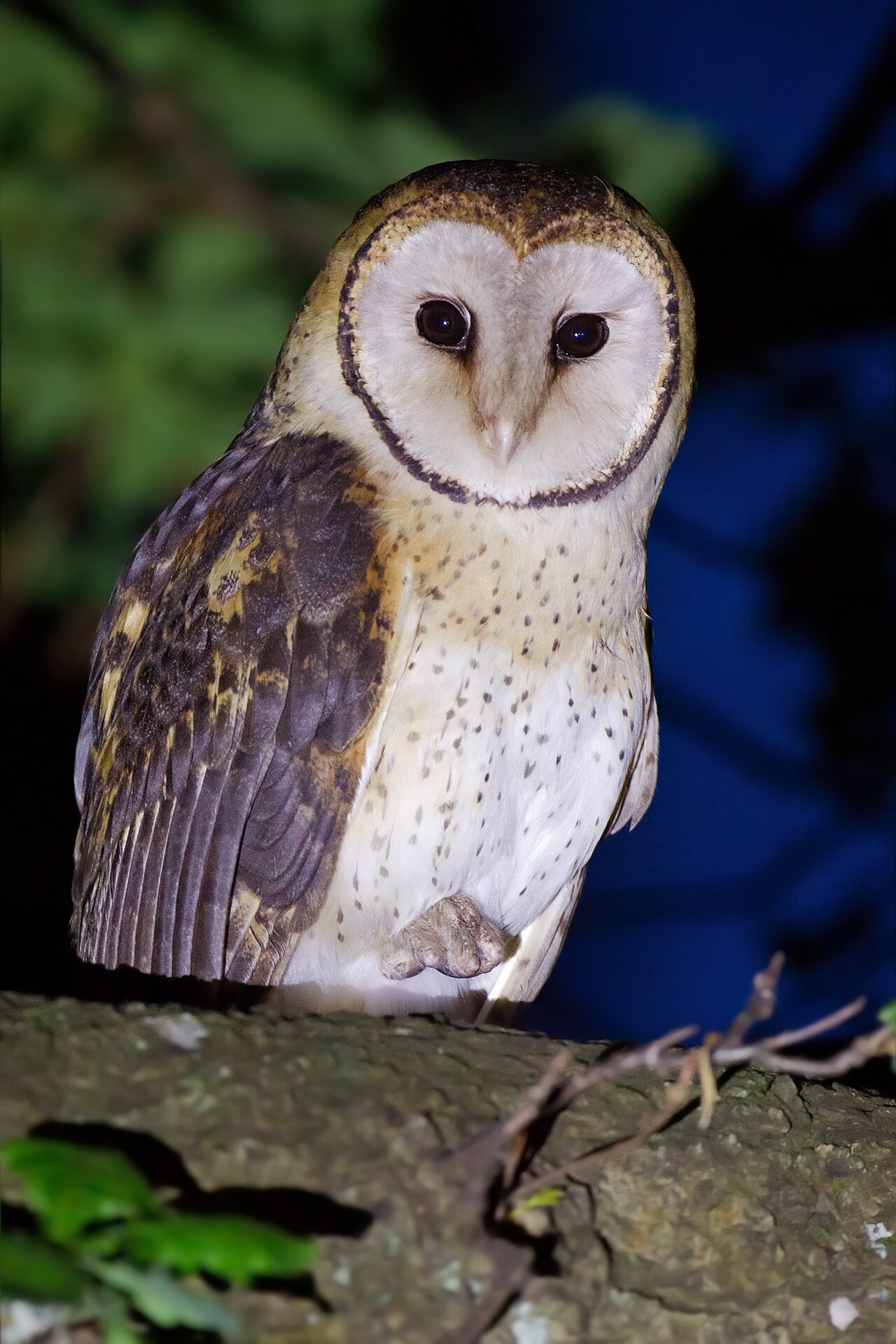
The Australasian Masked Owl is the largest of all barn owls and, after the Powerful Owl, the heaviest night bird in Australia. The heart-shaped mask, dark eyes and powerful legs feathered to the toes sit a long way from the picture most people carry of a barn owl: this is a solid forest owl that can take rabbits and bandicoots.
Voice
The call is a deep, raw rasping screech lasting a few seconds and breaking off sharply — fuller, lower and more menacing than the thin shriek of the Eastern Barn Owl, and at close range frankly unpleasant. There are also series of short dry clicks, a drawn-out hiss at the nest, and a sustained grating whine from begging young. The pair calls mostly in the first hours of the night and in the weeks before breeding; outside that period the species is remarkably silent, which makes it hard to find.
No freely licensed recording has been found for this species yet; what to listen for is described below.
Identification
A heavy, broad-winged owl with a large, clearly rimmed heart-shaped mask and dark brown eyes. The plumage varies widely and is usually split into three forms — pale, intermediate and dark. The upperparts run from blackish brown to grey-white with grey and white spotting; the underparts from rufous to white, always with fine dark brown speckling. The female is clearly larger and darker than the male. The legs are heavy, feathered to the toes, and the talons are massive; that is the best separation from every other barn owl in the region. Freshly fledged young are white to cream. The Tasmanian subspecies castanops is the largest and darkest of all.
Confusion species
Eastern Barn Owl (Tyto javanica) is the hardest call: smaller (28–39 cm), far lighter in build, golden brown and grey above and usually pure white below, with thin legs feathered only halfway. A barn owl in open country is nearly always that one; a barn owl in forest with heavy feathered legs is this one. Eastern Grass Owl (Tyto longimembris) is darker chocolate brown above, has extremely long, thin, barely feathered legs that trail well beyond the tail in flight, and keeps strictly to tall grassland — never forest. Greater Sooty Owl (Tyto tenebricosa) is dark sooty grey above and below with silver speckling, has an even larger and rounder mask, and stays in damp gully forest.
Habitat
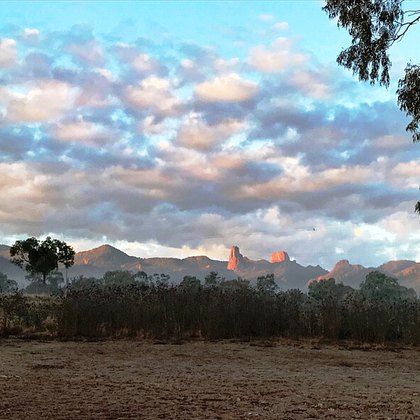
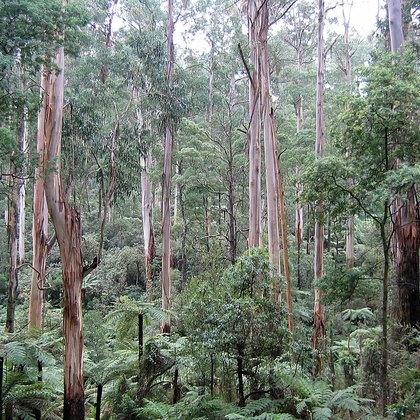
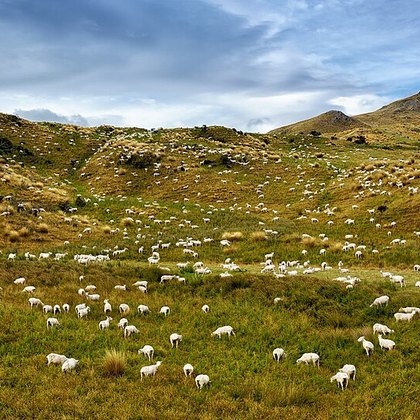
Forest and woodland with tall trees, timbered watercourses and the open fringes around them: it breeds and roosts in a large tree hollow and hunts over adjoining open ground, pasture or cleared land. Rock cavities and caves serve as roosts too, especially in the dry inland. The combination is what counts — big hollows on one side and open hunting ground on the other; where either is missing, so is the owl.
Where the bird is most often found, arranged by main group and formation.

Range and movements
A broad coastal band around nearly the whole Australian mainland, for the most part within three hundred kilometres of the sea, plus all of Tasmania, where the species is most numerous. On the mainland it is thinly spread everywhere and seldom seen. The northern subspecies kimberli occupies the Kimberley, the Northern Territory and Cape York. Beyond Australia the species continues into southern New Guinea. On Lord Howe Island it is not native: Tasmanian Masked Owls were released there in the 1920s against the rats, and their descendants have been a problem ever since. It does not occur in New Zealand.
- Resident
- dark = core range, pale = thinly spread
Where and when to look
Work the line where forest meets pasture, and drive slowly at night with the headlights on the verges: the owl hunts from a low post or branch and searches the grass edge in the first hours after dark. Tasmania gives the best chance, above all in dry eucalypt forest in the north and east of the island. Do not rely on voice — the species calls little — but search by day under big hollow-bearing trees for large pellets holding rabbit and bandicoot bones.
Conservation
Not threatened globally (LC), but that does not hold for Australia itself: mainland populations are declining and the species is listed as threatened in Victoria and New South Wales, while the Tasmanian subspecies castanops and the northern kimberli both carry national protection. The loss of big hollow-bearing trees to logging and too-frequent fire is the heart of the matter, since an owl this size needs a hollow of exceptional size. Beyond that count the loss of bandicoots and other medium-sized ground mammals, and secondary poisoning by rodenticides in farmland. On Lord Howe the roles are reversed: there the released owl has itself become the problem, for native seabirds and the Lord Howe Woodhen.
Scientific name
Tyto novaehollandiae | (Stephens, 1826)
Stephens described the species in 1826 as Strix (?) Novae Hollandiae — the question mark over the genus stands in the protonym itself — and because it later moved to Tyto, author and year stand in parentheses. The epithet means 'of New Holland', the old name for Australia; the type locality is read as New South Wales. The genus Tyto was introduced by Billberg in 1828, from the Greek tuto, 'night owl'. The English name Masked Owl refers to the sharply rimmed facial mask.