All species › Owls › Bay owls and barn owls › Sooty Owl
Sooty Owl | Tyto tenebricosa
Zwarte kerkuil | Lechuza tenebrosa
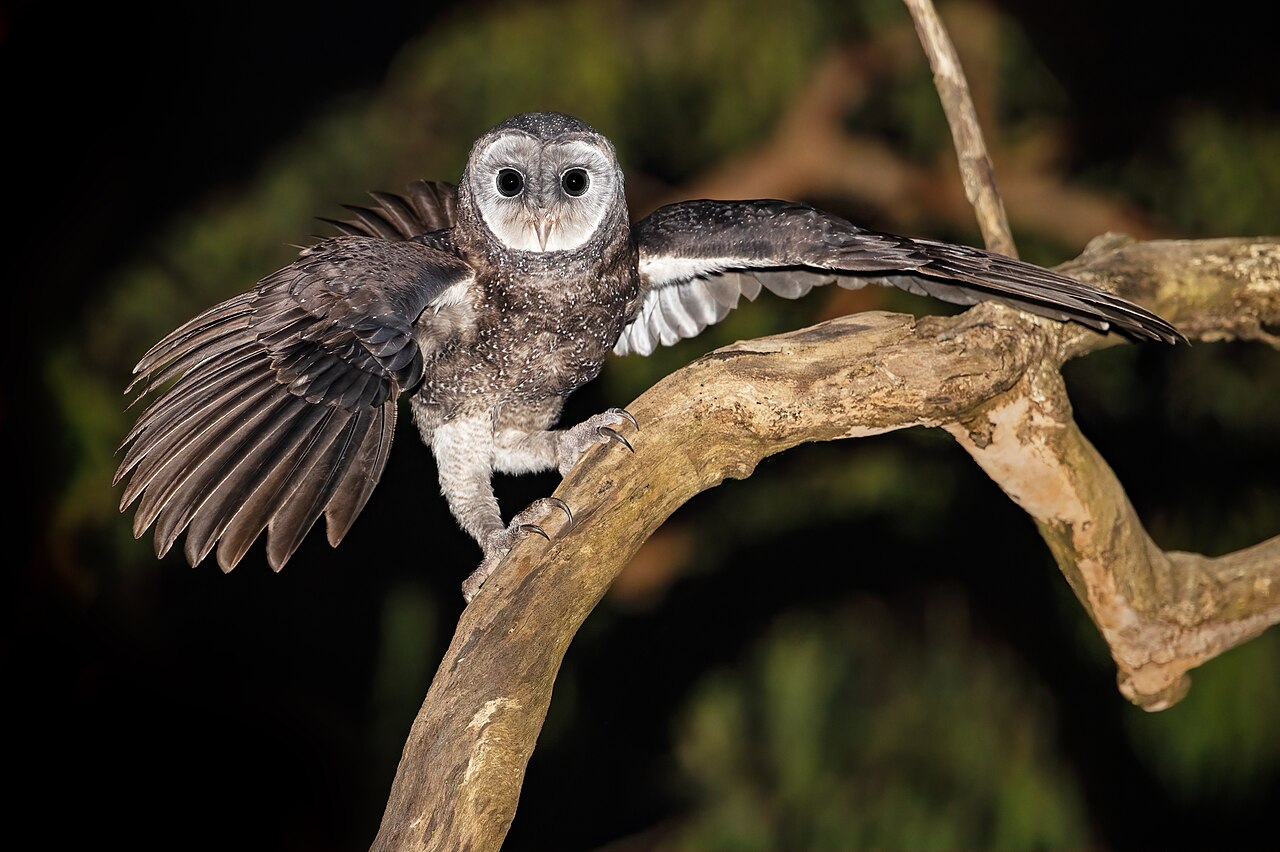
The Sooty Owl is the darkest owl in Australia: sooty black to slate grey, finely spotted with white, with huge black eyes in a heavily rimmed heart-shaped mask. It keeps to the wet gullies of the southeast and hunts arboreal marsupials there. Anyone who finds it usually finds it by ear.
Voice
The best known sound is a piercing shriek lasting up to two seconds that cuts the length of a gully. There is also a long whistle sliding slowly down in pitch, known for that reason as the falling bomb: tsheeeeew. At the nest and between partners comes a fast, insect-like twitter that at any distance no longer reads as an owl at all. All of it comes after full dark and almost always from the depth of a gully, seldom from an open ridge.
No freely licensed recording has been found for this species yet; what to listen for is described below.
Identification
A squat barn owl with a large round head, a strikingly short tail and heavy, densely feathered legs with big talons. The plumage is sooty black to dark slate grey with fine white spots on crown, mantle and wing coverts, the underparts a shade paler and more closely spotted. The facial disc is silver-grey to sooty black, darkening with age, and carries a heavy black rim around very large dark eyes. The female is paler than the male and at 41 to 50 centimetres and three quarters to well over a kilo much the larger and heavier bird; the male measures 37 to 43 centimetres and weighs half to seven hundred grams. Young birds fledge in a plumage already close to that of the adults, with little down left.
Confusion species
Australasian Masked Owl (Tyto novaehollandiae) lives in the same forest but is brown to buff above and pale below, with a longer tail; an owl dark above and below is not this one. Eastern Barn Owl (Tyto javanica) is pale golden brown with a white mask and belongs in open country, not gully forest. Powerful Owl (Ninox strenua) hunts the same marsupials in the same forest, but has yellow eyes, no facial disc and coarse V-shaped markings below. The smaller, more closely spotted birds of northeastern Queensland are treated as a separate species on some lists; AviList v2025b does not, and neither does this guide.
Habitat
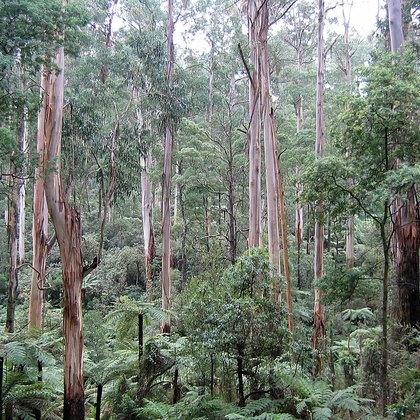
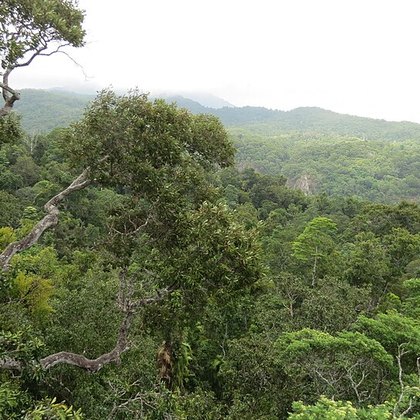
Tall, moist eucalypt forest with deep gullies, tree ferns and smooth-barked gums, and the rainforest margins that abut them. By day it roosts in a large hollow, in a curtain of vines or in a cave or under an overhanging rock face; those shelters set where it occurs as firmly as the hunting ground does. Dry open forest and treeless country go unused, and where gullies dry out it disappears.
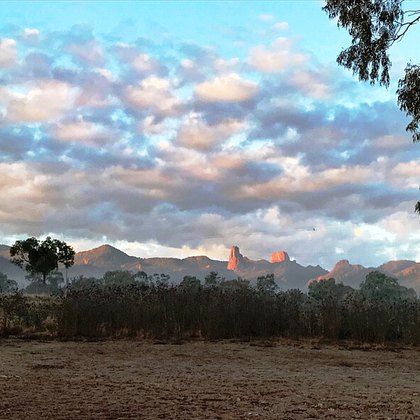
Where the bird is most often found, arranged by main group and formation.

Range and movements
Confined to the coast and ranges of southeastern Australia, from the Sunshine Coast in Queensland south to eastern Victoria, and beyond that in the montane forests of New Guinea. It is sedentary and moves little; young birds wander over short distances. The range has become fragmented over the past century as old forest with large hollows was logged, leaving more and more empty forest between the occupied gullies.
- Resident
- dark = core range, pale = thinly spread
Where and when to look
Stand in a wet gully with tree ferns well after dark and wait for the shriek; by day the species is all but unfindable. A fresh pellet with the bones of a ringtail possum under a smooth-barked gum points to a regular roost more reliably than a single sighting does. Do not play recordings in the breeding season.
Conservation
Not threatened (LC) on the world list, with a large but thinly occupied range. The heaviest constraint is the loss of old forest with large nest hollows, because without a hollow it does not breed; with the large arboreal marsupials its food goes as well. Severe fires strike precisely the wet gullies it occupies, and after a fire it takes decades before there are hollows again.
Scientific name
Tyto tenebricosa | (Gould, 1845)
Gould described the species in 1845 as Strix tenebricosus; because it was later moved to another genus, author and year stand in parentheses. The genus Tyto was introduced by Billberg in 1828 and is the Greek word for owl. The epithet tenebricosa means 'full of darkness', after the sooty plumage. The type locality is the brushes — the dense gully forests — of the Clarence River in New South Wales. Because AviList v2025b does not list the birds of northeastern Queensland separately, the English name here is Sooty Owl and not Greater Sooty Owl.