All species › Passerines › Swallows › Fairy Martin
Fairy Martin | Petrochelidon ariel
Feezwaluw | Golondrina ariel
The Fairy Martin is the smallest swallow in Australia and the only one with a wholly chestnut head and a clean white rump. It is known above all for its nest: a closed bottle-shaped globe of thousands of mud pellets with a downward-pointing tunnel as entrance, built in colonies of tens to hundreds against the underside of a bridge, a culvert or an overhanging rock face. Where such a colony sits, the air hisses with small fast swallows shooting in and out of the spouts.

Voice
A dry, short, slightly hoarse tschrrp or prrt, higher and sharper than the Tree Martin's rattle and repeated continuously in flight. At the colony this runs up into a loud, unbroken, excited chatter from dozens of birds at once, audible from tens of metres away and the first thing to strike one at a bridge over a dry creek. The song is a soft bubbling, somewhat creaky twitter, given at the nest spout. The alarm is a high short tschik, at which the whole colony goes up as one swarm and circles above the bridge until the danger has gone.
Recording: James Lambert — CC BY-NC-SA 4.0 · Aspley, Brisbane City, Queensland, Australia · xeno-canto
Identification
A very small, stocky swallow of eleven to twelve centimetres with broad triangular wings and a short square-cut tail without any fork — in flight it looks almost bat-like as a result. Crown, forehead and nape are plain chestnut to cinnamon, with fine white streaks on the nape; the back is glossy blue-black. The rump is clean white and sharply bounded and forms in flight a striking pale panel between the dark back and the black tail. The underside is white to dirty white, without breast band and without streaking; the wings are grey-brown below. Male and female are alike. Young birds have a duller, more brown-grey head on which the chestnut hardly shows, and are then easily taken for Tree Martins.
Confusion species
Tree Martin (Petrochelidon nigricans) is the constant companion and the only real trap: it has a blue-black crown with at most a small rusty forehead patch, and a dull off-white rump with an ill-defined edge, whereas the Fairy Martin has a wholly chestnut head and a clean white, sharply cut rump. The Tree Martin is besides larger and heavier. Welcome Swallow (Hirundo neoxena) has a dark rump and a deeply forked tail with white spots. Eastern Red-rumped Swallow (Cecropis daurica) also shows a pale rump, but rusty rather than white, and the bird is half as large again and has long tail streamers. Fork-tailed Swift (Apus pacificus) has a white rump but is far larger and sickle-winged. For young birds: the nape streaking and the short straight tail remain usable even then.
Habitat
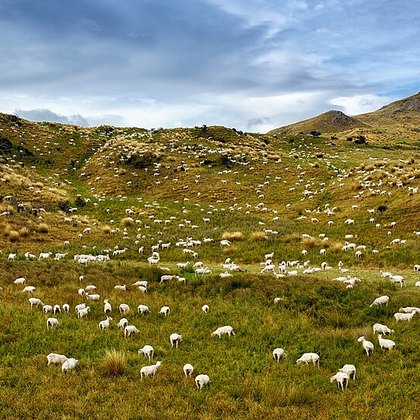
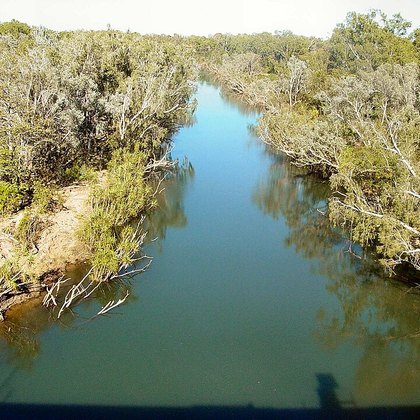
Open country with a vertical face to build against and mud nearby: pasture and grazing land, the banks of creeks and rivers with steep loam walls, rock faces and scree in the interior, and above all human structures — bridges, culverts, water tanks, weirs, abandoned buildings — which in the dry interior have taken the place of natural cliffs. Pools, dams and reservoirs supply both the mud and the insects. The species avoids closed forest and enters deep desert country only along watercourses. The availability of suitable colony sites governs where it sits more than anything else.
Where the bird is most often found, arranged by main group and formation.


Range and movements
Mainland Australia from the west coast to the east, excepting the south-western deserts; in Tasmania it is no more than a rare visitor. The pattern is that of a migrant within the continent: the southern birds leave the breeding grounds in autumn and winter in northern Australia, where the species then gathers in large flocks, and some reach New Guinea. In the north it can therefore be seen all year, in the south only from August to March. The distribution is strikingly tied to the road network, because every culvert and every bridge is a possible colony site; the species is thereby one of the clearest examples of an Australian bird that has gained range through human building. To New Zealand it comes only by rare exception.
- Resident
- Breeding (summer)
- dark = core range, pale = thinly spread
Where and when to look
Look for the nests, not the bird. Drive the bridges and culverts of the interior and look underneath: the bottle-shaped mud globes with their downward spout are unmistakable and betray the species outside the breeding season too, for the nests stand for years. At an occupied colony identification is trivial and the main thing is not to come too close, for the birds then stay off the nests for long periods. In a mixed flock overhead: pick out the smallest birds with the whitest rump, and judge the head only when a bird catches the light on its crown in a turn.
Conservation
Least Concern (LC), and probably increased in numbers and range since the building of the Australian road and rail network, which has supplied culverts and bridges in abundance where the landscape itself offered no cliffs. Against that, the same dependence on structures makes the species sensitive to maintenance work: hosing off or removing nests under bridges during the breeding season costs whole colonies, and that happens regularly without anyone looking. In the longer run the availability of mud also counts, which fails in sustained drought and forces the birds to postpone building. There is no national decline and no special protection applies; well-timed bridge inspection is the only measure that really matters.
Scientific name
Petrochelidon ariel | (Gould, 1842)
Gould described the bird in 1842 as Collocalia ariel, from material from New South Wales; he thus first placed it with the swiftlets, and because the species now sits elsewhere, author and date are bracketed. The epithet ariel comes from Ariel, the spirit of the air in Shakespeare's play, and refers to the light agile flight — a name followed directly in the English Fairy Martin and the Dutch feezwaluw, while the Spanish golondrina ariel takes the Latin over untranslated. The genus Petrochelidon was introduced by Cabanis in 1850 from Greek petros, 'rock', and chelidon, 'swallow'; for this species the name fits better than for its relative, for the natural colony site is indeed an overhanging rock.