All species › Passerines › Swallows › Tahiti Swallow
Tahiti Swallow | Hirundo tahitica
Tahitizwaluw | Golondrina de Tahití
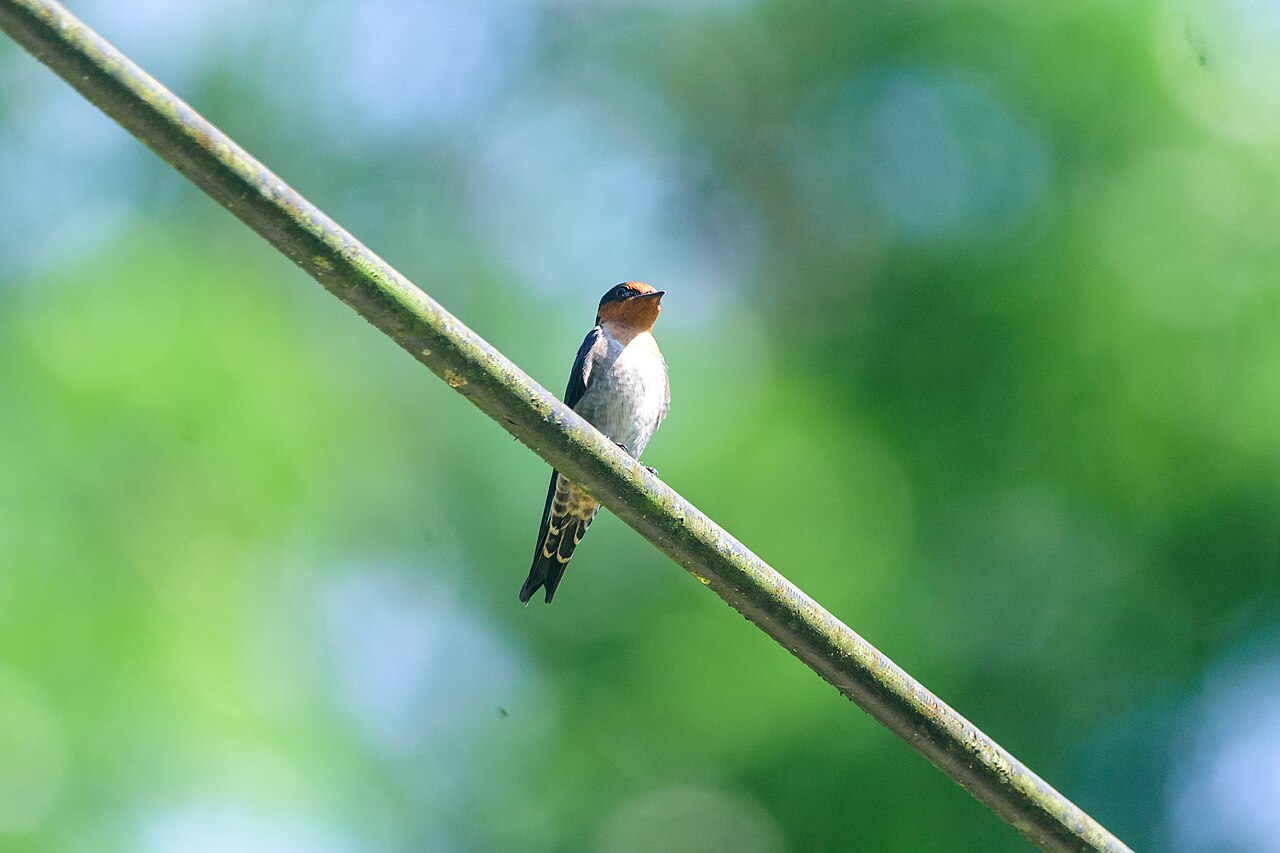
The Tahiti Swallow is a small short-tailed swallow of the Pacific islands, carried for Australasia only as a vagrant. It resembles a stocky Barn Swallow without the long streamers and without the closed breast band: steel-blue above, rusty on forehead and throat, and with greyish rather than white underparts. A taxonomic cloud hangs about it, for the name Hirundo tahitica has over time been applied to a whole series of island forms and has since been sharply narrowed.
Voice
A short dry two- or three-syllable chirp, tswit or chee-wit, repeated in flight and lower and flatter in tone than the Welcome Swallow's. About the nest site comes a soft sustained twitter with little structure, barely recognisable as song; this species lacks the long cheerful rattling strophe the Barn Swallow gives. At disturbance follows a sharp cheep. For Australasia this is of little practical value: a vagrant is usually silent, and the voice of the Pacific swallows cannot reliably be separated from the Welcome Swallow's.
Recording: David Darrell-Lambert — CC BY-NC-SA 4.0 · Red Boardwalk Bridge (near Tambon Phanthai Norasing), Mueang Samut Sakhon District, Samut Sakhon, Thailand · xeno-canto
Identification
A stocky swallow of about thirteen centimetres, with a relatively short tail that is forked but carries no elongated outer feathers — the silhouette is therefore blunter than the Barn Swallow's. The upperside is glossy steel-blue, forehead and throat are dull rusty red, less bright and less sharply bounded than in its relatives. The underside is grey to grey-brown and not white; only the upper breast may be a shade paler. A closed dark breast band is absent, though there is often a vague dark border below the rusty throat. The spread tail shows a row of white spots on the inner webs. The rump is dark, with no pale panel. Male and female are alike; young birds are duller and buffish on the throat.
Confusion species
Welcome Swallow (Hirundo neoxena) is what any claim in this region will most likely prove to be, and was moreover long treated as a form of the Tahiti Swallow: it is longer-tailed, with clearly elongated outer feathers, and brighter rusty on forehead and throat. A swallow with short tail points in Australia may simply be a young or moulting Welcome Swallow, which makes this distinction unusable in practice without good photographs. Barn Swallow (Hirundo rustica) has a full blue-black breast band and a white belly. Tree Martin (Petrochelidon nigricans) has a pale rump and a near-square tail. Note as well that the name is itself a trap: Hirundo tahitica is now restricted to the birds of Tahiti and Moorea, while the Pacific swallows of South-East Asia and New Guinea are carried as Hirundo javanica; older Australian reports of 'Pacific Swallow' as a rule refer to the latter.
Habitat
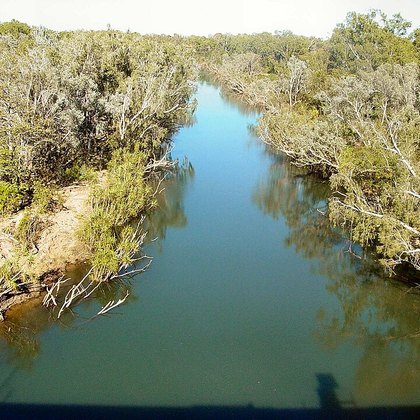
Coastal country and island interior with open air over water: rocky shores and sea cliffs, sandy beaches and dunes, creeks and rivers in the valleys, and in good measure villages and towns, where the species builds an open half-cup mud nest under eaves, on verandas, beneath bridges and in culverts. Unlike most swallows it keeps as a rule close to the coast and to fresh water and avoids high open country. In Australasia the question of habitat has little content: a vagrant hangs where the insects hang, usually over a lagoon, a creek mouth or a coastal village.
Where the bird is most often found, arranged by main group and formation.



Range and movements
In the current narrow sense the species is confined to Tahiti and Moorea in the Society Islands, in eastern Polynesia, where it is resident and does not migrate. In the broad sense, current until well into the twenty-first century, Hirundo tahitica also took in the Pacific swallows of South-East Asia, New Guinea and the Melanesian islands, and on a wider reading the Welcome Swallow of Australia and New Zealand as well. In Australasia the species has been reported as a vagrant; which form lies behind those records cannot be established with certainty.
- Non-breeding visitor
- dark = core range, pale = thinly spread
Where and when to look
Accept no short-tailed swallow in Australia or New Zealand as this species until you hold a series of sharp photographs of tail, rump, throat and underparts, preferably of a perched bird on a wire or fence. The grey underside is the most usable field character, but grey is easily feigned against the light and by dust and wear, so judge it only in good side light and at close range. Watch too the shape of the tail points: rounded and short, not thin and drawn out. Report the bird as a swallow of the Pacific group while the form is not settled; that is more honest than a name the taxonomy will not carry.
Conservation
The IUCN lists the species as Least Concern (LC). On Tahiti and Moorea the bird is numerous and benefits from building, which supplies nest sites where naturally cliffs and caves were chiefly available; there it counts as one of the few native land birds doing well alongside introduced species and introduced predators. Even so, for any land bird with so small a range the lowest concern category leaves little margin: a new disease, a new rat or a storm can bring an island population down in short order. For Australia and New Zealand there is no management task, for the species carries no population there.
Scientific name
Hirundo tahitica | Gmelin, 1789
Gmelin described the bird in 1789 as Hirundo tahitica, from Tahitian material, and that name has never changed; author and date therefore stand unbracketed. Hirundo is the Latin word for swallow, and the epithet tahitica refers to the island the type came from — hence also the English Tahiti Swallow and the Dutch tahitizwaluw, both following the recent narrowing of the species. The Spanish golondrina de Tahití does the same. The older English name Pacific Swallow, and the broader concept that went with it, has since moved to Hirundo javanica; anyone reading older literature must therefore be alert that the same scientific name there denotes a far larger group of birds than it does now.