All species › Passerines › Swallows › Barn Swallow
Barn Swallow | Hirundo rustica
Boerenzwaluw | Golondrina tijereta
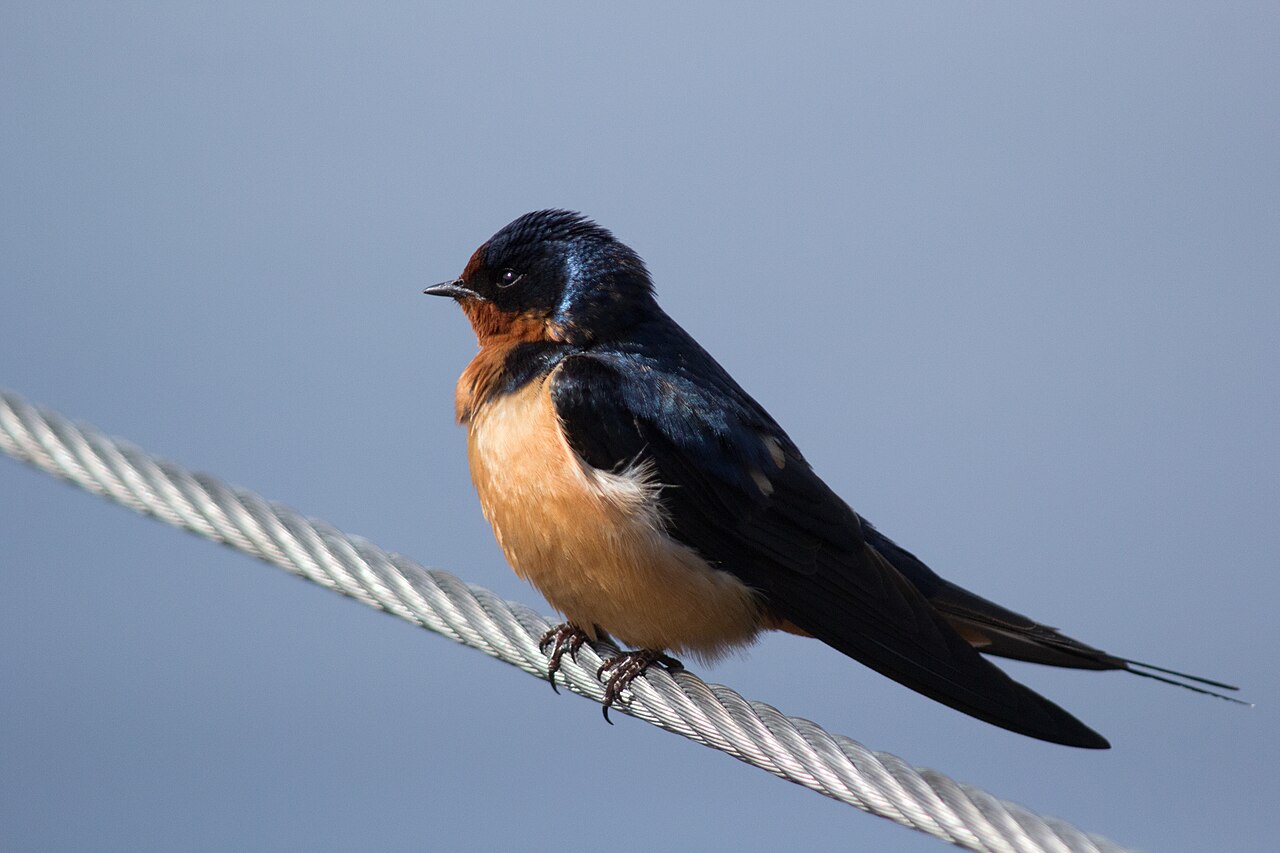
The Barn Swallow is the same species that breeds at every barn door in Europe, and in Australia and New Zealand it is precisely not a common bird: here it is a visitor from Asia, moving south during the northern winter and reaching the tropical north coast of Australia in small numbers. Among the region's resident swallows it stands out by its full dark breast band, its sharply cut rusty throat and its very long thin tail streamers. Whoever finds one here is looking at a migrant at the far end of its journey.
Voice
A busy, clear two-syllable chirp, vit-vit, rapidly repeated and heard most when a flock lifts or circles. At danger — a falcon, a cat, a snake at a nest — follows a sharp penetrating alarm, siflitt, which puts the whole flock up at once. The song is a long sustained cheerful twitter with, set in it, a characteristic dry drawn-out rattling churr, given from a wire or in flight; in the Australian winter half-year passage birds rarely sing in full, so here it almost always stays at the contact chirp. That sound cannot reliably be separated from the Welcome Swallow's, and identification on voice alone is unwise in this region.
No freely licensed recording has been found for this species yet; what to listen for is described below.
Identification
A slender swallow of fifteen to nineteen centimetres, of which in adults a good part is tail streamer. The upperside is glossy steel-blue, forehead and throat are deep rusty red, and below them lies the decisive character: a full, closed blue-black band across the upper breast. The rest of the underside is white to buff — in the Asian birds that reach Australia, of the form gutturalis, usually clean white with a narrower band, sometimes broken in the middle. The tail is deeply forked, with thin outer feathers projecting far in old males, and carries when spread a row of white spots across the inner webs; that row shows well from below in flight. The rump is blue-black, not pale. Young birds have a dull buff throat, a vague breast band and short streamers, and are by far the hardest.
Confusion species
Welcome Swallow (Hirundo neoxena) is what nearly every claim in this region turns out to be: it also has rust on forehead and throat and a deeply forked tail with white spots, but it lacks the dark breast band entirely, has greyish rather than white underparts and shorter streamers. The breast band is the only character on which a record may rest. Eastern Red-rumped Swallow (Cecropis daurica) has a rusty rump, no breast band and no white tail spots. Tree Martin (Petrochelidon nigricans) and Fairy Martin (Petrochelidon ariel) both have a pale rump and a short square-ended tail. Young Welcome Swallows with a dirty dark-mottled upper breast are regularly taken for Barn Swallows; in those birds the band lacks a sharp continuous edge, and the underside stays grey rather than white.
Habitat
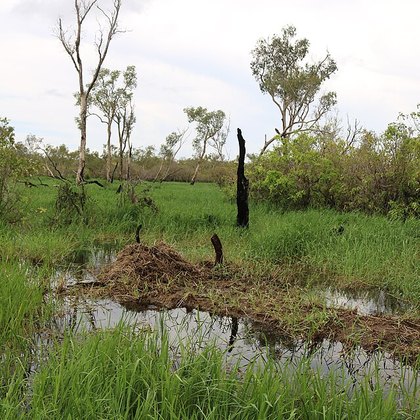
Open country with plenty of air above it and something to perch on: pasture and grazing land, crop edges, lake shores and reed swamp, tidal flats and coastal lagoons, and in good measure the farmyard, the village and the town, where wires, fences and roofs serve as perches. The species hunts flying insects low over grass and water, following stock, mowers and fires that put insects up. In Australia and New Zealand these are non-breeding birds, which seek no nest site and are therefore steered entirely by food: wet coastal country, sewage works and freshly cut fields on the tropical north coast are where they most often hang.
Where the bird is most often found, arranged by main group and formation.



Range and movements
The most widely distributed swallow in the world, breeding across virtually the whole northern hemisphere and wintering in Africa, southern Asia, Australasia and South America. The birds reaching this region come from north-east Asia and belong to the form gutturalis; they reach the north coast of Australia in small numbers each year, from the Kimberley through the Top End to Cape York and Torres Strait, with scattered records further south along the east coast. In New Zealand the species is a rare but near-annual visitor, with the occasional bird oversummering. Presence coincides with the northern winter, roughly October to April. The guide therefore lists the species with the migrant visitors and not with the resident breeders; the status field in the species record reads 'inheems' and deserves revision.
- Resident
- dark = core range, pale = thinly spread
Where and when to look
In the northern winter months work every swallow flock over wet pasture, sewage works and freshly cut fields in tropical Australia, and look in it for the bird with the white belly. Look at the breast and at nothing else: the band decides, tail length does not, for a young Welcome Swallow can be short-tailed too, and so can a moulting Barn Swallow. Work the flock in side light, for against the light every swallow turns dark-breasted. A record away from the north coast needs images; the species is claimed more often than it occurs.
Conservation
Not threatened globally, with a very large range and a population in the hundreds of millions. In parts of Europe and North America the species has declined over recent decades, tied to the fall in flying insects, the disappearance of open stock sheds and the loss of mud for nest building; that decline touches the breeding grounds and not Australasia. For Australia and New Zealand there is no management task: it concerns a small number of non-breeding visitors. The species is nonetheless a useful gauge there, for changes in the numbers reaching the north coast reflect what is happening thousands of kilometres north in East Asia.
Scientific name
Hirundo rustica | Linnaeus, 1758
Linnaeus described the bird in 1758 as Hirundo rustica, from European material, and that name has never changed; author and date therefore stand unbracketed. Hirundo is simply the Latin word for swallow, rustica means 'of the countryside, rustic' — together, literally, the farm swallow. The Dutch boerenzwaluw and the Latin thus coincide, both stressing the tie to the farmyard, which in Europe is ancient: there the species breeds almost solely in and on buildings. The English Barn Swallow does the same with the barn; the Spanish golondrina tijereta takes a different character and names the bird for the scissors, that is, for the deeply forked tail. The Asian birds that reach Australia belong to the form gutturalis, described by Scopoli in 1786, whose epithet refers to the rusty throat.