All species › Passerines › Swallows › Welcome Swallow
Welcome Swallow | Hirundo neoxena
Welkomzwaluw | Golondrina australiana
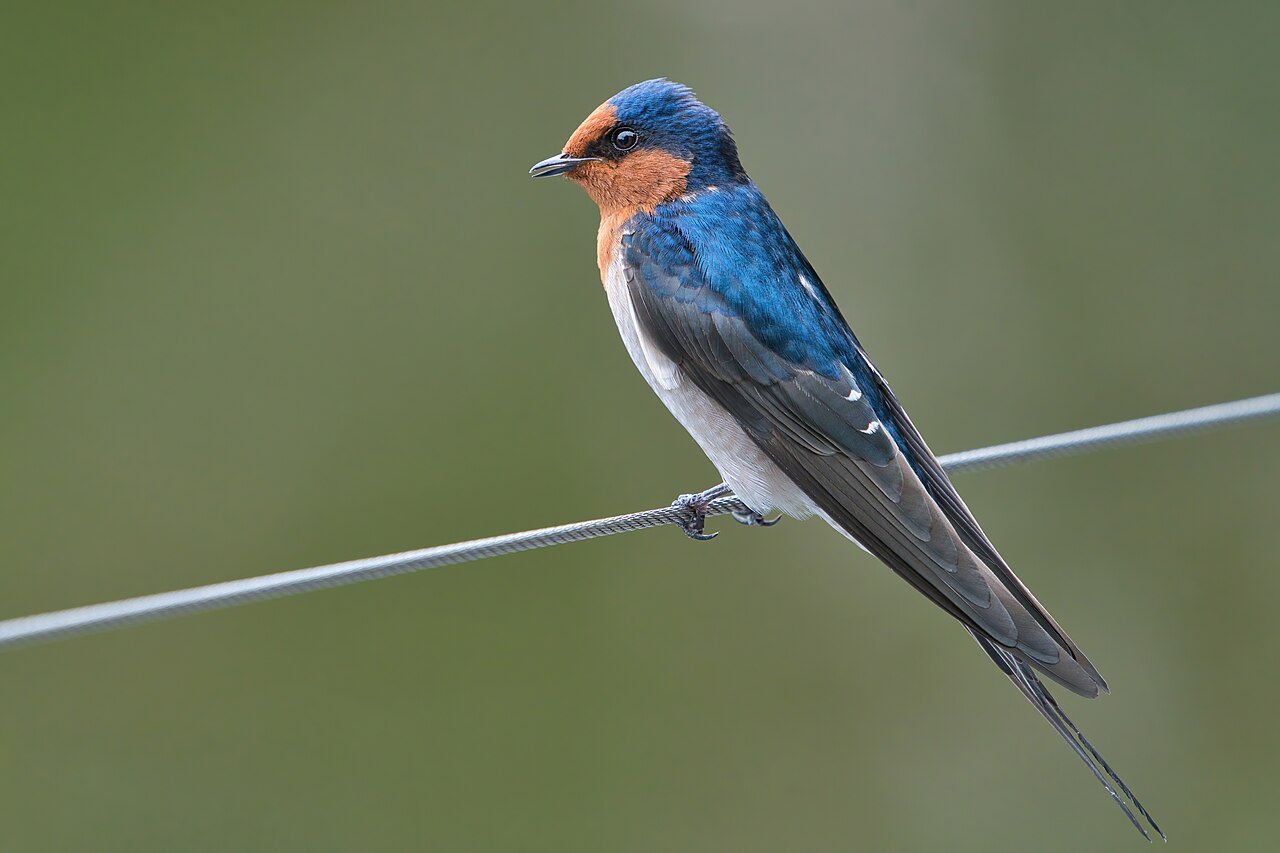
The Welcome Swallow is the commonest swallow of Australia and New Zealand, the bird that skims low over the grass above almost every town, paddock and stock dam. It builds its mud cup under bridges, culverts, verandas and shed roofs, and between hunting flights sits on a wire with half a dozen of its kind. In New Zealand it arrived from Australia under its own power; it has bred there only since 1958.
Voice
A continuous, cheerful twitter of high light notes with soft rolling flourishes between, traded from a wire or on the wing. In alarm comes a sharp high sweet! that lifts the heads of every swallow in the neighbourhood; over a nest with young it becomes a sustained yapping. The sound does not carry far, but at a colony under a bridge it never stops.
No freely licensed recording has been found for this species yet; what to listen for is described below.
Identification
A slim swallow of fifteen centimetres with long pointed wings and a deeply forked tail that reveals a row of white spots when spread. The upperparts are metallic blue-black, the underparts light grey, and forehead, throat and upper breast are rusty red. Unlike many swallows it has no dark band across the breast. The sexes are alike; young birds have a duller throat, shorter tail streamers and a yellow gape.
Confusion species
Barn Swallow (Hirundo rustica), a rare Asian visitor to northern Australia and New Zealand, has a full black breast band, a white belly and much longer tail streamers. Petrochelidon nigricans has a pale rump and a short square tail; P. ariel a white rump and rufous head. White-backed Swallow is split black and white and lacks the rusty throat. A swift is larger, more scythe-winged and never perches on a wire.
Habitat
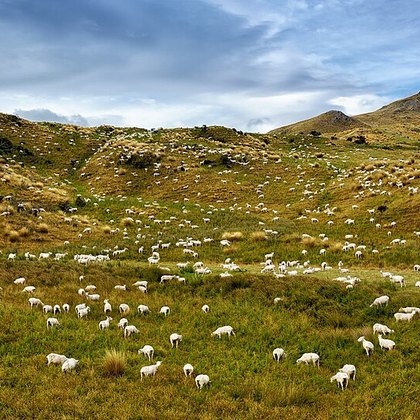
Almost all open country: town and village, pasture and grazed rangeland, the margins of lakes, ponds and storages, and rocky coast and sea cliff where it nests in crevices. It avoids closed forest, true desert and the alpine zone. Where people build, it gains ground: bridges, culverts, garages and verandas offer more nest sites than natural rock faces ever did.
Where the bird is most often found, arranged by main group and formation.



Range and movements
Across virtually all of Australia except the driest interior and the far north, throughout New Zealand, and on Norfolk Island. Birds from southern Australia move north in June and July and return in August; in New Zealand they roam in large flocks after breeding. The New Zealand foothold is recent: scattered records from the 1920s, first breeding in Northland in 1958, and the whole country occupied within thirty years.
- Resident
- dark = core range, pale = thinly spread
Where and when to look
Look under every bridge, culvert and veranda you pass: the mud cup sits on a beam or against a rough wall, often beside last year's. In summer stand at a stock dam when the wind runs low over the water; the swallows then pass within a couple of metres. Check the missing breast band on every bird — it settles the question of whether this one is a Barn Swallow after all.
Conservation
Least Concern (LC), and one of the few native songbirds that has plainly gained from the arrival of people. Buildings, bridges and stock dams have greatly increased both nest sites and inland drinking water, and on the back of that the species has extended its range and colonised New Zealand. Nests are lost locally when buildings are cleaned down and to insecticides; at national scale that does not register.
Scientific name
Hirundo neoxena | Gould, 1842
Gould described the bird in 1842 as Hirundo neoxena, and it has stayed in that genus, so author and year carry no parentheses. Hirundo is simply the Latin word for swallow; Linnaeus introduced the genus in 1758. neoxena is Greek for 'new guest', from neos, 'new', and xenos, 'stranger'. The English name Welcome Swallow comes from the bird's return in southern Australia, welcomed there as the announcement of spring.