All species › Passerines › Swallows › White-backed Swallow
White-backed Swallow | Cheramoeca leucosterna
Witrugzwaluw | Golondrina dorsiblanca
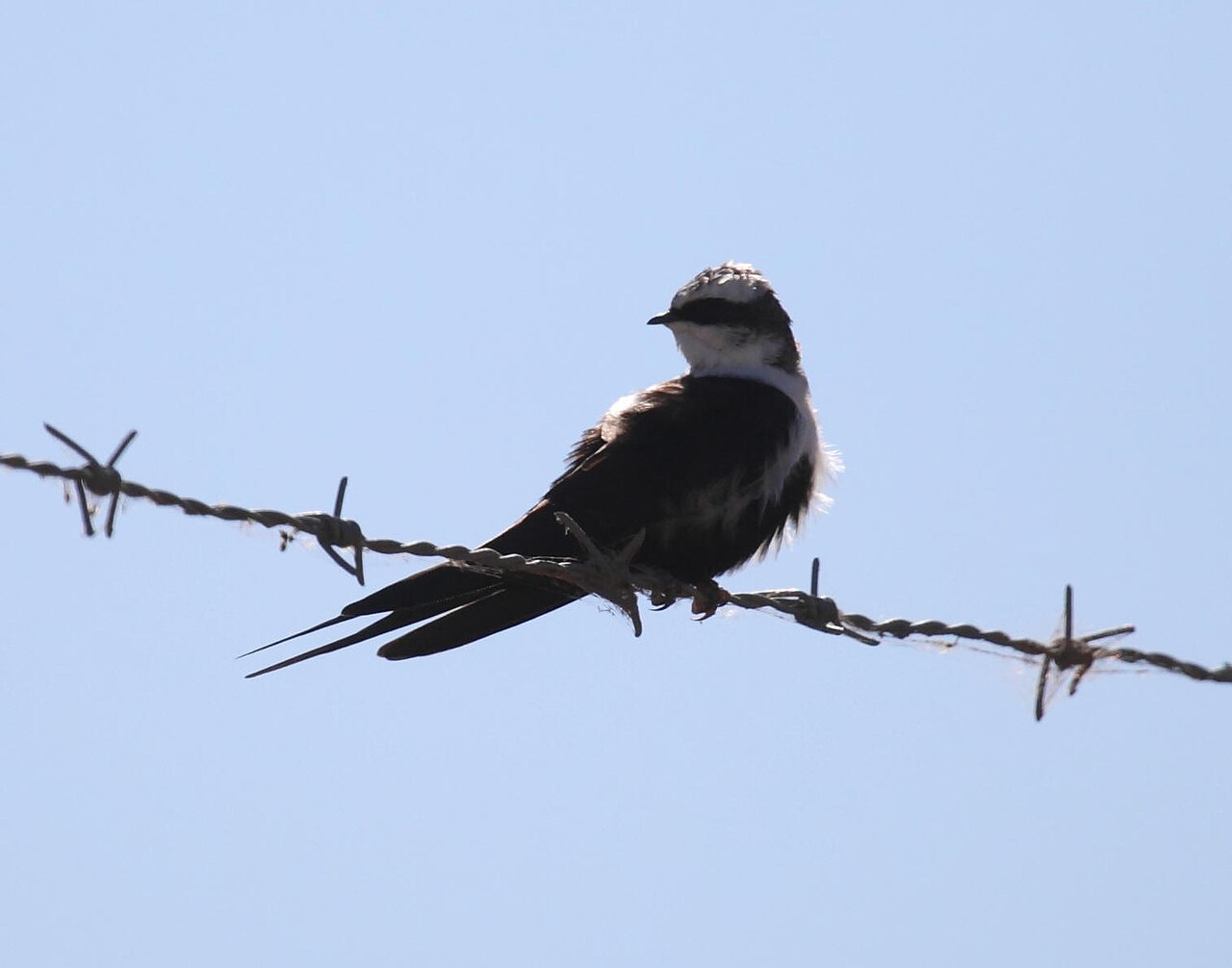
The White-backed Swallow is the only swallow in the world with a white back, and the only Australian one that lays its eggs at the end of a tunnel it digs itself. Over the dry inland plains it swings about in small parties, the white of head, back and breast flashing against black wings and a deeply forked tail. In winter whole groups crowd into an old nest tunnel to sit out the cold.
Voice
Unobtrusive and soft: a dry, high twitter of short chip and chirrp notes traded between birds as they hunt, inaudible at fifty metres. At the colony the chatter is faster and more excited, and anyone approaching a tunnel gets a short sharp alarm note. The species has no real song.
No freely licensed recording has been found for this species yet; what to listen for is described below.
Identification
A slim swallow of about fifteen centimetres with a long, deeply forked tail and narrow, pointed, curved wings. Crown and nape are streaked grey-brown with a white eyebrow, and a dark line runs from the lores back into the nape. Back, throat and breast are white; belly, wings and tail are black. In flight the bird is therefore split black and white from above — a pattern no other swallow in the region has. The sexes are alike; young birds are duller and greyer.
Confusion species
Petrochelidon nigricans is dark with a pale rump and a short square tail; P. ariel has a rufous head and a white rump patch, but no white on the back. Welcome Swallow is rusty on forehead and throat and has a blue-black, not white, back. Artamus leucorynchus is grey and white but has broad triangular wings and soars for long spells; that confusion resolves on the second wingbeat.
Habitat
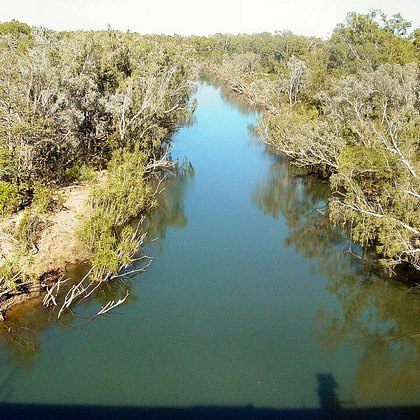
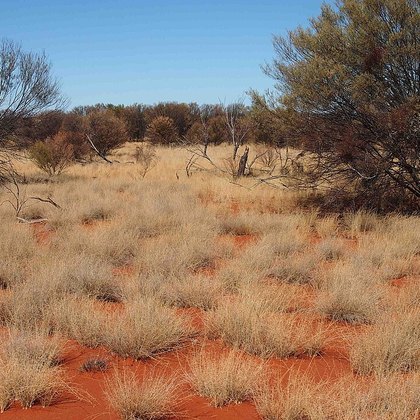
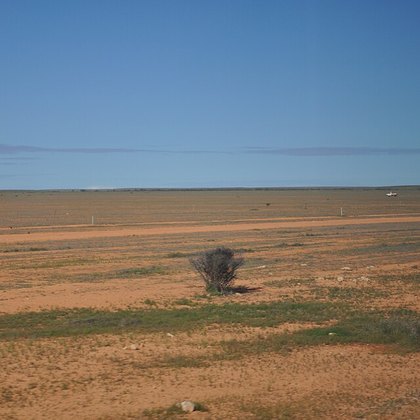
Open dry country with a bank somewhere: creek and river margins with sandy cut faces, mulga and acacia scrub, saltbush and bluebush plain, and increasingly quarries, sandpits and road cuttings. It avoids forest. Where there is no natural bank but a fresh cutting, it moves in within a season.
Where the bird is most often found, arranged by main group and formation.

Range and movements
Endemic to Australia, across most of the dry and semi-arid south and centre, roughly up to the Tropic of Capricorn; it is absent from the wet north and the east coast. After inland rain the range pushes temporarily out into the deserts. It does not migrate but does wander locally: colonies disappear as a bank erodes and turn up again a few kilometres on.
- Resident
- dark = core range, pale = thinly spread
Where and when to look
Drive a dry creek with steep sandy banks and look for rows of round holes about five centimetres across, usually just under the lip. Sit facing the bank and wait: the birds come in on a curve and shoot into the tunnel without slowing. In June and July the same tunnels are worth a second look, because groups roost in them.
Conservation
Least Concern (LC), and on the latest assessment even slightly increasing: land clearing and thousands of kilometres of road batters, quarries and sandpits have added to the supply of banks. Against that stand local losses to foxes and cats at the tunnels and the battering-down of banks in stream restoration. The species is little surveyed and nowhere well mapped.
Scientific name
Cheramoeca leucosterna | (Gould, 1841)
Gould described the bird in 1841 as Hirundo leucosternus, among the typical swallows; because it was later placed in a genus of its own, author and year stand in parentheses. The genus Cheramoeca was introduced by Cabanis around 1850, from Greek kheramos, 'hole', and oikeo, 'to inhabit' — a reference to the nest tunnel. leucosterna means 'white-breasted', from leukos, 'white', and sternon, 'breast'. The type came from the interior of New South Wales.