All species › Passerines › Swallows › Eastern Red-rumped Swallow
Eastern Red-rumped Swallow | Cecropis daurica
Amoerroodstuitzwaluw | Golondrina dáurica
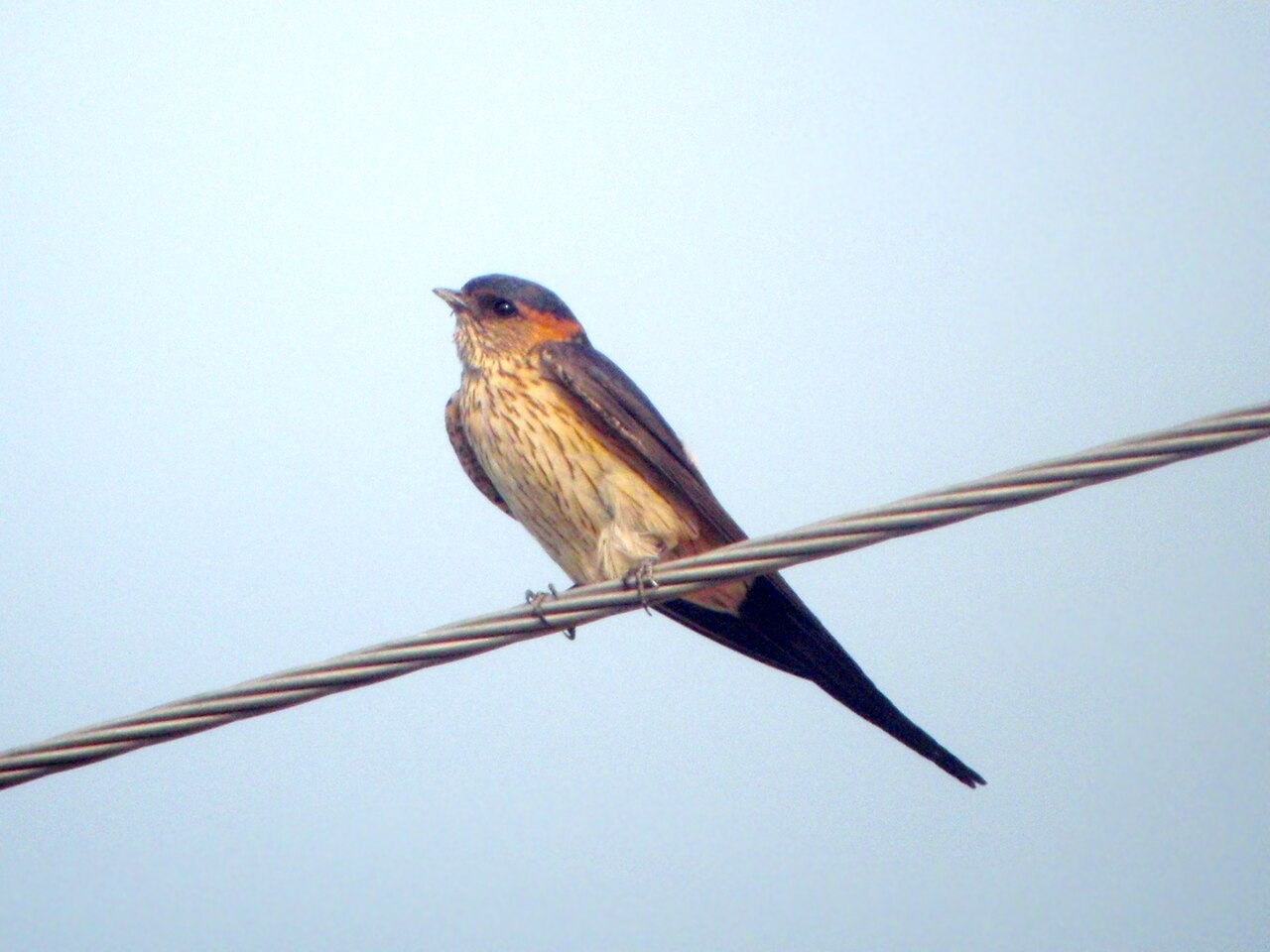
The Eastern Red-rumped Swallow is an Asian swallow that reaches Australia only as a vagrant, and there ranks among the rarest finds in the family. It is a big, slower bird than the swallows that belong there: blue-black above, with a broad rusty rump and a rusty nape band, and with long tail streamers but no white tail spots. Anyone who sees it sees a bird that in silhouette recalls the Barn Swallow but is in every respect a little heavier and more deliberate.
Voice
The voice is drier and thinner than the Barn Swallow's. The contact call is a short nasal tschwit or djweet, far less clear than the sharp chirping of its relatives, and often the first thing that betrays a vagrant among other swallows. The song is a soft sustained twitter with a rattling, almost grating end, given in the breeding range from a wire or in flight. In Australia the species is in practice silent and is established on appearance rather than voice; even so it pays to listen for that dry call when a large swallow stands out among Welcome Swallows.
No freely licensed recording has been found for this species yet; what to listen for is described below.
Identification
A stout swallow of sixteen to eighteen centimetres with long pointed wings and a deeply forked tail with long thin points. The upperparts are glossy blue-black, and set in them is the character that decides everything: a broad rusty to orange-brown rump lying like a pale band between back and tail, obvious in flight from the side and from above. A rusty nape band runs round the hindneck and onto the side of the head. The underparts are dirty white to warm buff with fine dark streaks, and there is no dark breast band. The undertail coverts are black, giving a dark point beneath the tail in flight. The tail lacks the white spots the Barn Swallow shows when it spreads. Male and female are alike; young birds are duller, with shorter streamers and a dull-fringed upperside.
Confusion species
Barn Swallow (Hirundo rustica), the species it most often shares a flock with in Australia, has a full blue-black breast band, a rusty throat, a blue-black rump and white spots in the spread tail — four characters the Eastern Red-rumped Swallow lacks. Welcome Swallow (Hirundo neoxena) is smaller, carries its rust on forehead and throat rather than on the rump, and also has white tail spots. Fairy Martin (Petrochelidon ariel) likewise has a pale rump, but white and not rusty, its head is chestnut rather than blue-black, its tail is square-ended, and the bird is barely two-thirds the size. Tree Martin (Petrochelidon nigricans) has a dull off-white rump without any rust and a short tail. In case of doubt: rusty rump plus long streamers plus no breast band settles it.
Habitat
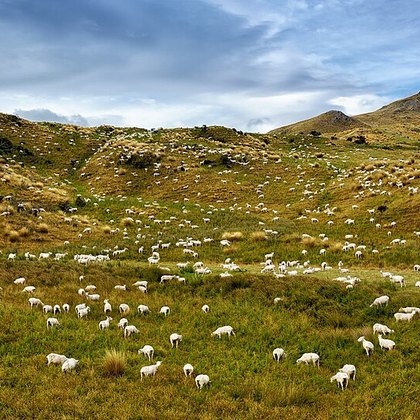
In the Asian breeding range, open and half-open country with scattered rock faces, bridges, culverts and buildings to nest beneath, often near water; the species avoids closed forest and climbs into mountain valleys. The few Australian records concern birds over open grassland, pasture and tropical eucalypt savanna on the north-west coast, over wetlands and around settlement, generally in company with other swallows and swifts working the same insect food. In Australia there is no habitat in the proper sense: a vagrant hangs where the food hangs.
Where the bird is most often found, arranged by main group and formation.


Range and movements
A breeding bird of a broad belt across Asia, from southern Siberia and the Amur region through Mongolia, China and Korea to Japan, and south into the Himalaya and India. The northern populations are full migrants wintering in South and South-East Asia. On that migration birds go off course every year, and a small number reach the islands north of Australia; in Australia itself it is a handful of accepted records, almost all along the north-west coast and on the reefs and islands offshore, in late southern spring and summer. The guide therefore carries the species as a vagrant. Anyone needing exact numbers and dates should consult the national rarities committee; those figures were not checked in this round.
- Breeding (summer)
- dark = core range, pale = thinly spread
Where and when to look
Do not look for it, find it: work through flocks of swallows and swifts in the north-west coastal country and watch for one bird that looks larger and slower than the rest. The rump is the only character that really counts, and it can only be seen from behind or above — so stand higher than the birds fly if you can, on a levee or a dune. Get images before you name it; at this level of rarity a record without a photograph is seldom accepted. Watch too for the black undertail coverts, which against the light sometimes show better than the rump itself.
Conservation
The species is widespread and numerous across its Asian range and is not threatened; BirdLife holds the red-rumped swallow at the lowest concern category. Note that the recent split of the red-rumped swallows adds noise here: AviList carries Cecropis daurica in the narrow sense — the eastern form — and leaves the Red List for that split unit unassessed for the time being, while the species in the broad sense stands as not threatened. For Australia the question is without practical consequence either way: a vagrant carries no population there and asks for no management. In Asia the species does depend locally on bridges, culverts and buildings as nest sites, so that renovation and demolition have local effect.
Scientific name
Cecropis daurica | (Laxmann, 1769)
Laxmann described the bird in 1769 as Hirundo daurica, from Siberian material; because the species now sits in another genus, author and date are bracketed. The epithet daurica refers to Dauria, the country east of Lake Baikal from which the type came. The genus Cecropis was introduced by Boie in 1826 and goes back to Cecrops, the mythical first king of Athens, the form 'Cecropis' meaning in Greek poetry simply 'the Athenian woman' — a name with no bearing on the bird's appearance. The species long stood in Hirundo; molecular work separated the red-rumped swallows from it. The English Eastern Red-rumped Swallow follows the recent split by position, the Dutch amoerroodstuitzwaluw names the eastern form after the Amur country, and the Spanish golondrina dáurica keeps the old type locality.