All species › Passerines › Grasshopper warblers, grassbirds and allies › New Zealand Fernbird
New Zealand Fernbird | Poodytes punctatus
Varengrasvogel | Yerbera maorí
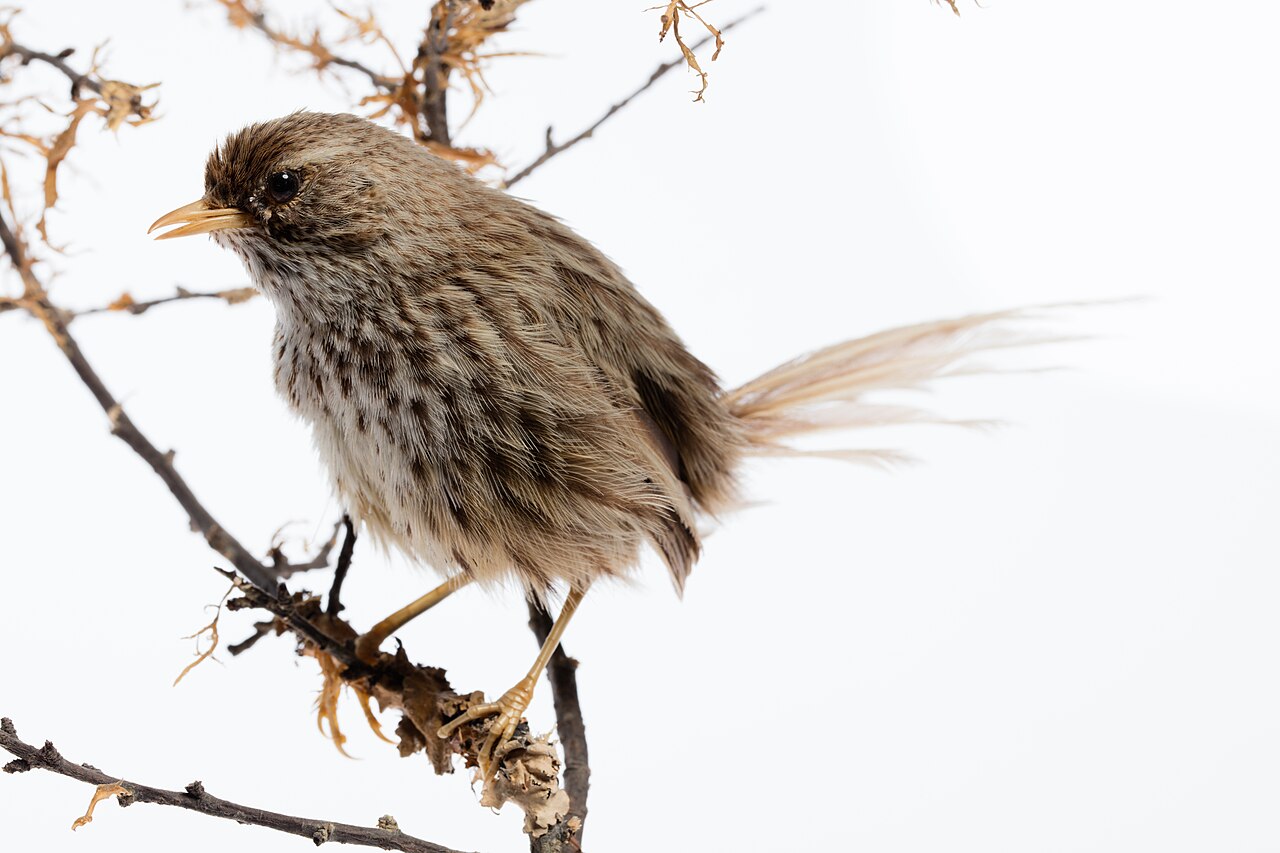
The New Zealand Fernbird, or matata, is the swamp bird of New Zealand: a spotted, long-tailed clamberer living in raupo, flax and sedge that is found almost solely by listening. A pair divides the call between two birds — one says u, the other answers tick — so that what sounds like one bird's note is in fact a duet. The tail is the trademark: the barbs wear away until only the shafts remain and the whole looks like a frayed broom.
Voice
The best-known sound is the duet: a short metallic u-tick, in which one bird takes the first syllable and its partner the second, so tightly joined that it sounds like a single call. Observers who know the pattern can tell by direction that the two syllables come from different clumps. There is also a sharp repeated chip or tick in alarm, and a soft rattling little song that seldom carries more than a few tens of metres. The birds call all year and at all hours, but most at daybreak; they respond fiercely and pointedly to playback of their own voice, which makes the species vulnerable to disturbance and is the reason to leave it alone in practice.
Recording: Daniel Hinckley — CC BY-NC-SA 4.0 · Ngunguru, Whangarei District, Northland, New Zealand · xeno-canto
Identification
Eighteen centimetres, a good part of it the long tail. The upperparts are warm brown with dark streaking; the crown is rufous to cinnamon and sharply marked off, and beneath it runs a broad bright white brow that carries well behind the eye. The underparts are white to pale buff with a dense scattering of sharp dark brown spots across throat, breast and flanks — a spotted, not a streaked pattern, and that separates the species from its Australian relative. The trademark is the tail: the vanes of the tail feathers wear away so that the bare shafts stand out like spines and the tail looks frayed. The flight is weak, low and fluttering, the tail hanging down, and seldom lasts long; the bird would rather climb the stems. Male and female are alike.
Confusion species
Within New Zealand no second bird in swamp is spotted like this. Dunnock (Prunella modularis), an introduced species that also enters rank wetland, is greyer on head and breast, streaked rather than spotted, and has a short ordinary tail with no projecting shafts. Grey Gerygone (Gerygone igata) is far smaller, grey and unspotted, and stays in forest. New Zealand Pipit (Anthus novaeseelandiae) shares open damp ground but walks on open sand and carries white outer tail feathers. Against its Australian relative Little Grassbird (Poodytes gramineus), the Fernbird is larger, more heavily spotted and much whiter on the brow; the two occur nowhere together, so the difference matters chiefly when reading older literature in which both stood under Megalurus. In the field the frayed tail and the broad white brow settle it.
Habitat
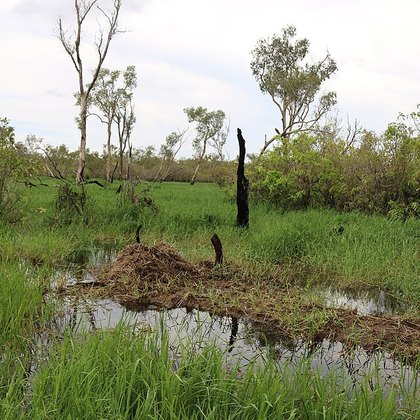
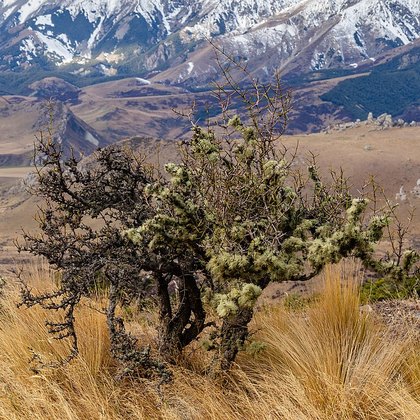
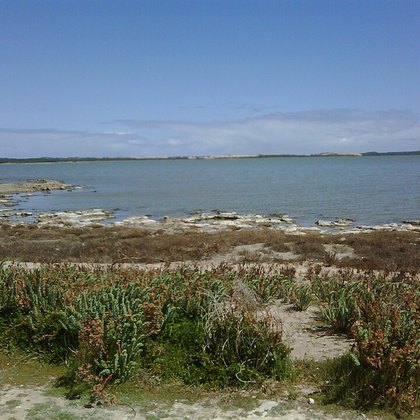
Low dense vegetation on wet ground: raupo and flax swamp, sedgeland, pakihi and peat bog, the reed fringes of lakes and lagoons, saltmarsh, and the rank transition from swamp into manuka scrub. The bird needs a closed vegetation layer at eye height to climb through, and ground that stays wet or at least sodden. Shallow varied swamp with a mixture of clumps and small openings is better than an even bed of reed. Drained land is abandoned and not reoccupied while it stays dry, which is why the species' distribution map is an imprint of where swamp still survives in New Zealand.
Where the bird is most often found, arranged by main group and formation.

Range and movements
Endemic to New Zealand: the North Island, the South Island, Stewart Island and a series of smaller islands, wherever enough continuous swamp remains. The picture is fragmented and follows the surviving wetlands; large parts of the original range in the lowlands of both main islands are empty because the swamp is no longer there. The species is thoroughly sedentary: its weak short flight makes the crossing of open farmland between two swamps a real barrier, so that restored wetlands do not repopulate themselves unless a breeding population sits nearby. The Maori name matata is in ordinary use in New Zealand alongside the English one.
- Resident
- dark = core range, pale = thinly spread
Where and when to look
Walk a track or a stopbank along the edge of a raupo or flax swamp and stand still; the bird often climbs a few stems of its own accord to see who is there, sits for perhaps five seconds and then drops back. Listen for the u-tick and note whether the two syllables come from the same direction: if not, there are two birds. Do not use playback — the species reacts violently to it and leaves the nest in doing so. The best times are the first two hours after sunrise in still weather, for in wind neither the soft voice nor the movement in the reeds can be followed.
Conservation
The international list still carries the species under its current name Poodytes punctatus as Not Evaluated (NE); that follows from the taxonomic rearrangement and not from ignorance of the bird, for under the older name it was assessed as of least concern. In the New Zealand national threat listing the species sits among the declining taxa, and that is the figure that counts. The cause is in the first place the swamp itself: since European settlement New Zealand has lost the great majority of its lowland wetland to drainage and conversion to pasture, and every swamp drained is a population fewer. On top of that comes predation by rats, cats, stoats and weasels on a bird that nests low in the vegetation, and fires in sedgeland and pakihi that take whole broods. The management that works is also the simplest: rewet swamp, keep stock and fire out of the margins, and control predators around the remaining strongholds. Because the bird itself flies poorly, reconnecting wetlands matters at least as much as restoring them.
Scientific name
Poodytes punctatus | (Quoy & Gaimard, 1832)
Quoy and Gaimard described the bird in 1832 as Synallaxis punctata, from material out of Tasman Bay on the South Island collected on the voyage of the Astrolabe; because the species now sits elsewhere, author and date are bracketed. The epithet punctatus is Latin for 'spotted' and refers to the scattered breast pattern. The species stood long in the New Zealand genus Bowdleria and after that in the broad Megalurus; since molecular work broke that last genus apart it has stood in Poodytes, introduced by Cabanis in 1851 from Greek poa, 'grass', and dutes, 'diver'. The Dutch varengrasvogel follows the English Fernbird, in which fern refers to the bracken of New Zealand scrubland, although the bird is bound to reed and sedge rather than to ferns; the Spanish yerbera maorí and the Maori matata choose respectively the country and the language in which the bird belongs.