All species › Passerines › Grasshopper warblers, grassbirds and allies › Little Grassbird
Little Grassbird | Poodytes gramineus
Dwerggrasvogel | Yerbera chica
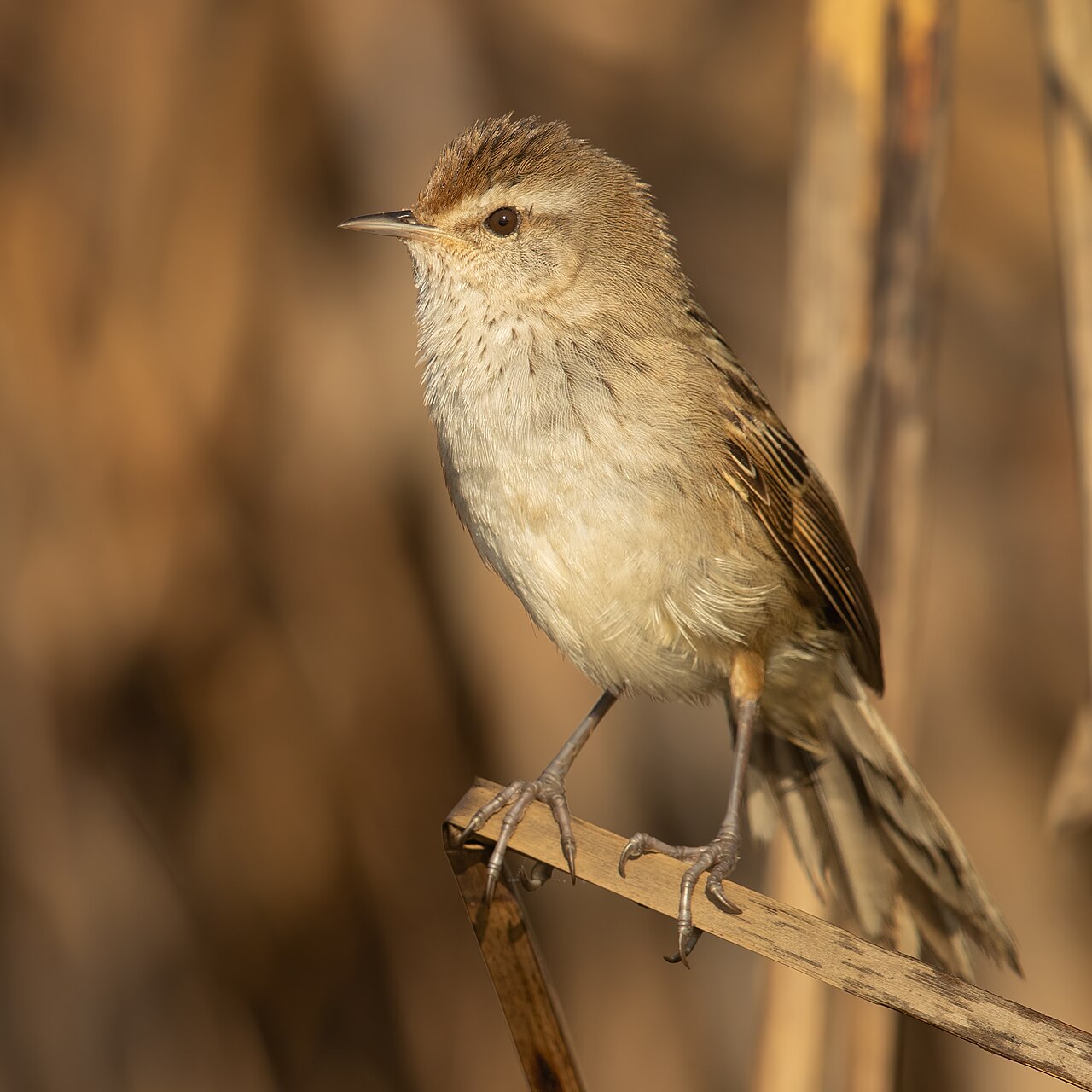
In most Australian swamps the Little Grassbird is a sound and not a bird. At dusk a thin mournful three-note whistle comes out of the reeds, with long silences between, and whoever goes to it usually sees nothing: the bird stays low and moves mouse-like among the stems. It is the smaller of the two species of the genus Poodytes, finely streaked from crown to breast, and in southern Australia it is the commonest bird that is almost never seen.
Voice
The voice is the species. It is a high, thin, mournful whistle of three notes, the first standing alone and the next two following quickly — approximately peeee ... pee-pee — with easily ten or twenty seconds of silence between series. The tone is pure and wholly without roughness and carries through the reeds as if coming from everywhere at once; it is remarkably hard to place the bird, and observers consistently overestimate the distance. Song is given chiefly at first light and in the last hour before dark, but in the breeding season at night as well. There is also a short hard tschik when the bird is disturbed. Once the whistle is known, the species can be heard on virtually every swamp of any size in the south of the continent.
No freely licensed recording has been found for this species yet; what to listen for is described below.
Identification
A small, dark, long-tailed swamp bird of thirteen to fifteen centimetres that climbs through reeds rather than flying. The upperparts are dark grey-brown with heavy black streaking on crown, nape and back; the character that matters is that the streaking carries on underneath: throat and breast bear fine dark streaks on a dirty white to pale buff ground, and that separates the species from any other small wetland bird in Australia. The tail is long, graduated, often ragged, and carried drooping, so that in crossing a drain the bird looks tail-heavy. A narrow pale brow runs over the eye, the bill is fine and dark, the legs stout and flesh-coloured. Male and female are alike.
Confusion species
Tawny Grassbird (Cincloramphus timoriensis) stands in the same swamp but is a third larger, has a rufous crown and, decisively, wholly unstreaked underparts. Australian Reed Warbler (Acrocephalus australis) is larger, plain olive-brown without any streaking, and has a longer straight bill and a loud rattling song. Golden-headed Cisticola (Cisticola exilis) is shorter-tailed, paler and lives in drier grass; it also sings from a projecting stem, which the Little Grassbird rarely does. Spinifexbird (Poodytes carteri) of the dry interior is unstreaked on the breast and does not overlap in swamp. New Zealand Fernbird (Poodytes punctatus), the only other species of the genus, is larger and more heavily spotted and occurs only in New Zealand, so the two meet nowhere. In case of doubt: streaking on the breast plus the three-note whistle settles it.
Habitat
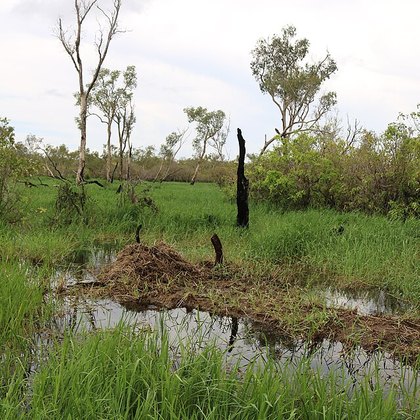
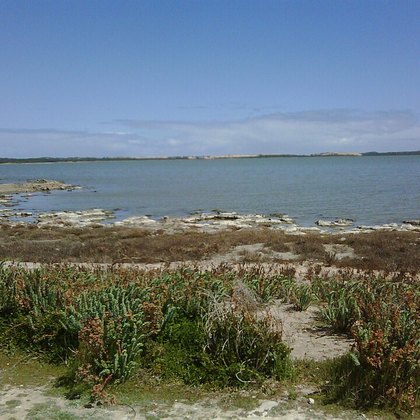
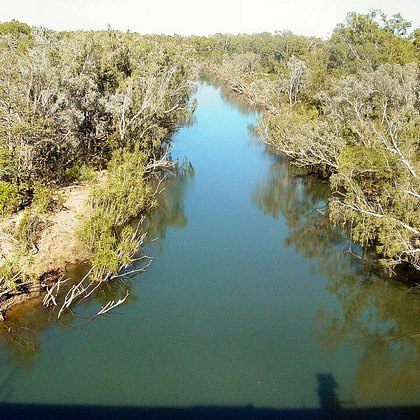
Dense low wetland vegetation over water or sodden ground: reed, rush, sedge and cumbungi along lakes, pools, creeks and drains, further lignum in the interior, saltmarsh and samphire on the coast, and in good measure the reed fringes of settling ponds and sewage lagoons, where the species often sits at high density. The bird needs no open water but does need wet feet beneath the vegetation, and it stays almost always within a metre or two of the ground. Drying swamps are abandoned once the ground hardens; on refilling the species returns quickly.
Where the bird is most often found, arranged by main group and formation.


Range and movements
Southern and eastern Australia including Tasmania, the south-west of Western Australia, and scattered across virtually the whole interior wherever permanent or semi-permanent water with reed growth stands. Beyond that the species occurs in the highlands of New Guinea. There is no migration in the ordinary sense, but there is considerable movement between swamps: in drought the inland populations vanish and birds concentrate in the lasting wetlands of the coastal strip and along the great river systems, refilling the interior after rain. That movement is hard to follow, because the birds can only be counted by voice.
- Resident
- dark = core range, pale = thinly spread
Where and when to look
Stand at the edge of a reed fringe at dusk and listen; searching with binoculars yields almost nothing. Do not play the call but wait, for the species responds poorly to it and it disturbs breeding birds. To see the bird, work the narrow transitions where reed meets a ditch or an open roadside drain: there it will sometimes cross a metre of open ground, low and with the tail trailing. Settling ponds with reed fringes are the most reliable places of all, even in the middle of the day. Still damp weather is decisive, for the song is soft and the silences between series are long.
Conservation
Least Concern: the species is widespread, numerous and undemanding so long as there is wet cover. It is one of the few Australian wetland birds to have clearly benefited from human works, for the reed fringes of sewage treatment plants, irrigation channels and stock dams supply exactly the habitat required. Against that stands the loss of natural swamp in the south-east, where drainage, extraction from the great river systems and the trampling back of reed fringes by stock have done their work; in the Murray-Darling basin the presence of the species hangs directly on water management. Because it is established almost entirely by voice, national trends are uncertain and rest on a limited number of standardised counts.
Scientific name
Poodytes gramineus | (Gould, 1845)
Gould described the bird in 1845 as Sphenoeacus gramineus, from material from Tasmania; because the species now sits elsewhere, author and date are bracketed. The epithet gramineus is Latin for 'grassy, of the grass', from gramen, 'grass'. The genus Poodytes was introduced by Cabanis in 1851 from Greek poa, 'grass', and dutes, 'diver' — a name that catches the behaviour well, for the picture of a bird diving away into grass is exactly what one gets to see of it. The species stood long in the broad genus Megalurus; molecular work broke that genus up in the twenty-first century, this bird going with the New Zealand Fernbird and the Spinifexbird to Poodytes and the Australian songbirds of open country to Cincloramphus. The Dutch dwerggrasvogel and the English Little Grassbird take the size; the Spanish yerbera chica does the same.