All species › Passerines › Grasshopper warblers, grassbirds and allies › Spinifexbird
Spinifexbird | Poodytes carteri
Spinifexzanger | Yerbera del spinifex
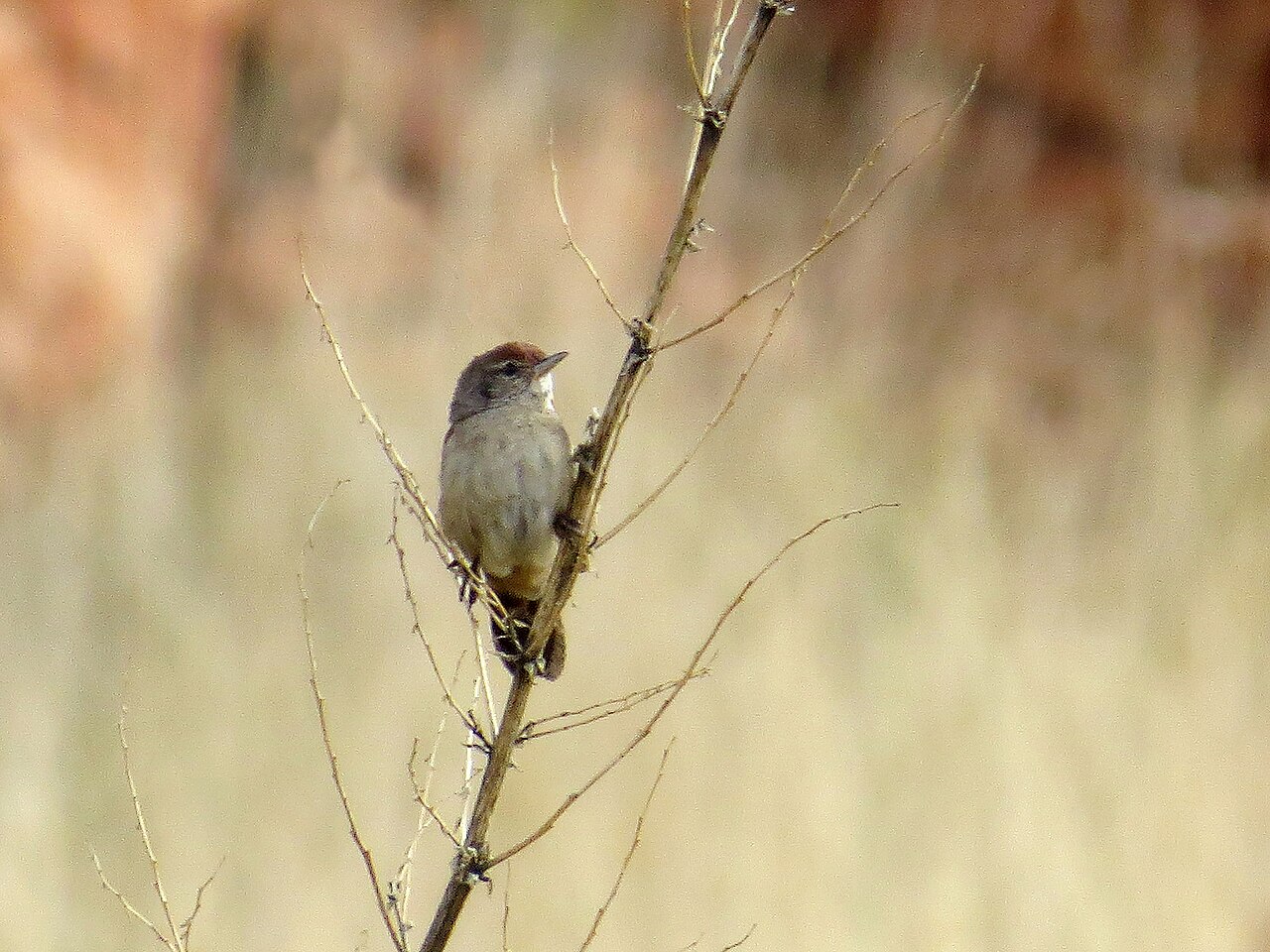
The Spinifexbird lives in the prickliest habitat Australia has and almost never leaves it: a nondescript brown bird with a long, drooping tail that runs between the Triodia hummocks as though it were a mouse. To see it you climb onto a hummock early in the morning and wait for a male to sit up on a stem and sing — after which it is lost again for an hour.
Voice
The song is a run of short chirped phrases recalling a reed warbler but softer and more hurried, a cheerful chwee-chwee-cher that does not carry far over the flat. The contact note is a sharp dry chik, often repeated as the bird works through the hummocks. In winter, in June and July, it is all but silent and then nearly impossible to record.
No freely licensed recording has been found for this species yet; what to listen for is described below.
Identification
A slim, long-bodied warbler of fourteen to sixteen centimetres, warm rufous on the crown and golden brown with dark streaking on back and wings; the underparts are dull buff. The long broad tail is carried low almost all the time and sometimes cocked, and it is the first thing that registers. The sexes are alike. Flight is weak and fluttering: it rises half a metre above the hummocks and flops back in ten metres on, tail trailing.
Confusion species
The grasswrens of the genus Amytornis share the spinifex but hold the tail upright, are finely white-streaked on head and back, and hop with both feet together. Cincloramphus mathewsi is shorter-tailed, has a rufous rump and sings in flight. Poodytes gramineus, its nearest relative in the genus, lives only in wet reeds and so does not overlap in dry spinifex country. At range a Spinifexbird making off can pass for a mouse or a small lizard.
Habitat
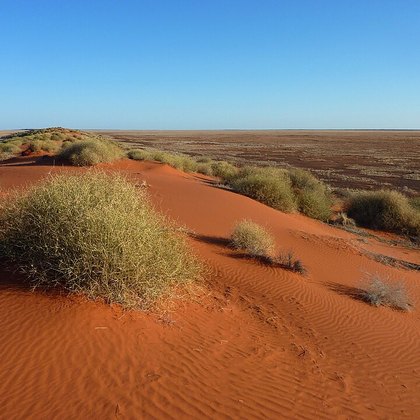
Old, dense Triodia hummocks and nothing else: the spinifex country of the interior, the swales between the red dune ridges of the sand deserts, and spinifex on scree and along gorges in the ranges. It needs hummocks big enough to build a nest into, and so vanishes from an area for years after a fire — until the spinifex has closed up again.
Where the bird is most often found, arranged by main group and formation.


Range and movements
The arid interior of Australia only, from the Pilbara and the Kimberley in Western Australia east through the Northern Territory into western Queensland, with outliers to northwestern New South Wales. It occurs nowhere outside Australia. It neither migrates nor wanders: it stays in the same patch of spinifex for life, which makes it doubly vulnerable after fire.
- Resident
- dark = core range, pale = thinly spread
Where and when to look
Find country where the spinifex has gone five to ten years unburnt — tall ring-shaped hummocks with a bare centre — and walk it slowly in the early morning. Stand still the moment you hear the dry chik and wait: out of curiosity the bird will often climb up onto a hummock of its own accord. Wear long trousers; Triodia leaf tips go through everything.
Conservation
Least Concern (LC). The species has an enormous range and is locally ordinary in suitable old spinifex, but it is seldom seen and there are no good population estimates. Fire regime is the deciding factor: burning too often or on too large a scale keeps the spinifex young and makes whole districts unusable for years, while the fine-grained burning of traditional Aboriginal land management leaves hummocks of every age side by side.
Scientific name
Poodytes carteri | (North, 1900)
North described the bird in 1900 as Eremiornis carteri, in a genus of its own meaning 'desert bird', from Greek eremia, 'desert', and ornis, 'bird'; because the species has since been moved, author and year stand in parentheses. Molecular work in 2018 placed it in Poodytes, a genus introduced by Cabanis in 1851 from Greek poa, 'grass', and dutes, 'diver'. carteri honours Thomas Carter, the English pastoralist and collector who took the type at Point Cloates in Western Australia.