All species › Tubenoses › Petrels, shearwaters and diving petrels › Flesh-footed Shearwater
Flesh-footed Shearwater | Ardenna carneipes
Australische grote pijlstormvogel | Pardela pata pálida
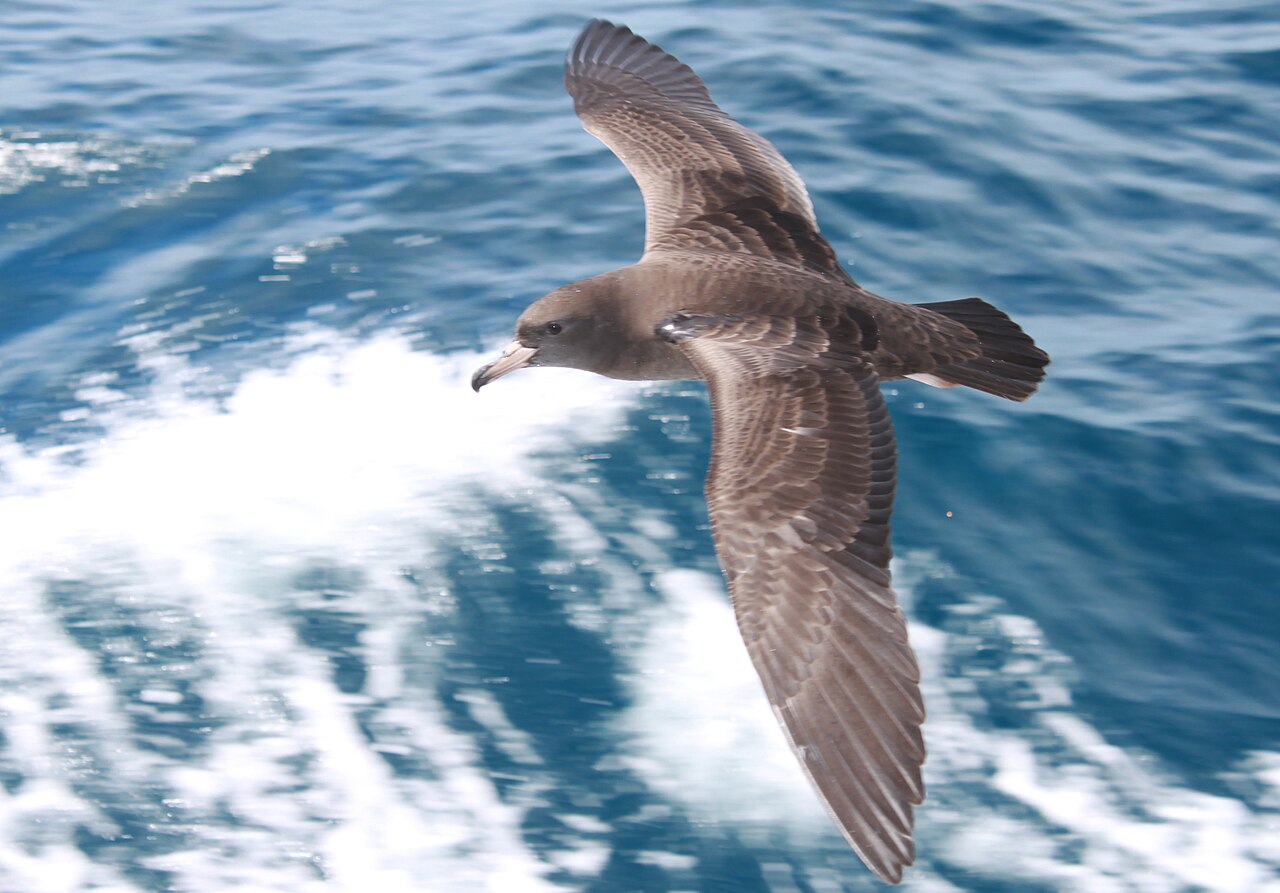
The Flesh-footed Shearwater is a big, uniformly dark brown shearwater with broad wings and a heavy, unhurried flight. The mark that gives it its name is underneath: pale flesh-coloured legs and feet, together with a pink-white bill ending in a sharply defined dark hook. It breeds on islands off New Zealand, on Lord Howe and off Western Australia, and winters in the North Pacific.
Voice
At sea it is almost always silent. Over the colony at night it is loud: the sound is generally described as cats fighting, a sustained wailing and moaning with sharp yelps, and it carries out of the burrows until long after midnight. Birds coming in at dusk call briefly in flight before dropping into the vegetation.
No freely licensed recording has been found for this species yet; what to listen for is described below.
Identification
Forty-five centimetres and about seven hundred grams, so large for a shearwater, with long and fairly broad wings and a long, tapering tail. The whole plumage is even dark chocolate brown, with no paler panel on the underwing. The bill is pink-white with a sharply bounded dark, strongly hooked tip and measures thirty-eight to forty-five millimetres; the legs and feet are white-flesh, sometimes with pinkish webs, and in good light show at a distance. Flight is heavy and deliberate, slow deep beats alternating with long glides on stiff, slightly bowed wings.
Confusion species
Sooty Shearwater (Ardenna grisea) is the difficult pair: as dark, but slimmer in build, with a silver-grey flash in the middle of the underwing, an all-dark slender bill and dark grey feet, and a faster, far more energetic flight. Dark Wedge-tailed Shearwaters (Ardenna pacifica) are slimmer, with a longer wedge-shaped tail, an all-dark slate bill and a lighter, dancing flight. Black Petrel (Procellaria parkinsoni) and Westland Petrel (Procellaria westlandica) are larger and heavier, with an ivory bill marked in black and black legs. In short: on a dark shearwater look first at bill and feet, and only then at the underwing.
Habitat
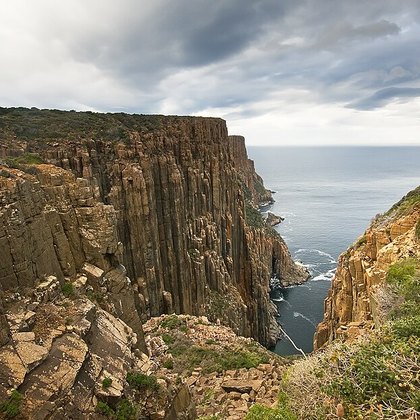
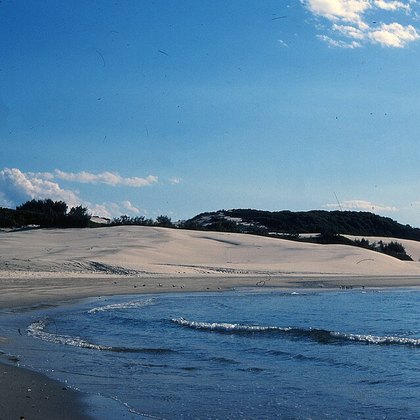
Open sea over and beyond the continental shelf, often along the shelf break and over submarine ridges, and in the breeding season regularly within sight of land. It breeds in burrows it digs itself under forest, scrub or grassland on islands and a few coastal headlands, from coastal forest on Lord Howe to pohutukawa forest and fernland on the New Zealand islands.
Where the bird is most often found, arranged by main group and formation.

Range and movements
Within this map window it breeds on some fifteen islands off the north-east coast of the North Island — the Hen and Chickens, the Mercury group, Ohinau and Karewa — and in Cook Strait, and in Australia on Lord Howe Island and on islands off the south coast of Western Australia. Lord Howe carries the region's largest colony, at more than twenty-two thousand pairs in 2017/18. At sea it is common from September to April in the Hauraki Gulf and along the east coast of Australia, and turns up regularly on pelagic trips out of New South Wales and Queensland. After breeding it leaves the region almost entirely, crossing the equator to the seas off Japan and the North Pacific.
- Resident
- Breeding (summer)
- dark = core range, pale = thinly spread
Where and when to look
Join a pelagic trip out of Wollongong, Sydney or Tutukaka in the southern summer and look for a large, uniformly dark shearwater that comes in slowly and heavily and often hangs behind the boat once berleying starts. At close range the pale bill with its dark tip does the work, and on a bird lifting off or banking away the pale feet flash against the dark body. At the Lord Howe colonies it comes in in numbers towards sunset.
Conservation
Near Threatened (NT), and classed in New Zealand as 'Relict' because it has gone from nearly all its old mainland ground. The heaviest pressure comes from fisheries: birds drown on longline hooks and are sometimes struck by recreational fishers to keep them off the bait. It is also one of the most heavily plastic-loaded seabirds in the world — chicks on Lord Howe are found with striking quantities of plastic in the stomach. On Lord Howe itself road deaths and light pollution count too, although collisions fell from about a hundred and twenty-five birds a year to forty-five in 2014/15 after an awareness campaign.
Scientific name
Ardenna carneipes | (Gould, 1844)
The British ornithologist John Gould described the species in 1844 as Puffinus carneipes; it has since been placed in the genus Ardenna, hence the parentheses round author and year. The epithet carneipes is built from Latin caro, carnis ('flesh') and pes ('foot'), after the flesh-coloured legs. The genus Ardenna was introduced by Reichenbach in 1853, who took the name from Artenna, a term the Italian naturalist Aldrovandi used for a seabird in 1603. The type locality lies on small islands off Cape Leeuwin, Western Australia. The Maori name is toanui.