All species › Tubenoses › Petrels, shearwaters and diving petrels › Great Shearwater
Great Shearwater | Ardenna gravis
Grote pijlstormvogel | Pardela capirotada
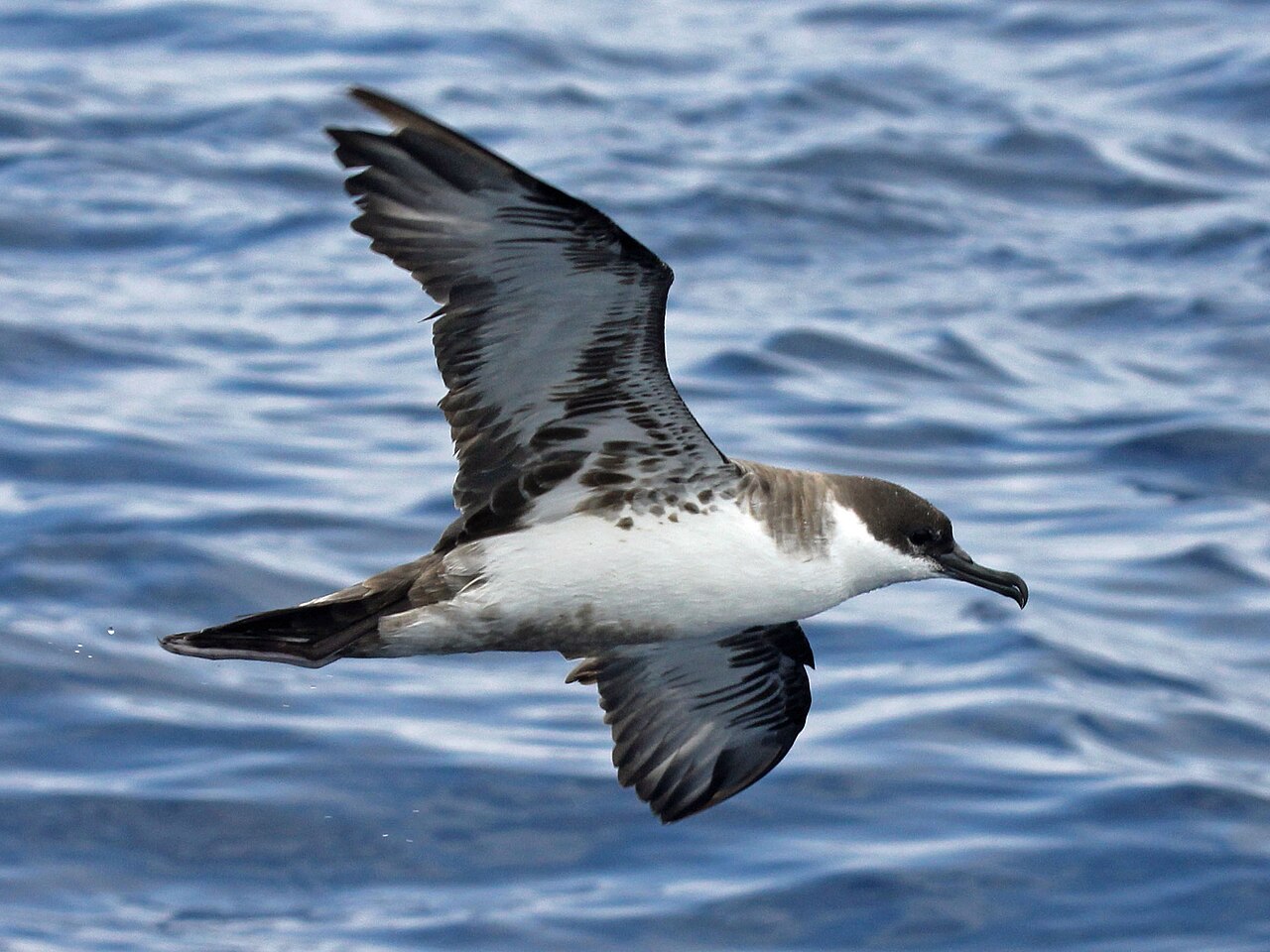
The Great Shearwater is a large, sharply marked shearwater of the Atlantic Ocean that turns up in this region only as a vagrant. It is known by a combination no resident species here can show: a black cap running below the eye, a pale collar behind it, a dark belly patch on otherwise white underparts, and a white horseshoe above the tail.
Voice
In this region entirely silent: the few vagrants are seen at sea and do not call there. On the breeding islands of the South Atlantic it is loud at night, with wailing and braying notes much like Sooty Shearwater's; none of those voices is ever heard within this map window.
Recording: Sven Normant — CC BY-NC-SA 4.0 · Haut Fond d'Ar Men (north Sein Island), France · xeno-canto
Identification
Forty-seven centimetres and about eight hundred and thirty grams, so large and heavy, with long fairly narrow wings and a powerful, steady flight of stiff beats and long glides. The crown is dark brown to black and runs below the eye, sharply bounded, with a conspicuous pale collar behind it separating cap from mantle. Mantle and scapulars have pale feather fringes that give a scalloped pattern. The underside is white, with a clear dark brown patch on the belly and dark lines in the underwing. A white horseshoe-shaped band crosses above the tail. The bill is dark grey, the legs pinkish grey, the eye dark.
Confusion species
Buller's Shearwater (Ardenna bulleri) is the only serious confusion risk in this region, and it is numerous: it too has a dark cap, but no pale collar, no belly patch and no white band above the tail, and it carries a sharp black M across the grey back that Great Shearwater lacks. Streaked Shearwater (Calonectris leucomelas) has a white, streaked head with no cap at all, and a pale bill. On any candidate the order is: find the belly patch first, then the white band above the tail, then the pale collar — all three present makes the identification, two of three is still too thin for a vagrant.
Habitat
Open sea over the continental shelf and beyond. In this region it is without exception a bird at sea outside the breeding season; its breeding habitat — burrows in peat and grassland slopes on South Atlantic islands — lies wholly outside this map window.
Where the bird is most often found, arranged by main group and formation.


Range and movements
It breeds almost entirely on the Tristan da Cunha group, with Gough, Inaccessible and Nightingale as the main islands, and a small colony on Kidney Island in the Falklands; the whole breeding range is thus Atlantic. Within this map window it is a vagrant recorded with some regularity over the past two decades: eleven accepted New Zealand records between 2006 and 2023, including near the Chathams, off Otago, off Kaikoura, off Stewart Island and at Taiaroa Head, and a handful of Australian records off the southern and eastern coasts. There is no fixed season and no fixed place.
- Non-breeding visitor
- dark = core range, pale = thinly spread
Where and when to look
Do not count on finding it: this is a bird you meet rather than seek, almost always on a pelagic trip among all the Sooty Shearwaters. Scan flocks of dark shearwaters for a bird that is strikingly paler and more crisply marked and shows a white band above the tail as it turns away. Photograph every candidate: the separation from Buller's Shearwater is rarely made in one glance in the field, and rarities committees ask for images.
Conservation
Least Concern (LC), with a very large world population breeding almost entirely on a handful of South Atlantic islands. That concentration is the weak point: one introduced predator on Gough or Nightingale would reach much of the species. Longline bycatch and the traditional harvest of chicks on Tristan da Cunha take their share. For this map window the species carries no conservation task of its own; what occurs here are scattered vagrants.
Scientific name
Ardenna gravis | (O'Reilly, 1818)
O'Reilly described the species in 1818 as Procellaria gravis, 'heavy', after its bulk compared with other shearwaters; the description appeared in a travel account of a voyage to Greenland, not in a scientific journal. Because the species was later placed in another genus, author and year go in parentheses. The genus Ardenna was set up by Reichenbach in 1853, with this very species as its type. The type locality covers the sea route between Cape Farewell and Newfoundland, as O'Reilly followed it on that voyage.