All species › Kingfishers, bee-eaters and rollers › Kingfishers › Forest Kingfisher
Forest Kingfisher | Todiramphus macleayii
Macleays ijsvogel | Alción de Macleay
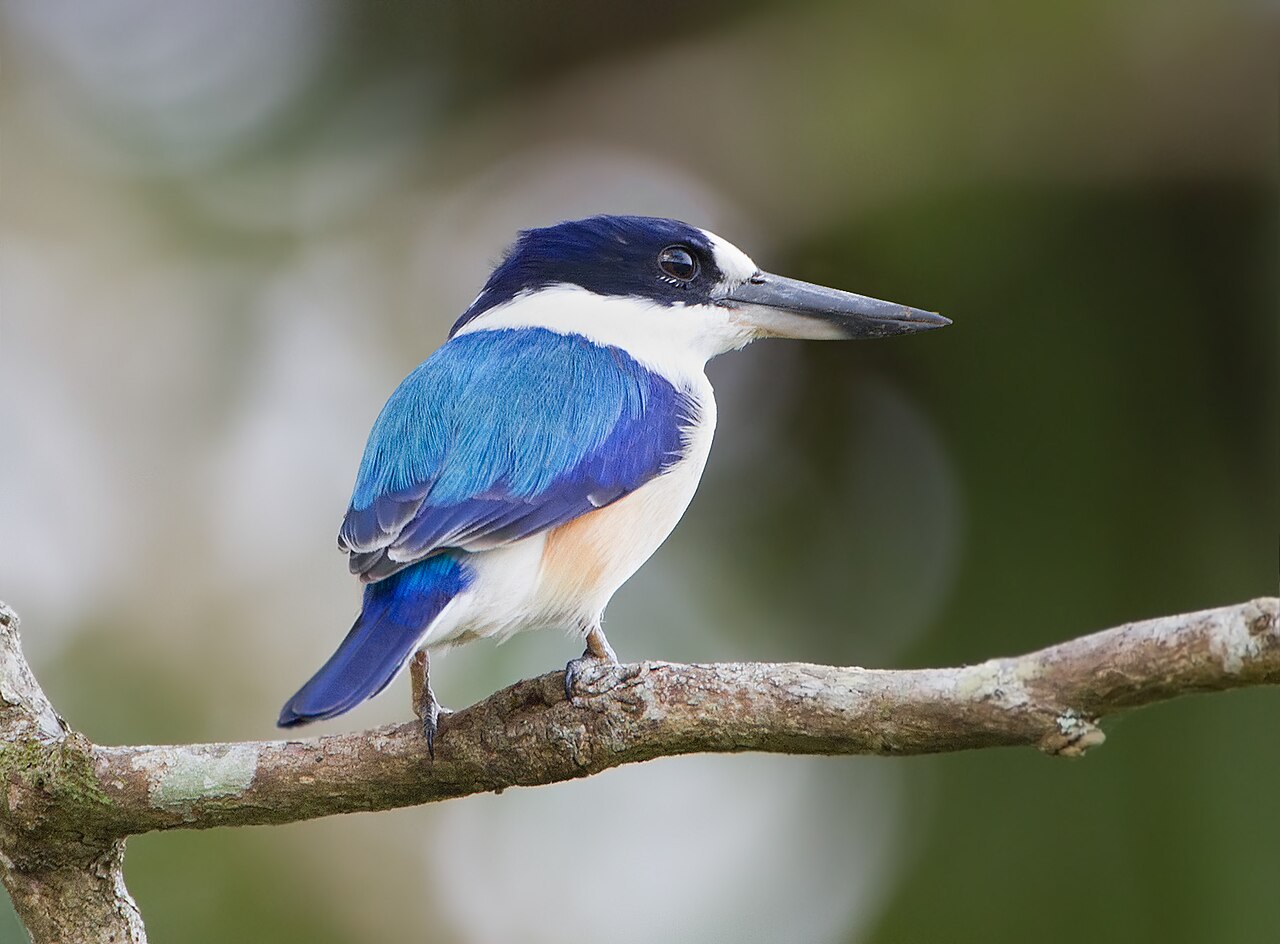
The Forest Kingfisher is the blue-and-white kingfisher of the tropical north: deep royal blue above, pure white below, with a white spot before the eye and a large white wing panel that flares at every flight. It likes to sit out in the open — on a wire, a bare twig or a roadside post — watching the ground below it.
Voice
The call is a shrill, high whistle repeated at a strict tempo: t-reek t-reek t-reek, dozens of times over and so even that Australians call it the 'machine gun'. It is loudest in the early morning and in the run-up to breeding. At the nest there are short hard rattles and an angry barking note.
Recording: Meena Haribal — CC BY-NC-SA 4.0 · Wooroonooran, Cairns Regional, Queensland, Australia · xeno-canto
Identification
A kingfisher of about twenty centimetres, with a deep blue crown, turquoise-blue back and blue tail, and wholly white underparts with no cream tone. A clear white spot sits before the eye, and a black band runs from the bill through the eye into the ear coverts. The male carries a white collar that runs right round the nape; on the female that nape is blue. The deciding feature shows only in flight: a large white window at the base of the primaries. The bill is long, straight and black, with a pink strip along the underside of the lower mandible.
Confusion species
Sacred Kingfisher (Todiramphus sanctus) is the hard one: cream rather than white below and with a cream collar, greener above, and lacking the white wing panel — that panel is the quickest decision on a bird flying off. Torresian Kingfisher (Todiramphus sordidus) is larger, heavier-billed, darker and duller above, and keeps to mangrove. Red-backed Kingfisher (Todiramphus pyrrhopygius) has a chestnut rump and a streaked pale crown and belongs to the dry interior, where this species rarely goes.
Habitat
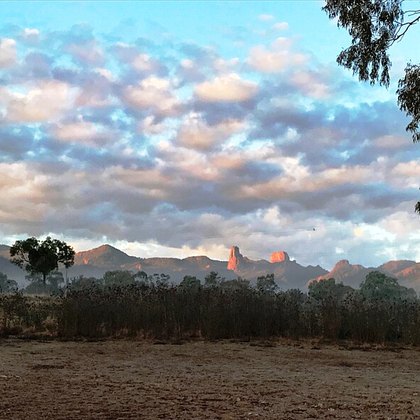
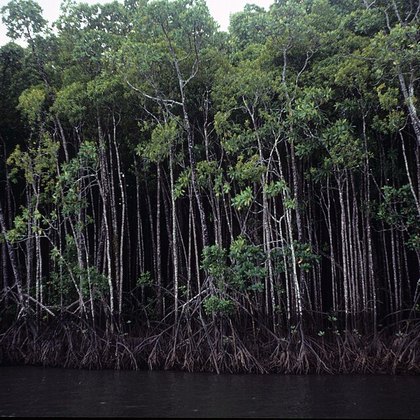
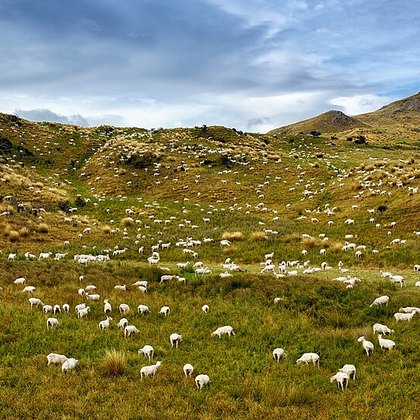
Open sclerophyll forest with a sparse or patchy understorey is the core; beyond that, vegetation along watercourses, the margins of swamps and billabongs (cut-off river channel that flows only at high water), melaleuca swamp, mangrove and farmland with scattered trees. It hunts in short sallies from a low branch for beetles, bugs, grasshoppers, spiders, worms, small lizards and frogs. The nest is nearly always a chamber the pair digs into an arboreal termite mound, four to twelve metres up.
Where the bird is most often found, arranged by main group and formation.


Range and movements
Two separate areas in the tropical and subtropical north: the nominate form from the Top End of the Northern Territory to the Gulf coast, and the form incinctus down the east coast from Cape York south to about the Macleay River and Port Stephens in New South Wales. In the north it stays year-round; in New South Wales and southern Queensland it is only a summer visitor. It does not occur in New Zealand.
- Resident
- dark = core range, pale = thinly spread
Where and when to look
In the north, drive a road through open forest and scan the wires, fence posts and dead branches: this is the kingfisher most often seen along roads. Make every blue kingfisher that flies off show you its wing — the white window in the primaries is unmistakable here and absent in all the others. In the early morning the relentless t-reek will point the bird out for you.
Conservation
Least Concern (LC), since the species is numerous across its range and uses disturbed and farmed country too. For nesting, though, it depends almost entirely on arboreal termite mounds in living or dead trees; where large trees carrying termitaria go out of the landscape, the nest sites go with them. The global trend is slightly downward.
Scientific name
Todiramphus macleayii | (Jardine & Selby, 1830)
Jardine and Selby described the species in 1830 as Halcyon macleayii; since it now sits in Todiramphus, authors and year take parentheses. The epithet honours Alexander Macleay (1767–1848), the Scottish entomologist who served as Colonial Secretary of New South Wales and built a famous insect collection in Sydney. No locality was given in the original description; Berlepsch designated Port Essington in the Northern Territory as the type locality in 1911.