All species › Kingfishers, bee-eaters and rollers › Kingfishers › Buff-breasted Paradise-Kingfisher
Buff-breasted Paradise-Kingfisher | Tanysiptera sylvia
Australische vlagstaartijsvogel | Alción colilargo silvia
The Buff-breasted Paradise-Kingfisher is the most exuberant bird of Australia's lowland rainforest: a blue kingfisher with a large red bill, warm buff underparts, a white patch on the back and two long white tail feathers that trail behind it like streamers. It is here for only half the year — it arrives from New Guinea in November to breed, and by April it is gone.

Voice
The call that fills the rainforest from late November is a clear, repeated choo-ka choo-ka choo-ka, also written ch-kow, in series of a few notes and often accompanied by a conspicuous swinging of the long tail. Pairs answer one another all morning. At the nest there is a harder, shorter rasp when an intruder comes near; outside the breeding season the bird is not present here and so not heard at all.
Recording: Zebedee Muller — CC BY-NC-SA 4.0 · Smithfield, Cairns Regional, Queensland, Australia · xeno-canto
Identification
Unmistakable: the male measures thirty-five centimetres with the tail included, of which the two elongated central tail feathers project thirteen centimetres beyond the rest and end in a widened, spatulate white tip; the female is thirty centimetres in all with an eight-centimetre projection. The bill is large and coral red, crown and wings deep blue to purple-blue, the underparts warm buff, and a white patch sits in the middle of the back. The body itself is no larger than a Sacred Kingfisher's — everything striking is in the bill and the tail.
Confusion species
No other kingfisher in Australia carries elongated tail feathers, so a well-seen bird cannot be confused. Only one with broken or not yet grown streamers can raise doubt; then the red bill, the white back patch and the buff underparts decide it, because every Todiramphus kingfisher here — Sacred Kingfisher (Todiramphus sanctus), Forest Kingfisher (Todiramphus macleayii) and relatives — has a black bill, no white on the back and white or cream underparts. Yellow-billed Kingfisher (Syma torotoro) also has a pale bill, but that one is yellow and the bird is orange-headed with a short tail.
Habitat
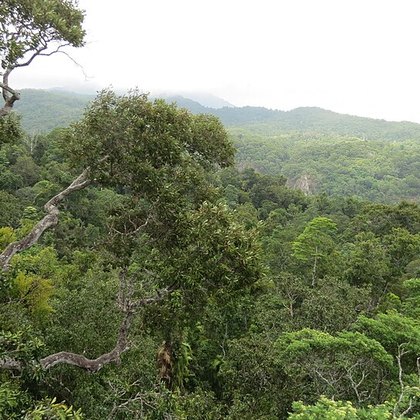
Tropical lowland rainforest and vine thicket, by preference where the floor is open and solid terrestrial termite mounds stand. Such a ground termitarium is indispensable for nesting: over three to four weeks the pair digs a tunnel of about fifteen centimetres into it, to a chamber in the heart of the mound. It hunts from a low branch in the shade of the lower storey for insects, worms, snails and small lizards taken off the forest floor.
Where the bird is most often found, arranged by main group and formation.

Range and movements
Northeastern Queensland only, in the narrow coastal belt of lowland rainforest between about Cooktown and Townsville — the Wet Tropics around the Daintree, Julatten, the Atherton Tablelands and Mission Beach — plus Cape York. It is present from November to early April; after that the whole breeding population crosses Torres Strait to New Guinea, a journey of four hundred to two thousand kilometres. It does not occur in New Zealand.
- Breeding (summer)
- dark = core range, pale = thinly spread
Where and when to look
Walk a rainforest track in the Wet Tropics between late November and March — Mission Beach, the Daintree or Julatten — and listen first: the repeated choo-ka series places the bird before you see it. Then search at eye level in the dim lower storey, because it perches lower than you expect, and watch for the white streamers, which catch the light even in dark forest. Keep away from a termite mound where a pair is digging.
Conservation
Least Concern (LC) globally, since the species is widespread across New Guinea and its surrounding islands. The Australian breeders, though, form a narrow strip wholly dependent on coastal lowland rainforest — precisely the forest type most heavily cleared in Queensland for cane and building — and they also need intact ground termite mounds. Cyclones that flatten lowland forest and the loss of corridors between forest remnants are the main local pressures.
Scientific name
Tanysiptera sylvia | Gould, 1850
John Gould described the species in 1850 as Tanysiptera sylvia, and it has stayed in that genus, so author and year carry no parentheses. The genus name goes back to Greek tanusipteros, 'long-feathered' or 'long-winged', and refers to the elongated tail feathers that mark the whole group. The epithet sylvia comes from Latin silva, 'forest'. The type locality is Cape York, Queensland.