All species › Kingfishers, bee-eaters and rollers › Kingfishers › Yellow-billed Kingfisher
Yellow-billed Kingfisher | Syma torotoro
Kleine geelsnavelijsvogel | Alción toro-toro
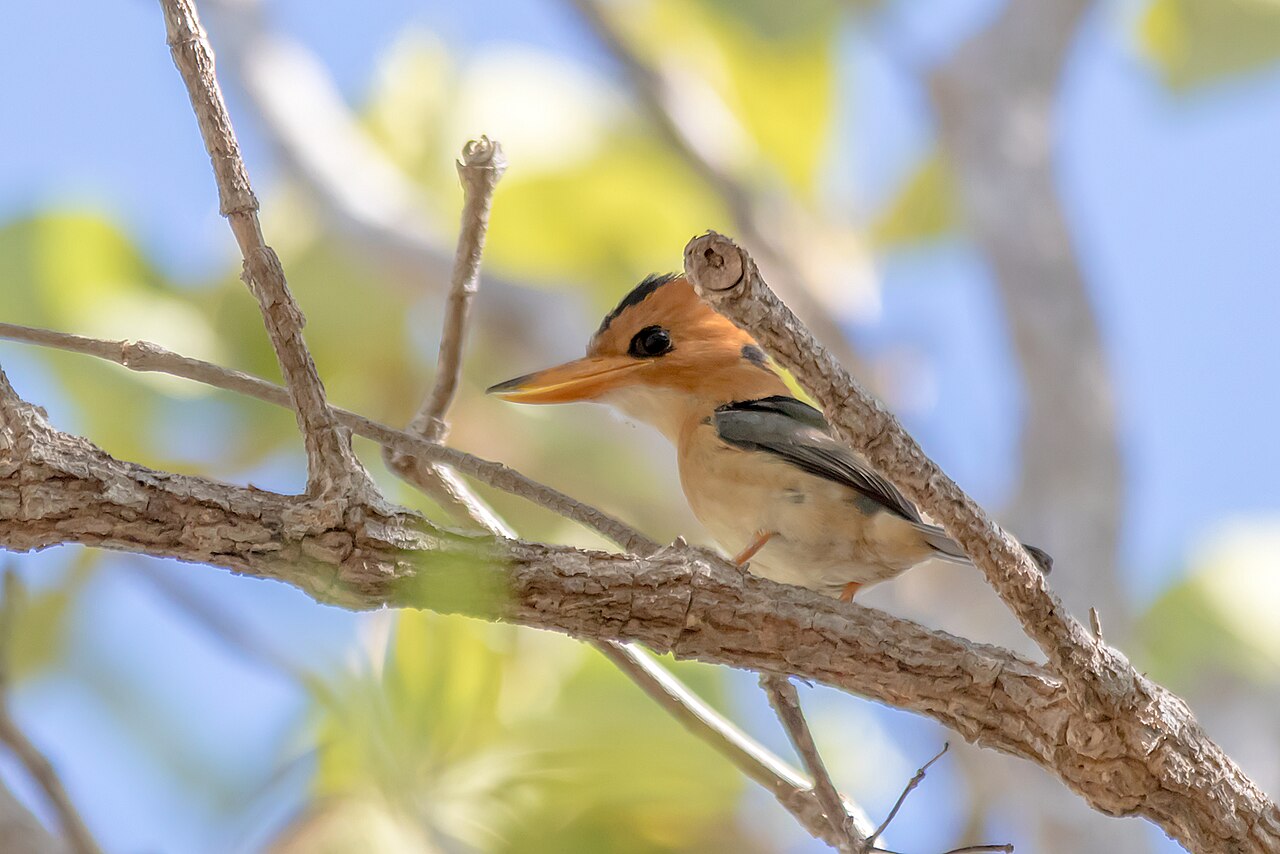
The Yellow-billed Kingfisher is the orange-headed kingfisher of the Cape York rainforest, and Australia's only kingfisher with a yellow bill. It is heard far more often than seen: a shrill whistled trill out of the low canopy, and when you finally find it, it is swaying gently to and fro on a branch.
Voice
The call is a long whistled trill that climbs and then falls away again, often likened in Australia to a postman's whistle: trrreew, repeated several times, and in the breeding season kept up all morning. It usually calls hidden in the lower canopy, so that the sound seems to come from every direction. Short, hard kek notes are added when the bird is uneasy.
No freely licensed recording has been found for this species yet; what to listen for is described below.
Identification
A stocky kingfisher of twenty centimetres with a wingspan of nearly thirty, of which the heavy orange-yellow bill is the first thing you notice — no other Australian kingfisher has one. Head and neck are orange with a white throat and a black patch on the nape; the mantle is blackish and grades through olive-green into blue-green on the rump, the tail is blue and the underparts pale orange-buff. The female additionally carries a black patch in the middle of the crown. Young birds have a dark grey bill and scaling on the breast.
Confusion species
The yellow bill settles identification in Australia: every Todiramphus and Ceyx kingfisher here has a black bill, and only Buff-breasted Paradise Kingfisher (Tanysiptera sylvia), which shares the same rainforest, also has a pale bill — but that one is coral red, and the bird carries long white tail streamers and a blue crown. An orange head might at range suggest a small kookaburra, but at twenty centimetres this bird is only half the size. The related montane form Syma megarhyncha is confined to the mountains of New Guinea and does not reach Australia.
Habitat
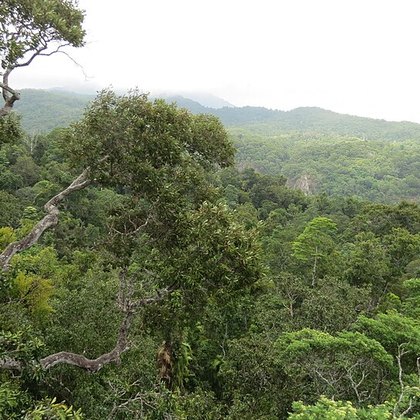
Tropical lowland rainforest, monsoon forest, vine thicket and forest edge, including disturbed forest and the sides of forest tracks. It hunts from the low canopy, where it sits swaying on a branch until it drops to the forest floor for large insects, earthworms and small reptiles — so it is far more a forest bird than a water bird. The nest is a chamber the pair digs out of an arboreal termite mound; the clutch is three or four glossy white rounded eggs.
Where the bird is most often found, arranged by main group and formation.

Range and movements
Within this guide's map window, only the northern tip of Cape York Peninsula in Queensland: from about the Iron Range (Kutini-Payamu) and the McIlwraith Range north to the tip. Elsewhere in Australia it is absent, and it does not occur in New Zealand. The weight of the world range lies in lowland New Guinea and the surrounding islands.
- Resident
- dark = core range, pale = thinly spread
Where and when to look
Go to Iron Range National Park (Kutini-Payamu) or the McIlwraith Range country, preferably in or just after the wet season, and listen in the morning for the whistled trill. Then search from eye level up to about ten metres: the bird sits still, and the swaying of head and body gives it away sooner than the colour does. Remember that the yellow bill is the only mark you need.
Conservation
Least Concern (LC): the range is large, numbers are stable and on New Guinea the species is common. The Australian part of the range is small, though, and confined to the rainforest of Cape York; that forest is largely intact and substantially protected, so the main concern there is not clearing but a changing fire regime and the effects of cyclones.
Scientific name
Syma torotoro | Lesson, 1827
Rene Primevere Lesson described the species in 1827 as Syma torotoro, and it has stayed in that genus, so author and year carry no parentheses. The genus name Syma goes back to Syme, a nymph of Greek myth. The epithet torotoro is onomatopoeic and comes from a Papuan language, where it refers to the bird's call. The type locality is Dorey, now Manokwari, on the northwest coast of New Guinea.