All species › Passerines › Crows, jays and magpies › Forest Raven
Forest Raven | Corvus tasmanicus
Tasmaanse raaf | Cuervo de Tasmania
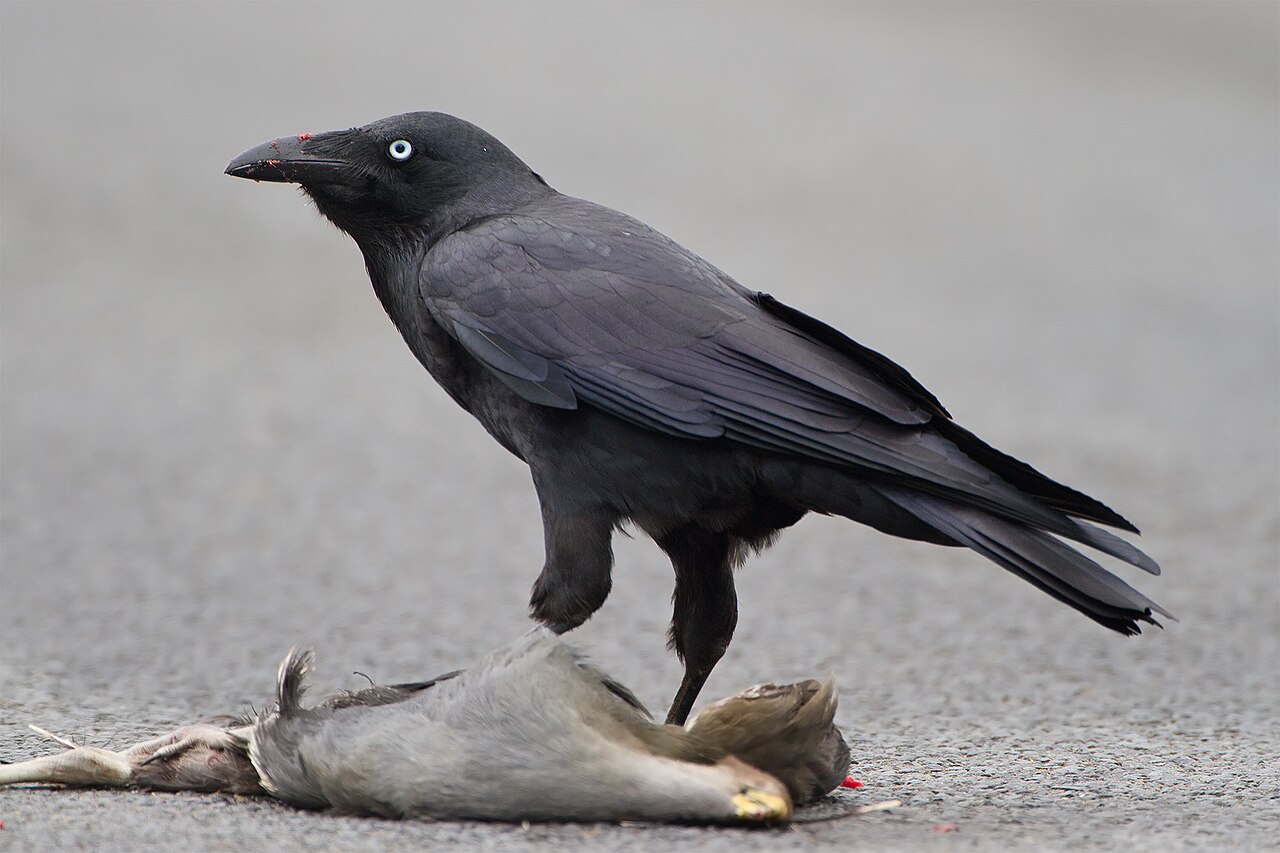
The Forest Raven is the heaviest corvid in Australia and on Tasmania the only one: a big black bird with a white eye there is this species and no other. On the mainland it is different — there it lives in a handful of separate forest populations among relatives that look almost identical, and one of the country's stiffest identification problems begins.
Voice
A deep husky series, korr-korr-korr-korr, whose last note, as in Australian Raven, is drawn out and dies away. Pairs greet one another with a long descending call, accompanied by a conspicuous flapping flight. The tone is fuller and rounder than the nasal yapping of Little Crow and slower than the croaking of Little Raven.
No freely licensed recording has been found for this species yet; what to listen for is described below.
Identification
A heavy, stocky corvid of 50 to 53 centimetres with a wingspan over a metre, wholly glossy black with a blue or green sheen on the upperparts. The bill is massive and deep, the tail relatively short, which makes the silhouette compact. Adults have a white eye; young birds pass through blue-grey, brown and hazel with a blue ring around the pupil before the eye turns white at nearly three years. The feather bases are grey, as in all ravens.
Confusion species
In Tasmania the problem is small: no other Corvus occurs there, and Black Currawong (Strepera fuliginosa) gives itself away by the yellow eye, the white in wing and tail, the slimmer wing and the very different call. On the mainland it is hard: Australian Raven (Corvus coronoides) is as long but slimmer, with a longer tail and longer throat hackles; Little Raven (C. mellori) is smaller with a much lighter bill. The heavy bill, the short tail and the voice decide — and even then a silent bird outside the Tasmanian range often cannot be named.
Habitat
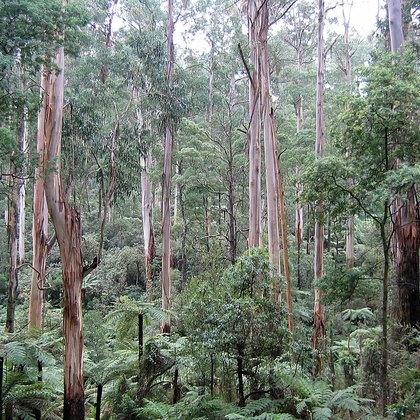
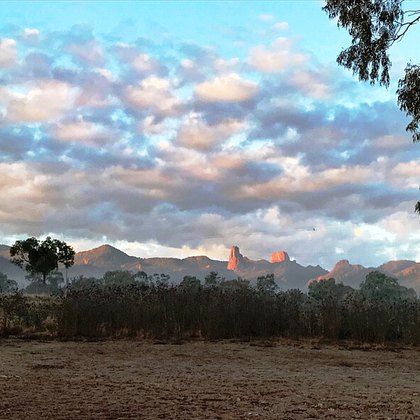
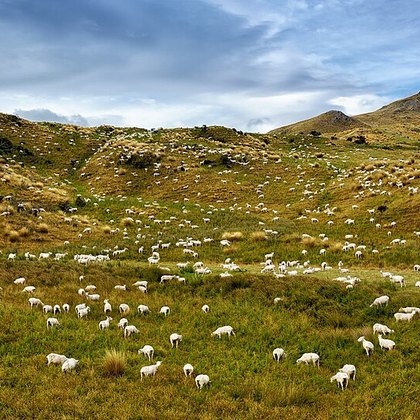
In Tasmania almost everywhere: forest and open woodland, mountains, coast, farmland and the edges of towns. On the mainland it is far more strictly tied to wet and dry sclerophyll forest and cool temperate rainforest, along with pine plantations. Everywhere it works road casualties, rubbish tips and picnic grounds; carrion makes up a larger share of the diet than in the smaller corvids.
Where the bird is most often found, arranged by main group and formation.


Range and movements
All of Tasmania, where it is the only corvid; in Victoria from Lakes Entrance through Gippsland to Wilsons Promontory, the Otway Ranges and the Grampians; and in northern New South Wales two separate populations, one coastal and one montane. Two subspecies, tasmanicus and the northern boreus. Sedentary; pairs stay together for life and hold a fixed territory.
- Resident
- dark = core range, pale = thinly spread
Where and when to look
In Tasmania range settles it: any raven-like bird there is this species. Elsewhere take the bill first — massive and deep — and the short tail, which makes the bird look almost blunt in flight. Wait for the call to be sure; and on the mainland feel free to leave a silent bird unidentified, because experienced observers do the same.
Conservation
Least Concern (LC) and numerous in Tasmania. The northern mainland populations in New South Wales are another matter: small, separated from one another, estimated around 2000 at some ten thousand breeding pairs and flagged as of concern. Logging of old forest and fragmentation hit exactly those populations; in Tasmania itself traffic and persecution on farmland are the main causes of death.
Scientific name
Corvus tasmanicus | Mathews, 1912
Mathews described the taxon in 1912 as the subspecies Corvus marianae tasmanicus, with Tasmania as type locality; Ian Rowley raised it to species rank in 1970. Author and year stand without parentheses because the genus Corvus was never left. Corvus is Latin for raven, tasmanicus refers to the island. The English name names not the island but the mainland habitat.