All species › Passerines › Stitchbird › Stitchbird
Stitchbird | Notiomystis cincta
Geelbandhoningzuiger | Hihi
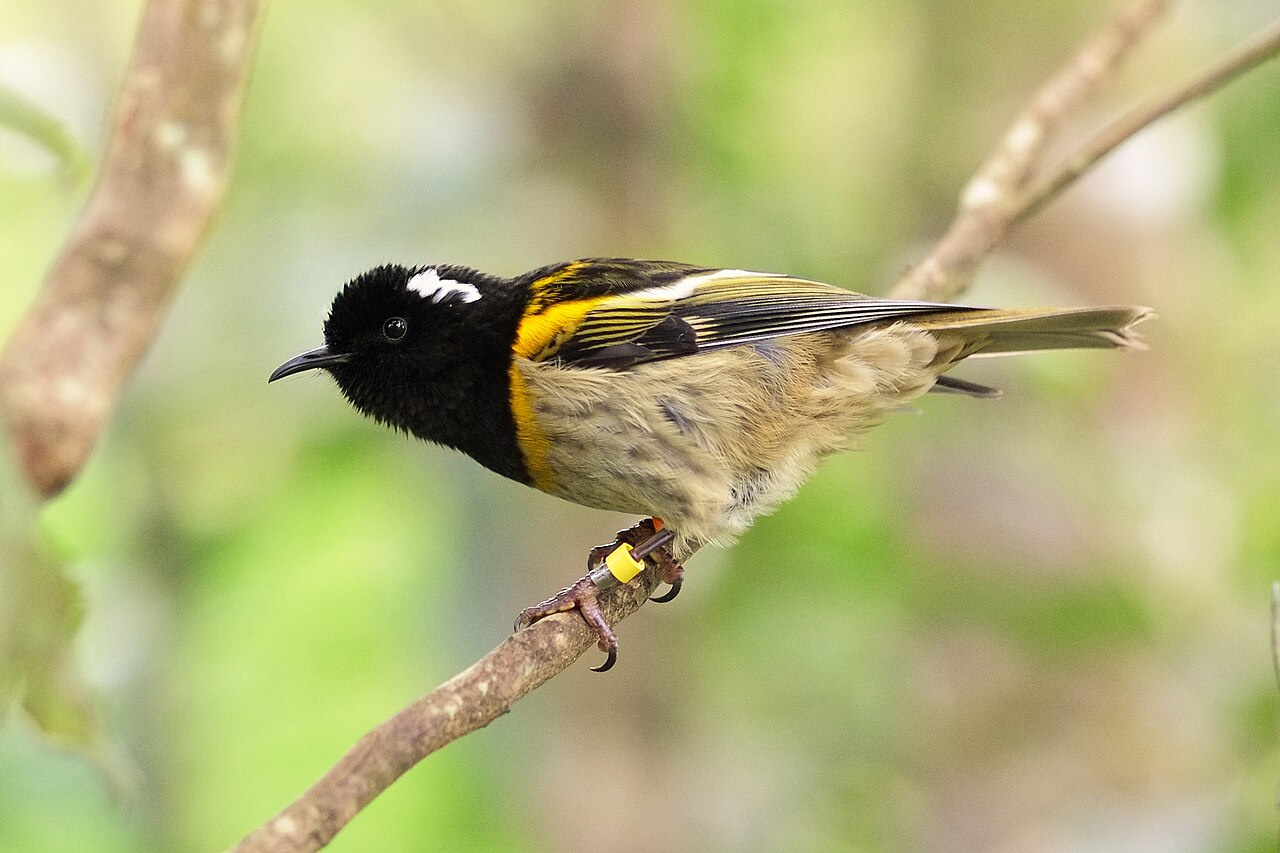
The Stitchbird, hihi in New Zealand, is the only species in a bird family of its own: not a honeyeater, as was long assumed, but the nearest relative of kokako and saddleback. The male is black with white ear tufts and a bright yellow band across breast and shoulder, and the species survived the rat invasion on a single island.
Voice
The commonest sound is a short, high tzit, given by both sexes as a warning and the origin of the English name — it carries the sound of a needle being drawn through cloth. The male adds a piercing whistle of two or three notes with many variants on it, and a soft warbling at the nest hole. In disputes over a nectar source comes a fast, scolding rattle.
No freely licensed recording has been found for this species yet; what to listen for is described below.
Identification
A medium-sized songbird of eighteen centimetres with a slender, slightly decurved black bill and a habit of carrying the tail cocked. The male has a velvet-black head with short white ear tufts, a yellow band running from the breast across the shoulder, and white wing bars. Female and young birds are grey-brown, without the black head and without any yellow, but they keep the striking white wing bar and the cocked tail.
Confusion species
New Zealand Bellbird (Anthornis melanura) is olive-green with a purplish sheen on the head and lacks the white wing bar; Tui (Prosthemadera novaeseelandiae) is far larger and dark with the white throat tuft. Female Stitchbirds are most often taken for a bellbird or a Silvereye (Zosterops lateralis); look then at the white wing bar and at the upright tail, which neither of those shows.
Habitat
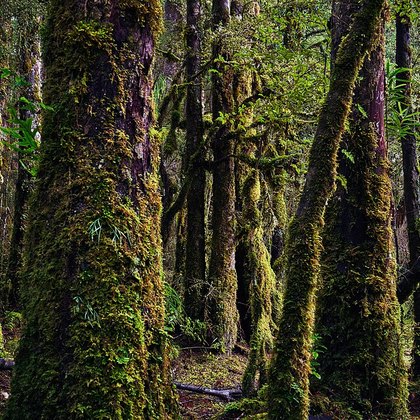
Old, closed podocarp-broadleaf forest rich in flowering and fruiting species, and on Hauturu the stands carrying kauri as well. It needs cavities high in old trees to nest in, and that is the bottleneck: younger forest offers none, so at most sites nest boxes have been put up. Where sugar water is supplied it also holds on in younger, regenerating forest.
Where the bird is most often found, arranged by main group and formation.

Range and movements
Formerly across the whole North Island and on Great Barrier, Little Barrier and Kapiti. After 1885 only the population on Hauturu, Little Barrier, was left, and everything else now standing comes from translocation: Kapiti, Tiritiri Matangi, Zealandia in Wellington, Maungatautari, Bushy Park and Rotokare. It does not migrate; birds stay within the forest of their island or reserve, and young settle close to where they hatched.
- Resident
- dark = core range, pale = thinly spread
Where and when to look
On Tiritiri Matangi or in Zealandia, stand at a sugar-water feeder or a flowering flax and wait for the sharp tzit; the bird nearly always comes to the nectar. Watch posture rather than colour: a small forest bird carrying its tail cocked and showing a white bar in the wing is this species, even when the yellow is missing. In spring, from September to December, the males are at their loudest.
Conservation
Vulnerable (VU), and under criterion D2 at that: the number of mature birds runs to some two and a half to three and a half thousand, but the number of populations is so small that one mishap could reverse everything. In New Zealand it is listed as Nationally Vulnerable. The ship rat caused the historic collapse; today fungal infection with Aspergillus fumigatus, shortage of nest cavities and shortage of food weigh heaviest, and most populations lean on supplementary feeding and boxes.
Scientific name
Notiomystis cincta | (Du Bus de Gisignies, 1839)
Du Bus de Gisignies described the bird in 1839 in another genus, so author and year stand in parentheses. The genus Notiomystis was introduced by Richmond in 1908; its first element is Greek notios, 'southern'. The epithet cincta is Latin for 'girdled' and refers to the yellow band across the breast. The species was long placed with the honeyeaters; since 2007 it has a family of its own, the Notiomystidae, alongside the New Zealand Callaeidae.