All species › Passerines › New Zealand wattlebirds › North Island Kokako
North Island Kokako | Callaeas wilsoni
Noordelijke kokako | Kokako de Isla Norte
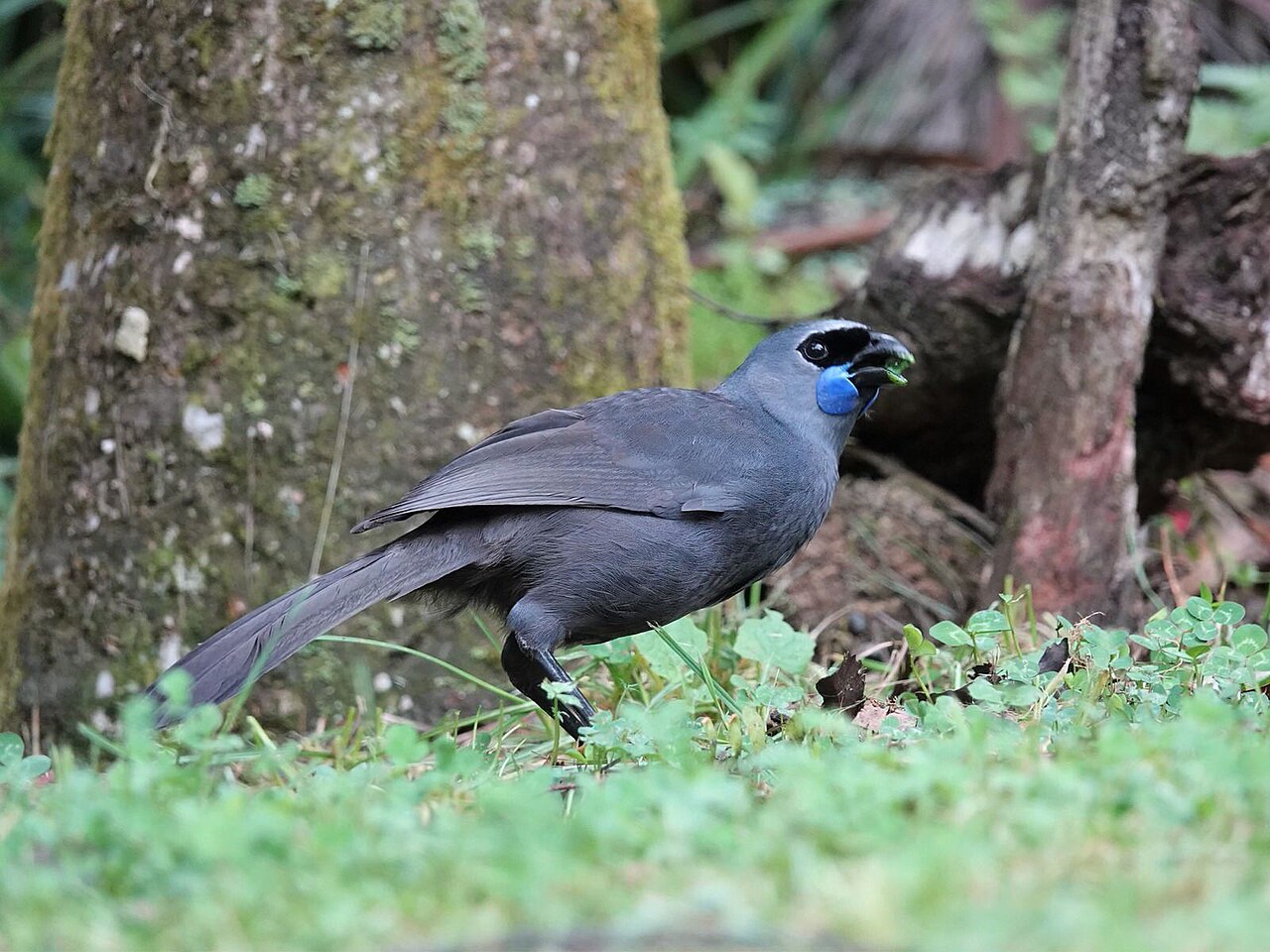
The North Island Kokako is the singer of the old forest of the North Island: a blue-grey bird with a black mask and two small, deeply blue wattles at the base of the bill. It hardly flies — it runs and bounds along the branches and glides from tree to tree — but its organ-like song carries across whole valleys at dawn, and that is nearly always how you meet it.
Voice
The song is made of full, sustained organ notes set slowly one after another, mournful and deeper than a songbird is expected to sound. Both sexes sing, often in duet from a high perch, the pair running their notes into one another. Alongside it is a short contact call, a repeated took, which betrays a bird moving close by through the canopy. The song comes chiefly in the first hours after sunrise.
Recording: David Bradley — CC BY-NC-SA 4.0 · Waipapa Ecological Area, Pureora Forest, North Island, New Zealand · xeno-canto
Identification
A substantial blue-grey songbird of nearly forty centimetres, with long strong legs, a long tail that bends downward at the tip and a short black bill. A velvet-black mask runs across the face, and a small, richly blue wattle hangs at either side of the bill base. Young birds have pink to lilac wattles that turn blue with the years; in old birds they are sometimes flushed orange. The sexes look alike.
Confusion species
Little in the same forest resembles it: Tui (Prosthemadera novaeseelandiae) is dark with a white throat tuft and flies noisily and fast, and North Island Saddleback (Philesturnus rufusater) is black with a chestnut back and far smaller. South Island Kokako (Callaeas cinereus) had orange wattles and is regarded as extinct; an encounter is out of the question. Anyone who sees a grey bird run rather than hop along the branches has this species almost for certain.
Habitat
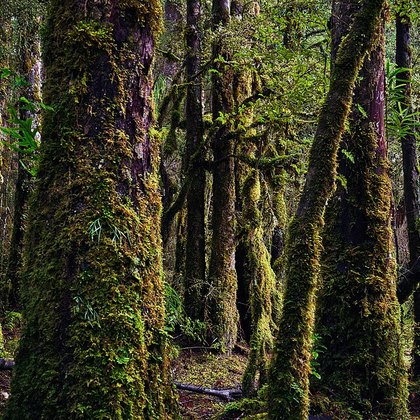
Tall, diverse native forest dominated by tawa or taraire with podocarps or kauri emerging above it. It needs a forest that offers something all year round, because it lives on leaf, fruit, flower and insect in turn, and only species-rich forest can supply that. Regenerating forest is taken up as soon as the canopy closes and the first fruiting trees join in.
Where the bird is most often found, arranged by main group and formation.

Range and movements
The North Island of New Zealand and its offshore islands only. Eleven relict natural populations survive in scattered forests in Waikato, the Bay of Plenty, Te Urewera, South Auckland and Northland; since 1981 the bird has also been moved to fourteen further sites, among them Tiritiri Matangi, Kapiti and Little Barrier and a series of mainland reserves under predator control. It does not migrate: a pair holds the same territory for years.
- Resident
- dark = core range, pale = thinly spread
Where and when to look
Stand still on a forest track in Pureora or Whirinaki at first light and listen; the song carries hundreds of metres and is the only thing that gives the bird away at range. Then walk in on the sound and search the canopy for movement rather than for colour, because against the light the blue-grey simply reads as dark. From October to February it sings most.
Conservation
Least Concern (LC) on the Red List, and in New Zealand listed as Nationally Increasing — one of the few reversals in the New Zealand forest. From about three hundred and thirty pairs in 1999 the population has risen, through rat control, possum control and translocation, to around two thousand two hundred pairs in 2023. Ship rat and possum (climbing marsupial) remain the cause of every local setback: they take the nests, where the sitting female stays put for days.
Scientific name
Callaeas wilsoni | (Bonaparte, 1850)
Bonaparte described the bird in 1850 in another genus, so author and year stand in parentheses. The genus Callaeas was introduced by J. R. Forster in 1788 and is formed on Ancient Greek kallaia, 'a cock's wattles'. The epithet wilsoni honours a man named Wilson; which one is not known with certainty. This guide keeps Callaeas wilsoni as a species of its own, while GBIF still carries the name as a synonym under the extinct South Island Kokako Callaeas cinereus.