All species › Passerines › New Zealand wattlebirds › South Island Saddleback
South Island Saddleback | Philesturnus carunculatus
Zuidelijke zadelrug | Tieke de Isla Sur
The South Island Saddleback is a glossy black forest bird with a rust-brown saddle across back and rump and two orange-red wattles at the base of the bill. It is best known for what happened to it in 1964: when the species was down to a few hundred birds on a single islet and rats invaded that island, thirty-six birds were moved to two rat-free islands. It was the first time anywhere in the world that a bird species was saved from extinction in this way, and every saddleback alive today descends from those thirty-six.

Voice
A loud, ringing bird that fills the forest. The characteristic call is a clear, emphatic cheet-cheet-te-te-te-te, opening with a few separate notes and running into a fast rattling tail; pairs call in turn and keep it up at length. There is also a hard clicking alarm and a soft churring while feeding. Remarkably, each island population develops its own dialect: males learn their territorial song from their neighbours, so that birds on Ulva sound different from those on Motuara, and old recordings of the original population contain song types no longer heard anywhere.
Recording: David Welch — CC BY-NC-SA 4.0 · Ulva Island, New Zealand · xeno-canto
Identification
Twenty-five centimetres, with long legs and a fairly long tail. The plumage is deep glossy black with a sharply bounded chestnut to rust-brown saddle covering back, shoulders and rump and running onto the wing coverts; the undertail coverts are rust-brown too. A fleshy orange-red wattle hangs at either side of the base of the bill. The sexes look alike; the male is larger with larger wattles. Important for this southern species: the young are uniformly chocolate-brown with no saddle at all, a plumage so different that it was once taken for a separate species and in English is still called the jackbird. The bird flies poorly and moves mostly by bounding through the understorey and over the ground, where it prises open bark and moss with its stout bill.
Confusion species
Within the present range confusion is hardly possible, since there is no second black forest bird with a brown saddle. North Island Saddleback (Philesturnus rufusater) is the closest relative and was long treated as a subspecies of this one; it occurs only on the North Island and its offshore islands, carries a narrow ochre-yellow border along the front edge of the saddle that this species lacks, and its young already wear the saddle. North Island Kokako (Callaeas wilsoni) is the other wattlebird: far larger, blue-grey rather than black, with blue wattles and a quite different organ-like song. A Common Blackbird (Turdus merula) is plain black without saddle or wattles, and has a yellow bill.
Habitat
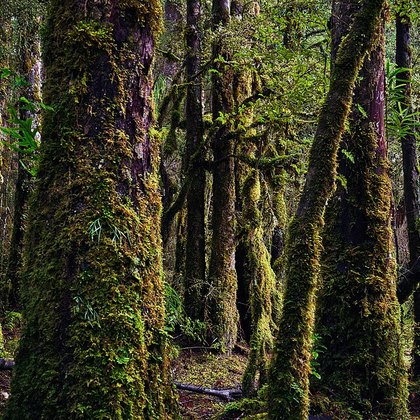
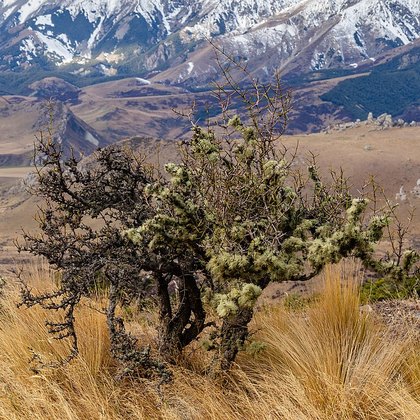
Native forest with a dense shrub layer and a deep litter layer: mixed podocarp-broadleaf forest on the islands, southern beech forest, and on the smaller, rougher islands also low scrub of manuka and muehlenbeckia stunted by salt and wind. The species needs little beyond dead wood, moss and epiphytes to rummage in and cavities to nest in, and so accepts fairly poor forest as long as there are no predators. It forages low: across the forest floor in the litter, along fallen trunks, and climbing trunks and branches, levering off bark with the bill to find beetles, grubs and weta. It nests in cavities and recesses — in trunks, under fallen trees, among rocks — which is what makes it so vulnerable where rats are present.
Where the bird is most often found, arranged by main group and formation.

Range and movements
Endemic to New Zealand. The species originally occupied forest throughout the South Island and Stewart Island, but had gone from the mainland by about 1905 and thereafter held on only on a few small islands off Stewart Island. Today, entirely through translocation, it occurs on more than fifteen predator-free islands, among them Ulva, Motuara, Breaksea, Anchor, Putauhinu and Whenua Hou, and in a few fenced mainland sanctuaries such as Orokonui near Dunedin. Outside those protected places the species does not exist: there is no free-living mainland population, and there is no migration — the birds fly so poorly that they will not cross even narrow straits of their own accord.
- Resident
- Breeding (summer)
- dark = core range, pale = thinly spread
Where and when to look
One of the easiest New Zealand endemics to see well, provided one is in the right place. On Ulva Island or Motuara Island the birds work right beside the track and allow an approach to a few metres; stand still on the track and wait, because a saddleback rummaging on the forest floor works its own way towards you. Listen for the ringing cheet-cheet-te-te-te and for the sound of bark being torn low down, which often registers before the bird itself does. When boarding a boat to such an island, check your bag and boots for stowaways: one pregnant rat is enough to erase an entire population.
Conservation
Least Concern (LC) on the world list, but those reassuring letters hide one of the sharpest stories in conservation. Rats, stoats and cats, together with the loss of lowland forest, drove the species off the whole South Island within half a century; by about 1905 the mainland was empty and only a handful of islets off Stewart Island remained. In 1962 ship rats reached Taukihepa (Big South Cape Island), by far the largest stronghold. The forest was eaten out within two years; the Stead's Bush Wren and the greater short-tailed bat were lost for good in the same event. In 1964 staff of the Wildlife Service, among them Don Merton and Brian Bell, moved thirty-six saddlebacks to two nearby rat-free islands. That it would work was far from certain at the time, and it became the blueprint for everything afterwards done in New Zealand with Kakapo, South Island Takahe and Black Robin. The population grew from those thirty-six birds to well over two thousand on more than fifteen islands. The weak point has remained: every bird descends from a handful of ancestors, they nest in cavities near the ground, they fly badly, and a single rat coming ashore can empty an island again. The species is therefore not saved but managed, and the single most important protective measure is that the islands stay free of predators.
Scientific name
Philesturnus carunculatus | (Gmelin, 1789)
Johann Friedrich Gmelin described the species in 1789 from the South Island as Sturnus carunculatus — as a starling, that is; because it now stands in Philesturnus, author and year go in parentheses. The epithet carunculatus is Latin for 'having a small fleshy caruncle' and refers to the orange-red wattles. The genus name Philesturnus is formed from Ancient Greek phileo ('to love') and Latin sturnus ('starling'), and preserves the old, mistaken relationship: the wattlebirds are an ancient, exclusively New Zealand family with no connection to starlings. In Maori the bird is tieke, a name imitating its call. The Dutch zadelrug and the English Saddleback describe the rust-brown saddle; Spanish uses tieke de Isla Sur.