All species › Passerines › New Zealand wattlebirds › North Island Saddleback
North Island Saddleback | Philesturnus rufusater
Noordelijke zadelrug | Tieke de isla Norte
The North Island saddleback, tīeke in Māori, is a black bird with a chestnut saddle, fiery red wattles at the bill base and a voice that carries far through the forest. It flies badly and climbs superbly, hammering dead wood apart in search of grubs. In the 1890s it was all but gone: one natural population on Hen Island, about five hundred birds. Sixty years of translocation, fencing and rat eradication later the count is above seven thousand, and it has recently been recognised as a species in its own right, separate from its southern counterpart.

Voice
The male commands more than two hundred song variants, all built to one recipe: two to four short introductory chips, followed by a series of highly stereotyped, repeated phrases. Neighbouring males copy one another's variant, so that an island effectively breaks up into dialect districts. There is also a loud, rattling, almost chattering call — the sound the Māori word tīeke is drawn from — and soft, flute-like contact notes that differ between the sexes and carry only a few metres. The overall impression is loud: in a forest full of saddlebacks the species is background noise rather than a find.
No freely licensed recording has been found for this species yet; what to listen for is described below.
Identification
A stocky songbird of 25 cm and 70 to 80 g, glossy black with a sharply cut chestnut saddle across the back, continuing over rump and uppertail coverts. Along the leading edge of that saddle runs a narrow ochre-gold band — the mark of this species. The bill is black, straight and pointed, starling-like, and at its base hang two fleshy orange-red wattles that grow with age; males have larger ones than females of the same age. The legs are heavy and long, the tail nearly as long as the wing. Young birds are duller black with dusty brown feather tips, small wattles and no gold band yet, but they already wear the chestnut saddle from the moment they fledge.
Confusion species
The nearest relative is the South Island saddleback (Philesturnus carunculatus), which has its own page in this guide and was until recently treated as the same species. Unlike the two New Zealand robins, these two can genuinely be separated, in two ways. The adult northern bird has a narrow ochre-gold band along the leading edge of the saddle which the southern bird lacks entirely. And the juvenile plumage differs fundamentally: young South Island saddlebacks wear the famous 'jackbird' plumage, uniform chocolate brown with no saddle at all — so different that they were once taken for a separate species — whereas young North Island birds already have the saddle, merely without the gold band. There is no overlap: this species occurs only on the North Island and its offshore islands, the southern one only south of Cook Strait. Confusion with other black forest birds is slight; the North Island kokako (Callaeas wilsoni) belongs to the same family and also has wattles, but is much larger, blue-grey rather than black, lacks the saddle and has blue rather than orange-red wattles. The starling, which at a distance is the nearest match in bill and gait, is smaller and speckled dark throughout.
Habitat
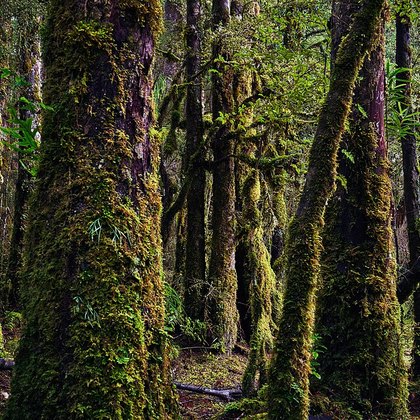
Coastal and inland forest from sea level to above six hundred metres, with a marked preference for structurally rich regenerating scrub and podocarp-broadleaf forest with plenty of dead wood. On the islands it now occupies — often kauri-bearing forest ringed by dense manuka and kanuka — it lives largely in the lowest four metres, stripping branches and prising bark off dead trunks. Decisive is the presence of cavities: it roosts and nests in tree hollows, rock crevices and even nest boxes, and it is exactly this that makes ground without old trees unusable for it.
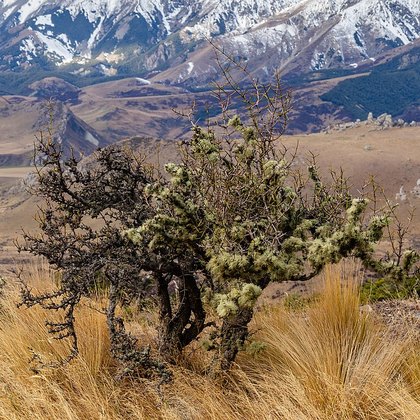
Where the bird is most often found, arranged by main group and formation.

Range and movements
Resident on the North Island of New Zealand and its offshore islands; measurements for this guide give ten qualifying years out of ten and 18,223 records, with five resident units and one breeding unit. The only natural population never lost sits on Hen Island (Taranga), about five hundred birds; Coppermine Island was colonised naturally. Every other population is made: since 1964 the species has been released on more than sixteen islands, among them Little Barrier, Tiritiri Matangi, Kapiti, Cuvier, Red Mercury, Mokoia, Moutohora, Motuihe, Rangitoto and Motutapu, and between 2002 and 2018 into six fenced mainland sanctuaries, starting with Zealandia in Wellington. The total is above seven thousand and probably heading for ten. This is a recent AviList split not yet carried through in GBIF's backbone taxonomy, so the figures were measured separately at subspecies level.
- Resident
- Breeding (summer)
- dark = core range, pale = thinly spread
Where and when to look
Go to Tiritiri Matangi or Zealandia and listen to dead wood. The sound of a saddleback prising off bark — a dry, irregular cracking and tapping at knee height — gives it away more often than its song does, since it sings from a fixed perch and is then hard to miss anyway. Check the leading edge of the saddle on every bird you see: that thin gold line is the one thing separating it from the southern species should the locality ever be in doubt.
Conservation
The IUCN lists the species as Near Threatened and the New Zealand list calls it Relict: the present distribution is a fraction of the original and almost entirely man-made. The cause of the collapse around 1890 was the stoat, combined with rats. The species roosts and nests in cavities at low height and flies poorly, and that combination makes it unusually defenceless: a single pregnant stoat on an island can erase a whole population. Against that, the recovery operation ranks among the most successful anywhere — start early, spread many small populations, keep islands predator-free — and numbers have risen for sixty years. The vulnerability remains structural: many of those populations are small, genetically narrow and dependent on permanent predator control.
Scientific name
Philesturnus rufusater | (Lesson, 1828)
The Dutch name puts the compass element before the group name, against the southern saddleback, and 'zadelrug' is a fairly literal rendering of 'saddleback': the chestnut panel lies across the back like a saddle. The specific name rufusater fuses Latin rufus 'reddish-brown' and ater 'black', describing the bird completely in two words. The Māori name tīeke is onomatopoeic, from the rattling call. The family, the Callaeidae or wattlebirds, is endemic to New Zealand and, since the huia's extinction, contains only two genera.