All species › Passerines › Australasian robins › Southern Scrub Robin
Southern Scrub Robin | Drymodes brunneopygia
Malleefluiter | Petroica matorralera sureña
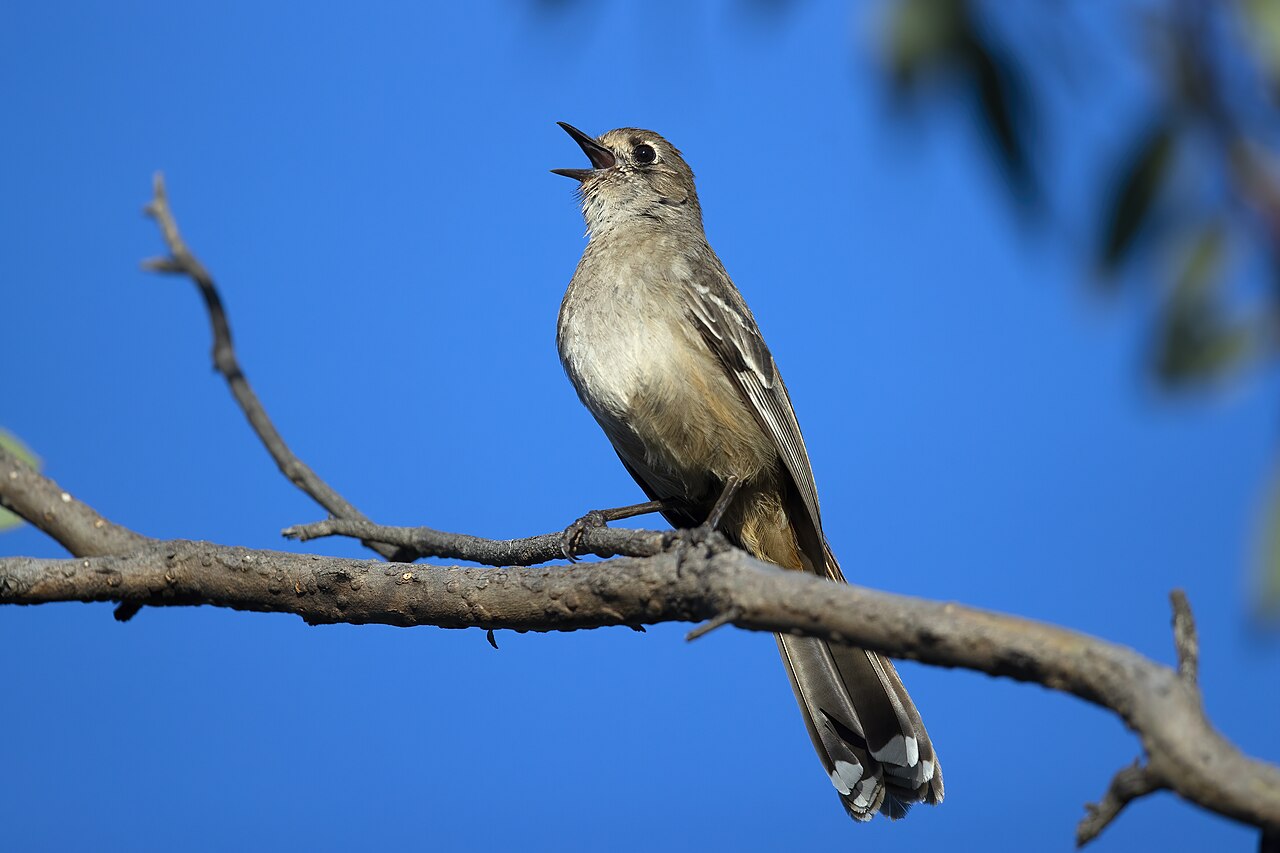
The Southern Scrub Robin is a large, long-legged, ground-dwelling robin of the mallee (low, multi-stemmed eucalypt scrub of dry southern Australia) and dry scrub of southern Australia. It walks and hops through the litter beneath the bushes, pushes leaves aside with its bill, and makes itself known almost solely by a clear, far-carrying whistle.
Voice
A loud, pure whistled series that carries for hundreds of metres, often of three or four notes with the last rising sharply; it repeats the series at long intervals, chiefly at sunrise and towards evening. Because the notes are pure and the scrub is dense, the sound seems to come from a different direction each time. When disturbed it gives a harsh rattling scold from the ground.
Recording: Craig Robertson — CC BY-NC-SA 4.0 · Monkey Mia, Shire of Shark Bay, Western Australia, Australia · xeno-canto
Identification
Twenty-one to twenty-three centimetres, with long pale legs and a long tail often carried slightly cocked. The upperparts are plain grey-brown, the only touch of colour a warm rufous rump and tail base; the underparts are off-white to pale buff. A dark line runs through the eye, ringed by a pale eye-ring that makes the eye look large. The dark wing carries two narrow white bars. Male and female look alike. It walks and hops and seldom flies.
Confusion species
Its only congener, Northern Scrub Robin (Drymodes superciliaris), lives in the rainforest of northern Cape York, thousands of kilometres away; the two never meet, yet in build and behaviour they are unmistakably related. The northern bird is also far more rufous and carries a sharp white eyebrow, which this species lacks. Within the mallee itself, Chestnut Quail-Thrush (Cinclosoma castanotum) is the other large bird of the ground: it is bulkier and more thickset, with a chestnut back, a black throat in the male and a bold black-and-white breast pattern, and it runs rather than hops. A slim, plain grey-brown ground bird with long legs and a pale eye-ring in the mallee is almost always this species.
Habitat
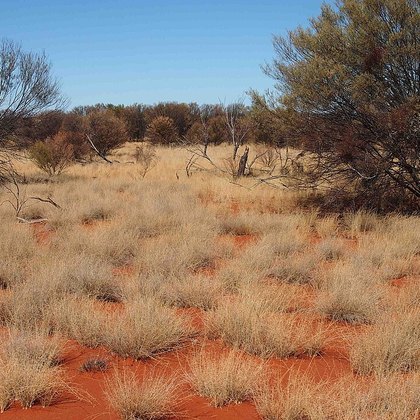
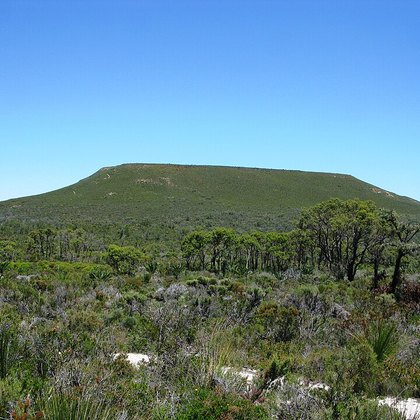
Mallee eucalypt on sandy soil with a dense understorey of broombush or heath shrubs, and besides that acacia scrub and sandplain heath. What makes a place suitable is the ground: a thick, undisturbed litter layer beneath closed shrubs, in which it forages and on which it nests. Long-unburnt scrub is therefore better than recently recovered vegetation.
Where the bird is most often found, arranged by main group and formation.

Range and movements
Southern and semi-arid Australia, in a broad band from the Shark Bay country of Western Australia through the interior of that state and along the edge of the Nullarbor into South Australia, taking in Eyre Peninsula, the Flinders Ranges and the Murray mallee, and on into north-western Victoria and south-western and central New South Wales. Resident: a pair holds the same ground year-round and barely moves.
- Resident
- dark = core range, pale = thinly spread
Where and when to look
Find this bird with your ears. Stand quietly at the edge of a piece of old mallee in the first hour after sunrise and wait for the whistle; then try not to see the bird but to follow the rustling, for the turning of leaves gives it away sooner than movement. Stay on the track and keep still: it regularly crosses a few metres away. The nest is a cup on the ground, often with a ring of twigs around it, and is easily trodden on.
Conservation
Least Concern (LC) and spread over a large area, but the range has been badly fragmented since the nineteenth century by the clearing of vast tracts of mallee for grain. What remains is sensitive to fire: the species needs the thick litter layer of long-unburnt scrub and returns to a burnt block only after years. Because it nests on the ground, the introduced fox and the feral cat depress its breeding success. Large, continuous reserves under a staggered fire regime are the decisive measure here.
Scientific name
Drymodes brunneopygia | Gould, 1841
John Gould described the species in 1841 in the Proceedings of the Zoological Society of London, from birds out of the timber belts along the Murray in South Australia. brunneopygia is compounded from Late Latin brunneus (brown) and Greek pyge (rump): brown-rumped, after the rufous rump that is the bird's only touch of colour. The genus Drymodes was likewise introduced by Gould in 1841, from Greek drymodes (woody, of the woodland). The Dutch name joins the habitat to the clear whistle.