All species › Passerines › Monarchs and allies › Frill-necked Monarch
Frill-necked Monarch | Arses lorealis
Witbuikfranjemonarch | Monarca elegante
The Frill-necked Monarch is one of Australia's most sought-after birds: a small black-and-white bird with a sky-blue ring of bare skin around the eye, found only in the rainforest of northern Cape York Peninsula. It behaves less like a monarch than like a treecreeper — spiralling around trunks and vines, often upside down — and carries an erectile ruff of white neck feathers that it spreads as a frill when excited. That ruff gives it its English name.

Voice
A soft, thin voice that comes as a surprise in so striking a bird. The usual contact note is a thin descending whistle, often repeated in a slow series; there is also a dry rattling churr and a rapid high squeaking between partners working a trunk together. The species calls little and quietly, so in practice sound is seldom the first clue — unlike most rainforest birds, this one is found quickest with the eyes, by searching trunks.
No freely licensed recording has been found for this species yet; what to listen for is described below.
Identification
A small, short-winged monarch with a fine blue-grey bill and a broad, bare, bright blue ring around the eye that shows even in moderate light. The male is black on crown, mantle, wings and tail, with a broad white collar running round the nape, a white shoulder stripe and a white rump; the entire underside — throat, breast, belly and undertail coverts — is pure and unbroken white. A small black lore patch between bill and eye is the character the scientific name refers to. The female has more black on the face, closing as a mask around the bill base and chin, but keeps the white underparts. Juveniles are duller, brownish-black, with a dull grey eye-ring.
Confusion species
The only real counterpart is Pied Monarch (Arses kaupi), all but identical in build, behaviour and blue eye-ring. Two things separate them. First the range, and in practice that settles it: this species inhabits northern Cape York Peninsula, kaupi the Wet Tropics of north-eastern Queensland, with a broad unoccupied gap between — they have never been seen together. Second the breast: here the whole underside is white, whereas kaupi carries a broad black band straight across the chest. White-eared Monarch (Carterornis leucotis) is also black and white, but has a white ear patch on a black head, no blue eye-ring and no ruff, and normally forages in the canopy rather than on trunks. Shining Flycatcher (Myiagra alecto) has a glossy black male without a white collar and keeps to water.
Habitat
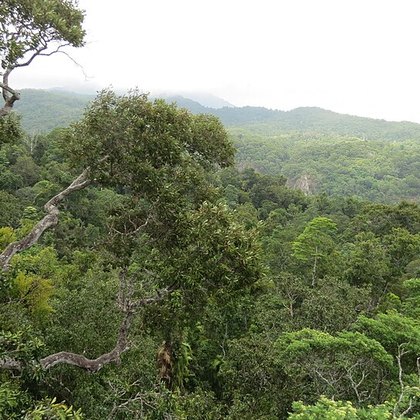
Tropical lowland rainforest and the adjoining vine thicket and gallery forest along creeks, where the bird forages almost exclusively on vertical surfaces: trunks, thick lianas and hanging branches, which it works in short spirals in search of insects and spiders under the bark. The nest is among the finest in Australia — a small, transparently woven basket of tendrils and cobweb, slung from a thin hanging vine, often over a track or a stream.
Where the bird is most often found, arranged by main group and formation.

Range and movements
Endemic to Australia and confined to the north-eastern part of Cape York Peninsula, Queensland, with the rainforest of Iron Range (Kutini-Payamu) and the McIlwraith Range as its core. The total range is small but continuous within those forests. There is no migration; pairs stay year-round in the same patch of forest and are strongly site-faithful.
- Resident
- dark = core range, pale = thinly spread
Where and when to look
Do not search the canopy; search the trunks. Walk a rainforest track at Iron Range slowly and let the eye travel over the vertical parts of the forest — thick lianas, mossy trunks, the lower stretch of leaning trees. The bird betrays itself by movement rather than by sound, and usually works upward in spirals before flicking across to the next trunk. If you see a blue eye-ring, look at the breast: all white belongs here, a black band belongs to the Wet Tropics species some seven hundred kilometres to the south.
Conservation
Not threatened (LC). The species has a small range, but the rainforest of northern Cape York is still largely intact and lies in good part within national park and Indigenous-managed country. The main hazards are indirect: the encroachment of fire in the drier margins, which slowly pushes the rainforest back, and severe tropical cyclones that can open the canopy at a stroke. Because virtually the whole population sits in one landscape, a single large event weighs more heavily here than it would for a widespread species.
Scientific name
Arses lorealis | De Vis, 1895
Charles Walter De Vis described the species in 1895, from material taken at Cape York. The genus Arses was introduced by Lesson in 1830 and is named for Arses, the Persian king who reigned as Artaxerxes IV — one of the many royal names with which nineteenth-century authors furnished this group of flycatchers, alongside Monarcha itself. The epithet lorealis derives from Latin lorum, 'thong, lore', and refers to the black patch between bill and eye. The English Frill-necked Monarch takes the erectile ruff, the Dutch witbuikfranjemonarch combines that ruff with the character separating the species from its sister, and the Spanish monarca elegante goes on the bird's appearance generally.