All species › Passerines › Monarchs and allies › Pied Monarch
Pied Monarch | Arses kaupi
Zwartborstfranjemonarch | Monarca pío
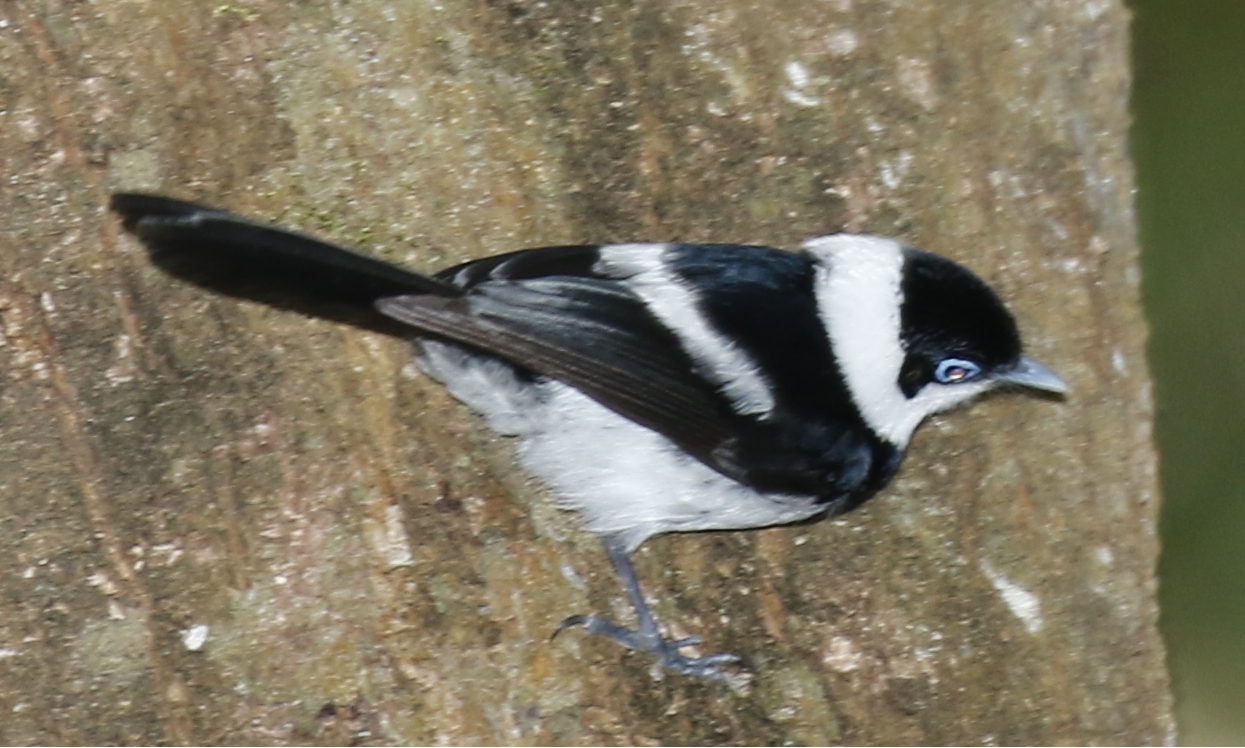
The Pied Monarch is the monarch of the Wet Tropics: a small black-and-white bird with a conspicuous pale blue ring of bare skin around the eye, found nowhere else on earth but the rainforest between Cooktown and Paluma in north-eastern Queensland. Like its northern sister species it climbs trunks and vines like a treecreeper. From that sister it is told by the broad black band straight across the white breast — and by the fact that the two never meet.
Voice
A soft and unobtrusive voice. The usual note is a thin descending whistle repeated slowly, supplemented by a short dry rattle and a high, rapid squeaking between partners working the same trunk together. Unlike most rainforest birds, sound is of limited help in locating it: the bird is quiet, and it is almost always movement along a trunk that gives it away.
No freely licensed recording has been found for this species yet; what to listen for is described below.
Identification
A small, compact monarch with a fine blue-grey bill and a broad, bare, pale blue eye-ring that shows up even in subdued forest light. The pattern is crisply black and white: black crown, mantle, wings and tail, a broad white collar round the nape that can be raised as a frill in excitement, a white shoulder patch and a white rump. The throat is white, but below it a broad black band crosses the breast, after which the belly is white again. In the female that breast band is narrower and duller, more sooty brown than black, and the white collar is less complete. Juveniles are dull brownish-black with a dingy eye-ring and a vague breast band.
Confusion species
The counterpart is Frill-necked Monarch (Arses lorealis), which barely differs from this species in build, behaviour, ruff and blue eye-ring. The decisive difference is the breast: here a broad black cross-band between white throat and white belly, in lorealis an unbroken white underside. More reliable still is range — this species in the Wet Tropics of north-eastern Queensland, lorealis on northern Cape York Peninsula, with hundreds of kilometres of unoccupied country between; the two have never been recorded together. White-eared Monarch (Carterornis leucotis) occurs in the same forest and is also black and white, but has a white ear patch, no blue eye-ring, no ruff and no breast band, and forages in the canopy. Shining Flycatcher (Myiagra alecto) has a glossy black male and a rufous-and-white female, neither with a collar nor with trunk-climbing habits.
Habitat
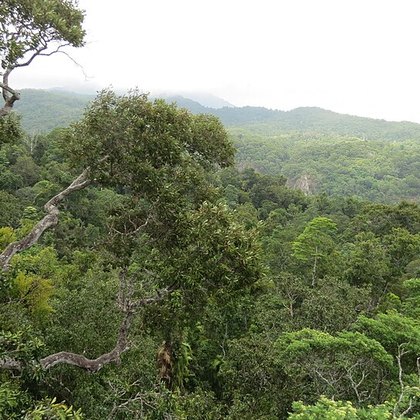
Tropical rainforest from the lowlands to middle elevations, including the moist margins with dense vine growth. The bird is almost wholly tied to vertical surfaces: it works trunks, thick lianas and hanging dead branches in short spirals, prising insects and spiders from under the bark, frequently hanging sideways or upside down. The nest is a finely, loosely woven hanging basket of tendrils and cobweb slung from a thin vine, often at modest height above a stream or track.
Where the bird is most often found, arranged by main group and formation.

Range and movements
Endemic to Australia and confined to the Wet Tropics of north-eastern Queensland, roughly from Cooktown in the north to the Paluma and Townsville area in the south, with the Atherton Tableland, Mount Lewis and the coastal ranges as the core. The range is small but continuous within that rainforest block. There is no migration, though some birds drop a little lower down the slopes outside the breeding season.
- Resident
- dark = core range, pale = thinly spread
Where and when to look
Search the trunks, not the canopy: walk a rainforest track near Kuranda, Mount Lewis or Paluma and let the eye move steadily over vines and mossy trunks. A small black-and-white bird spiralling up a trunk in this forest is almost certainly this species. Confirm with the blue eye-ring and the black breast band. It joins mixed feeding parties regularly, so it pays to follow a passing flock for a while.
Conservation
Not threatened (LC). The range is small but falls almost entirely within the Wet Tropics World Heritage Area, where the rainforest is well protected and no longer logged at scale. The remaining concerns are the exposure of a species with so restricted a range to severe cyclones, which can open the canopy over large areas at once, and in the longer term climate change, which is driving shifts in precisely this upland forest. There is as yet no evidence of a structural decline.
Scientific name
Arses kaupi | Gould, 1851
John Gould described the species in 1851 in the supplement to his The Birds of Australia; the type locality was later narrowed to Cairns, Queensland. The genus Arses, introduced by Lesson in 1830, is named for the Persian king Arses, who reigned as Artaxerxes IV. The epithet kaupi honours the German naturalist Johann Jakob Kaup, with whom Gould corresponded. The English Pied Monarch and the Spanish monarca pío name the black-and-white plumage as a whole, while the Dutch zwartborstfranjemonarch combines the ruff with precisely the character that separates the species from its northern sister.