All species › Passerines › Drongos › Spangled Drongo
Spangled Drongo | Dicrurus bracteatus
Glansvlekdrongo | Drongo escamoso
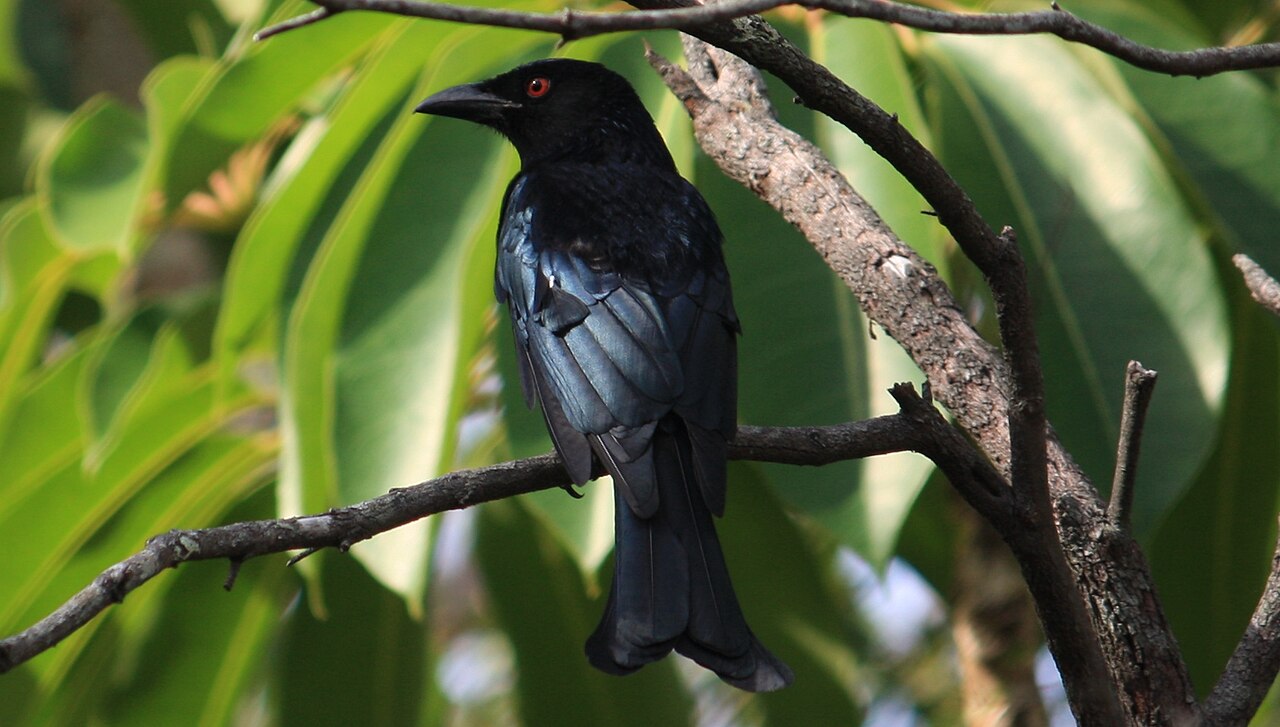
The Spangled Drongo is Australia's only drongo: a black bird with blood-red eyes and a long fish tail that curls outward at the tips, sallying from an open branch at anything that flies. Its voice is a racket of metallic sounds and material stolen from the whole forest, and it is as noisy as it is conspicuous.
Voice
One of the strangest voices in the Australian bush: hard metallic notes like a taut wire being plucked, mixed with rasping, gurgling and a sound much like a sneeze. In among that it mimics other birds, sometimes whole phrases at a time. It likes to call from a bare branch above the canopy, including in the middle of a hot day when everything else has gone quiet.
No freely licensed recording has been found for this species yet; what to listen for is described below.
Identification
A slim, long-tailed bird of 28 to 32 centimetres, wholly black with a strong blue and purple sheen and small glittering spots over head, neck and breast — the spangles of the name. The eye is blood-red, the bill heavy and slightly hooked at the tip, and the tail long, forked and turned outward at the ends, giving the bird a lyre-shaped rear in flight. Young birds lack the gloss and the spangles and have a dark brown eye.
Confusion species
Satin Bowerbird (Ptilonorhynchus violaceus) is as glossy blue-black, but has a straight tail, a pale bill and a violet eye. Common Starling (Sturnus vulgaris) also carries glossy spotting but is much smaller and short-tailed. White-winged Chough (Corcorax melanorhamphos) is bigger, dull black with a white wing patch, walks about in parties and has a curved bill. No other drongo occurs in Australia.
Habitat
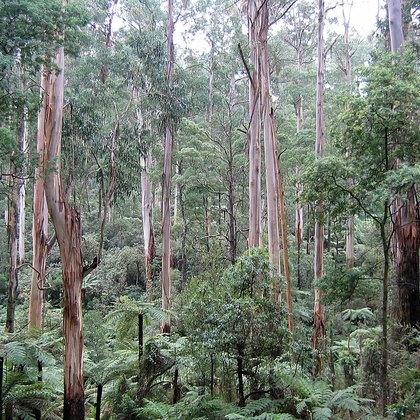
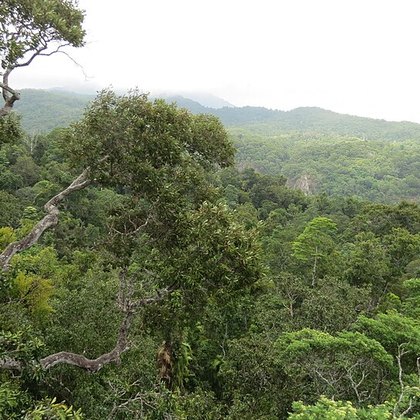
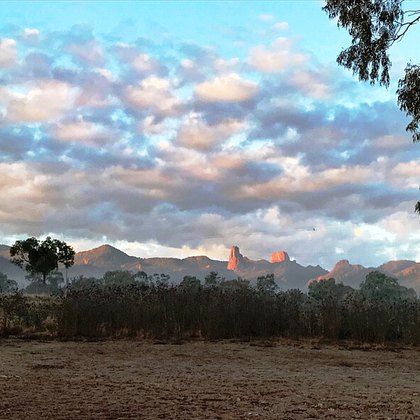
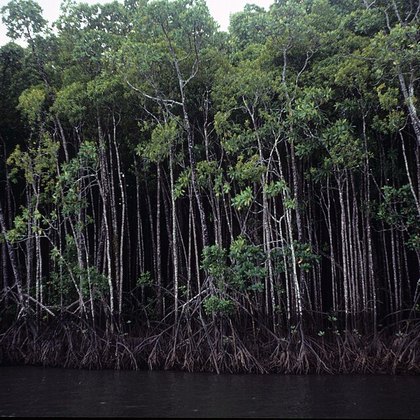
Wet eucalypt forest and the edges and clearings of rainforest form the core, with drier woodland, mangrove, creekside forest and town parks with flowering trees beside them. It avoids the closed interior of rainforest, because it needs open space to sally at insects from a projecting branch. Wherever eucalypts or bananas are in flower it comes in for the nectar.
Where the bird is most often found, arranged by main group and formation.

Range and movements
Northern and eastern Australia, from the Kimberley through the Northern Territory and Queensland into New South Wales and Victoria, and beyond that New Guinea, the Moluccas, the Bismarck Archipelago and the Solomon Islands. In the north and west birds cross to Indonesia and New Guinea for the winter; in the east they shift north to Cape York in winter and return in late spring. Some southern birds stay put and a few stray to Tasmania.
- Resident
- dark = core range, pale = thinly spread
Where and when to look
Look for a bare, projecting branch at the forest edge or over a creek: that is where it sits, upright, with the forked tail hanging. Check the eye — blood-red in adults — and the crossed tail tips, which no other black bird in Australia has. In late spring, from October to December, the eastern breeders arrive and are at their noisiest.
Conservation
Least Concern (LC). The species has a wide range from the Moluccas to Victoria and profits locally from the planting of nectar-rich trees in gardens and parks; in the eastern coastal cities it has increased over recent decades. Clearing of wet coastal forest works the other way, but the bird makes good use of forest edges and tree lines. Migrating eastern birds meet a fragmented landscape on the way.
Scientific name
Dicrurus bracteatus | Gould, 1843
Gould described the bird in 1843 directly in Dicrurus, so author and year carry no parentheses; the material described came from the eastern and northern coasts of Australia. The genus was introduced by Vieillot in 1816, from Greek dikros, forked, and oura, tail. bracteatus is Latin for covered with gold leaf, from bractea, a thin sheet of metal, after the glittering spots on head and breast.