All species › Passerines › Monarchs and allies › White-eared Monarch
White-eared Monarch | Carterornis leucotis
Witoormonarch | Monarca orejudo
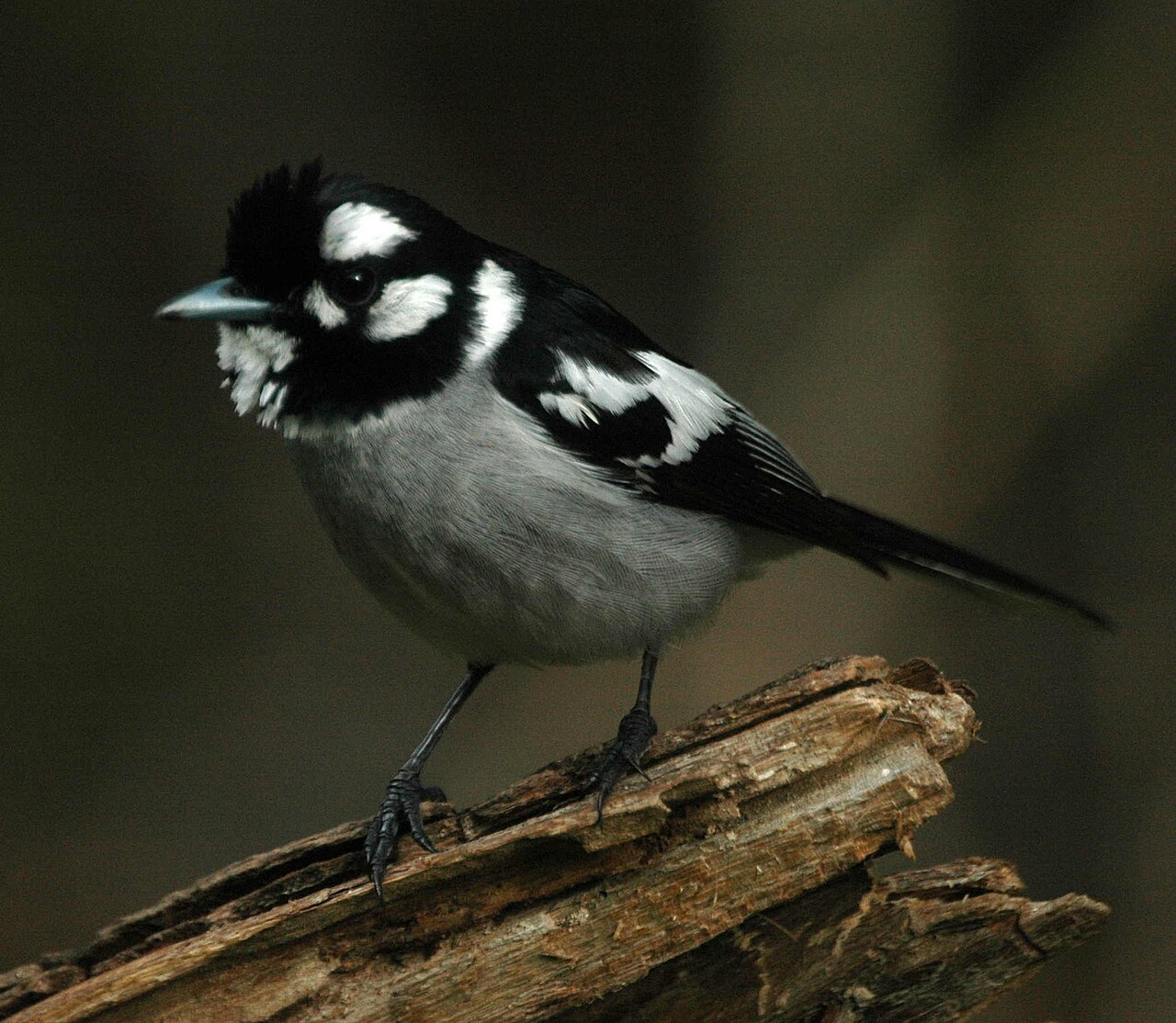
The White-eared Monarch is the smallest monarch in Australia and the only representative of the genus Carterornis in this guide. It is a black, white and grey bird of the canopy along east-coast rainforest edges, which almost never comes low and is therefore usually seen only from below and against the sky. The large white ear patch on the black head gives it its name, but in the field you often do not see it — what remains is a busy, shrilly calling black-and-white bird high in a tree.
Voice
Sharp, penetrating whistles in rapid, slightly descending series, often three to five notes together, with short rattling scolds in between. For so small a bird the call is strikingly loud and is usually the first — and often the only — thing by which the species is recorded, since the bird itself stays hidden in the canopy. Anyone hearing a high, sharp call at a rainforest edge that does not fit a Spectacled Monarch would do well to look up.
No freely licensed recording has been found for this species yet; what to listen for is described below.
Identification
A small, compact monarch of thirteen to fourteen centimetres. The head is black with a large, sharply defined white ear patch and a white stripe above the lores, giving the face a striped, almost masked pattern. The mantle is grey, the wings black with white feather edges, and the tail black with white tips to the outer feathers. The underside is white to off-white. Male and female are alike; young birds are duller with a less sharply defined ear patch. The bird is restless, hangs and twists among the outer branches and sallies briefly after insects.
Confusion species
Seen from below, every black-and-white monarch in north-eastern rainforest is a candidate. Pied Monarch (Arses kaupi) and Frilled Monarch (Arses lorealis) are also black and white but have a conspicuous blue eye-ring and a white collar, and climb up trunks instead of hanging in the outer twigs. Spectacled Monarch (Symposiachrus trivirgatus) has orange-rufous underparts and a black face without a white ear patch. Black-faced Monarch (Monarcha melanopsis) is grey with an orange belly and much larger. Magpie-lark (Grallina cyanoleuca) is black and white too but almost twice the size and lives on the ground. Decisive is the combination of small size, grey mantle, white ear patch and a life spent entirely in the canopy.
Habitat
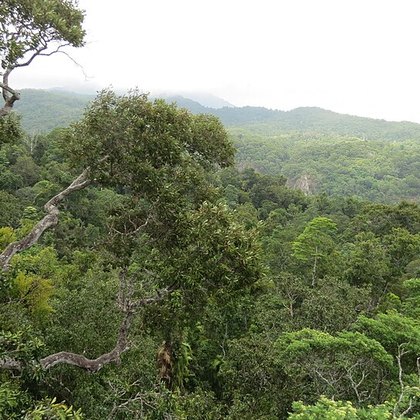
Edges and gaps of tropical and subtropical rainforest, monsoon forest and vine thicket, and alongside these adjoining paperbark swamp forest and the landward side of mangrove. The species avoids the closed interior of rainforest and seeks out the transitions, where the canopy breaks. It forages almost entirely high up, gleaning insects from leaves and twigs in the outer branches, and regularly joins mixed canopy flocks.
Where the bird is most often found, arranged by main group and formation.


Range and movements
Endemic to Australia and confined to a narrow band along the north-east coast: from northern Cape York Peninsula south through the coastal forests of Queensland to Ballina in north-eastern New South Wales, with occasional records further south. The species is not truly migratory, but numbers in the southern part of the range vary seasonally, which points to movements within the range. Nowhere numerous and everywhere tied to forest edges.
- Resident
- dark = core range, pale = thinly spread
Where and when to look
Stand at the edge of a rainforest block where the canopy can be overlooked at eye level from a slope or a track, and listen for the sharp descending whistled series. Then search the outer twigs for a small, busily moving black-and-white bird. If you get to see the head, the white ear patch is unmistakable; if you do not, the absence of a blue eye-ring rules out the Arses monarchs and the grey mantle takes you the rest of the way.
Conservation
Least Concern (LC). The range is narrow but runs over more than two thousand kilometres of coast, and the species still occurs through most of it. Because it is tied to the edges and transitions of coastal rainforest, and because exactly those forests in south-eastern Queensland and north-eastern New South Wales have been fragmenting for more than a century through clearing and coastal development, it counts there as a species to keep an eye on. Reliable trend figures are lacking, which owes above all to how hard a canopy bird is to count.
Scientific name
Carterornis leucotis | (Gould, 1850)
John Gould described the bird in 1850 as Monarcha leucotis, from material out of Cape York. The epithet leucotis is built from Ancient Greek leukos ('white') and ous, genitive ōtos ('ear'), and so describes the white ear patch — the same choice as the English White-eared Monarch, the Dutch Witoormonarch and the Spanish monarca orejudo. The genus Carterornis was split off from Monarcha by Gregory Mathews in 1912 and honours the English-Australian ornithologist Thomas Carter, with Ancient Greek ornis ('bird') appended. Besides this species Carterornis holds only two more, both outside Australia, in New Guinea and the Moluccas; within the Monarchidae the genus stands close to Monarcha and Symposiachrus, in which the species was formerly placed.