All species › Passerines › Monarchs and allies › Magpie-Lark
Magpie-Lark | Grallina cyanoleuca
Australische slijkekster | Grallina australiana
The Magpie-Lark walks on every lawn, playing field and car park on the Australian mainland: a black and white bird with a pale eye that picks its way over the ground in short, deliberate steps. Its nest is a round bowl of mud plastered onto a bare branch, and a pair sings in duet, male and female each supplying alternate notes.

Voice
The familiar pee-wee that gives the bird its Australian nickname is in fact a duet: the male calls tee-wee, the female answers within a tenth of a second with pee-o-wit, and together it sounds like one bird. Pairs sing their territory this way, often side by side on a wire with wings half open. In danger there is a hard, angry chak.
Recording: Mike FitzGerald — CC BY-NC-SA 4.0 · Bowra Station, near Cunnamulla, Queensland, Australia · xeno-canto
Identification
A slim black and white bird of 26 to 30 centimetres with long legs, a pale ivory bill and a white eye. Back, crown, breast band and tail tip are black; belly, rump, shoulder and wing stripe white. The male has a black throat and a white brow; the female has a white throat and no brow. Juveniles have both a white throat and a black eye-stripe and lack the pale eye. In flight the broad white wing panel stands out.
Confusion species
Australian Magpie (Gymnorhina tibicen) is a third larger, with a blue-grey black-tipped bill, a red eye and a white nape rather than a white brow, and sings a full organ-like carol. Pied Butcherbird (Cracticus nigrogularis) has a heavy hooked bill and a wholly black hood. The only congener, Grallina bruijnii, lives along mountain streams in New Guinea and does not occur in Australia.
Habitat
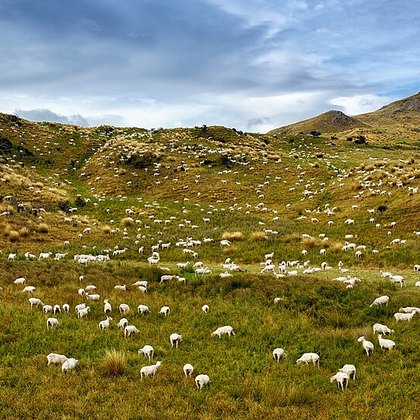
Almost any open country with bare ground, mud and a tree: pasture and grazing land, eucalypt savanna, the shores of lakes, dams and creeks, and beyond that gardens, parks, sports grounds, schoolyards and streets. It needs three things — soft bare ground to forage on, mud for the nest and a branch to build it on — and finds that combination as readily in town as on rangeland. Rainforest and the driest desert stay empty.
Where the bird is most often found, arranged by main group and formation.



Range and movements
The whole Australian mainland except the dry northwestern interior, plus southern New Guinea and Timor; it was introduced to Lord Howe Island in 1924 and is a rare vagrant to Tasmania. Two subspecies divide the range, a northern one and one across the rest of the continent. Pairs are resident and hold their territory year after year; outside the breeding season non-breeders form flocks that wander the country.
- Resident
- dark = core range, pale = thinly spread
Where and when to look
Check every lawn and playing field: it is nearly always there, and the short steps with the head bobbing give it away at distance. For the duet get close to a pair in spring, from August to December; stand still and listen for whether you can separate two voices. In the same months look along bare horizontal branches for the mud bowl, often over water and sometimes twenty metres up.
Conservation
Least Concern (LC) and one of the most numerous and visible birds in Australia. Pasture, lawns, farm dams and sports grounds have helped it greatly; it breeds into the centre of large cities and uses telephone poles and light standards as nest sites. Drought depresses breeding success because there is then no mud. Feral cats and traffic take birds without any visible effect on numbers.
Scientific name
Grallina cyanoleuca | (Latham, 1801)
Latham described the bird in 1801 as Corvus cyanoleucus, among the crows; because it later moved to another genus, author and year stand in parentheses. The genus Grallina was introduced by Vieillot in 1816, as a diminutive of Latin grallae, stilts, after the long legs. cyanoleuca means dark blue and white, from Greek kuanos and leukos. The species now sits with the monarchs (Monarchidae), not with the crows or the mudnesters.