All species › Passerines › Monarchs and allies › Black-winged Monarch
Black-winged Monarch | Monarcha frater
Zwartvleugelmonarch | Monarca alinegro
In Australia the Black-winged Monarch is a scarce summer visitor: a bird of New Guinea that reaches only the rainforests of northern Cape York Peninsula, and stays there for just half the year. It looks strikingly like the far commoner Black-faced Monarch, from which it is told by black wings and tail standing sharply against the grey body. Anyone hoping to see it must go to Iron Range or the McIlwraith Range in the austral summer.
Voice
A clear, rolling whistled motif of two to four notes, close in pitch and pace to that of Black-faced Monarch but on average slightly higher and faster; the difference is small enough that no identification should be built on it. There is also a dry, rasping scold when a pair is disturbed. In the Australian summer the birds are most vocal around sunrise; later in the day they fall almost completely silent and become very hard to find.
No freely licensed recording has been found for this species yet; what to listen for is described below.
Identification
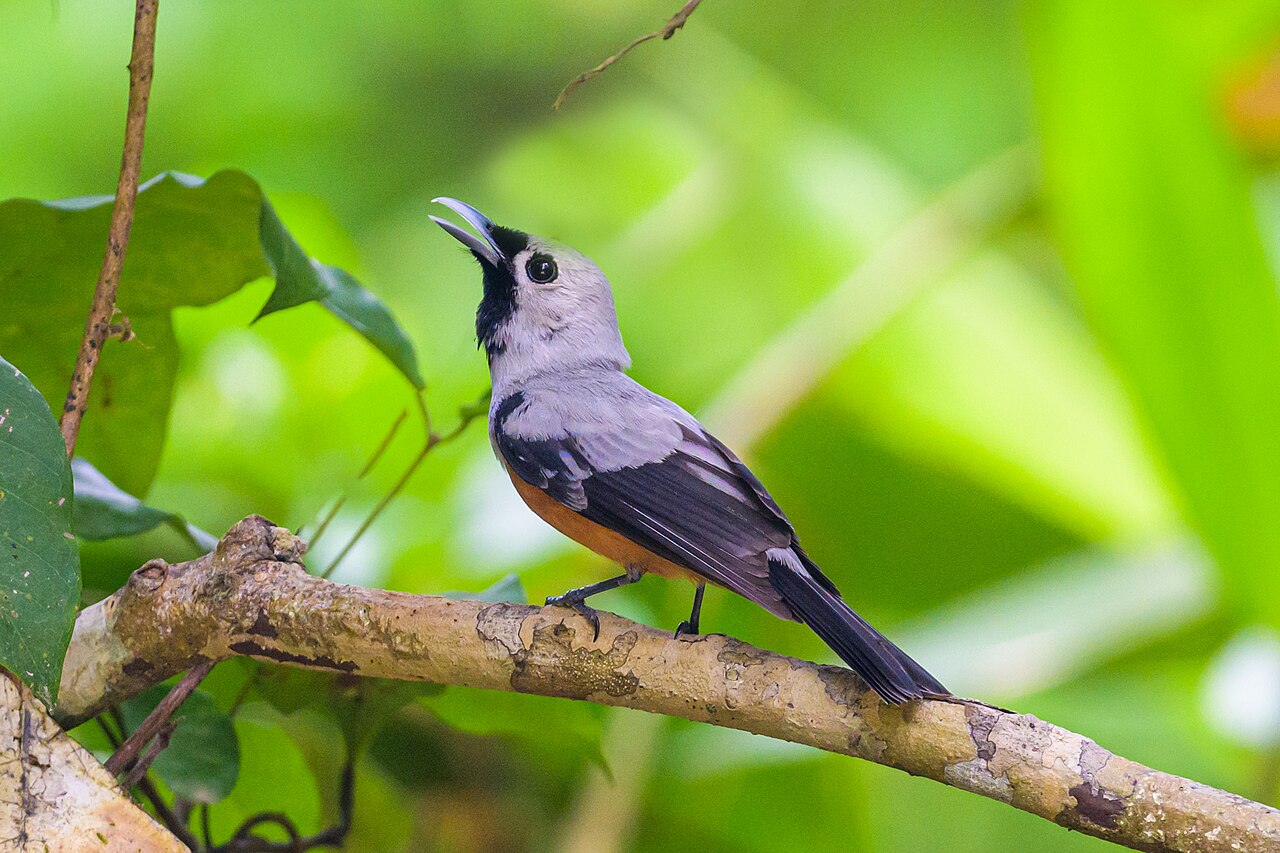
A medium-sized monarch with blue-grey head, mantle and breast, and a compact black mask covering forehead, lore, chin and upper throat. The decisive character is in the wing: primaries, secondaries and greater coverts are black and together form a dark panel that stands out clearly against the grey of the back, and the tail is black as well. The underparts are orange, but paler than in its relative, fading to white on the belly and undertail coverts. The bill is blue-grey, the eye dark. The sexes are alike; juveniles lack the black mask and show a dull, unmarked face.
Confusion species
This is in effect a single identification problem with a single solution: Black-faced Monarch (Monarcha melanopsis), present on Cape York in the same months. In that species wing and tail are plain blue-grey without black contrast, and the underparts are uniformly warm rufous-orange rather than paler orange with white on belly and undertail coverts. Against the light and high in the canopy the contrast is treacherous: a Black-faced Monarch with shadow across the wing quickly looks dark-winged, and it is then better to leave the bird unnamed. Beyond that, Spectacled Monarch (Symposiachrus trivirgatus) is smaller, carries its black around the eye rather than on the throat and shows white tail tips, while White-eared Monarch (Carterornis leucotis) is black and white and lacks any orange.
Habitat
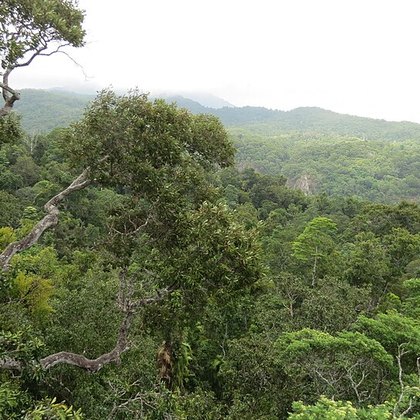
Tropical lowland and foothill rainforest and the adjoining strips of monsoon forest and vine thicket. The bird forages in the middle and upper storey, gleaning insects from leaves and twigs and making short sallies after flying prey. It tends to stay high and in shade, which together with its small numbers explains why the species is so seldom seen in Australia.
Where the bird is most often found, arranged by main group and formation.

Range and movements
The centre of the range lies in New Guinea, where the species is widespread in hill and montane forest; the type was collected in 1873 in the Arfak Mountains. In Australia it breeds only in the northern part of Cape York Peninsula, where it is present from roughly November to April before returning to New Guinea. That makes it one of very few Australian songbirds with a genuinely tropical migration pattern: not south-to-north within the continent, but back and forth across Torres Strait.
- Breeding (summer)
- dark = core range, pale = thinly spread
Where and when to look
Go in the austral summer to the rainforest of Iron Range or the McIlwraith Range and work the first two hours after sunrise, while the birds are still calling. Search the middle storey for a monarch with a black mask, then look only at wing and tail: black and contrasting belongs to this species, plain grey to Black-faced Monarch. Never judge that against the sky; wait until the bird sits in even light.
Conservation
Not threatened (LC). The world range in New Guinea is large and the montane forest there still largely intact, so the species as a whole is under no pressure. The Australian population is small, highly concentrated and entirely dependent on the rainforest of northern Cape York; those forests lie mostly in protected land, but are vulnerable to changes in fire regime at the margins and to severe cyclones. Precise Australian numbers are lacking, which leaves any statement about trends there provisional.
Scientific name
Monarcha frater | Sclater, 1874
Philip Lutley Sclater described the species in 1874, from a bird taken at Hatam in the Arfak Mountains. The genus Monarcha goes back to Ancient Greek monarkhos, 'sole ruler'. The epithet frater is Latin for 'brother' and is aptly chosen: Sclater saw at once how closely the bird resembled the already known Black-faced Monarch, and named it for that near relative. The English Black-winged Monarch, the Dutch zwartvleugelmonarch and the Spanish monarca alinegro all name the character by which the brotherhood can nevertheless be untangled.